This page is an extract from The Coal Miner’s Son, Cliff’s stories about the Depression and WW2, and the navigation reflects that. Click here if you want to return to THE BAUGHS. ~ Ian
§
Most of the following is in the first person, written by Dad, some in the third person, written by me from his notes, together with some added background material. I’ve kept it together as one piece since that’s how he wrote it, although it contains a fair amount that might be better read with the Corness pages. ~ Ian
§
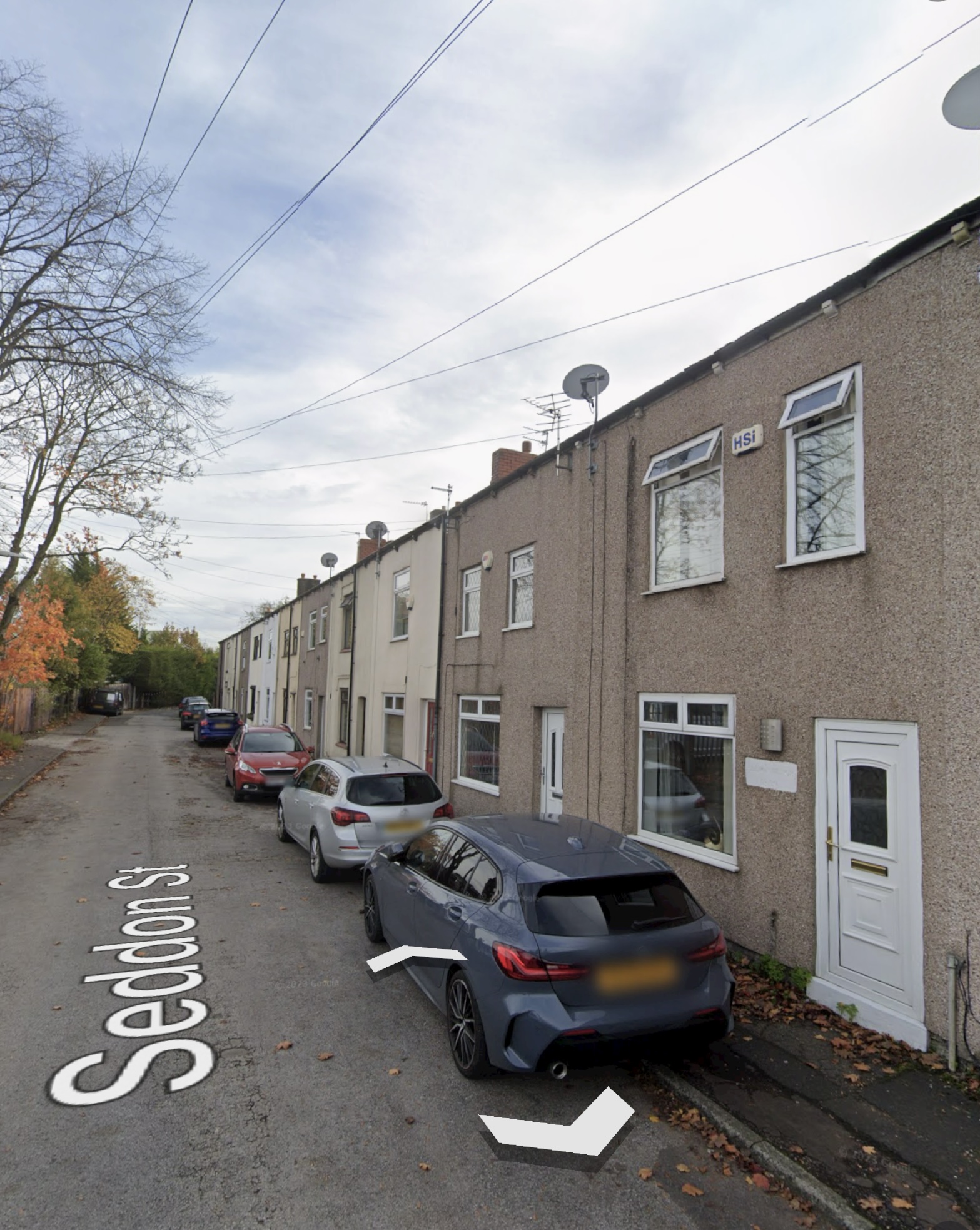
My birthplace and residence was 11 Seddon Street, Westhoughton in Lancashire, England, a short street of adjoining houses with two rooms up and two down. Typical “Coronation Street”.
From the front door you stepped onto the footpath.
From the back door you stepped into an enclosed flagged yard about the size of our lounge. In the far left hand corner was a dry privy (lavatory) and alongside that a coal bin. A gate let onto a narrow lane across which was another row of back yards serving a similar row of houses. Each house had its own chimney projecting from the roof, which ran from one end of the street to the other. There wouldn’t have been one bath, shower or indoor toilet on that street.
Later we moved to a new house and for the first time had a bath. I have often heard of the time my Aunt Nellie (Mum’s sister-in-law) came to visit. She decided she would like to have a bath. Mum filled it for her and left her to her own devices. Shortly, screams of terror came from the bathroom — I can vaguely remember this. Never before had Aunt Nellie been involved with so much water and she was afraid she was going to drown.
In 1969 when we visited Seddon Street it hadn’t changed. Across the street looking from the front door there was a large area of open land, and on the far side of that a cotton mill where my mother used to work.
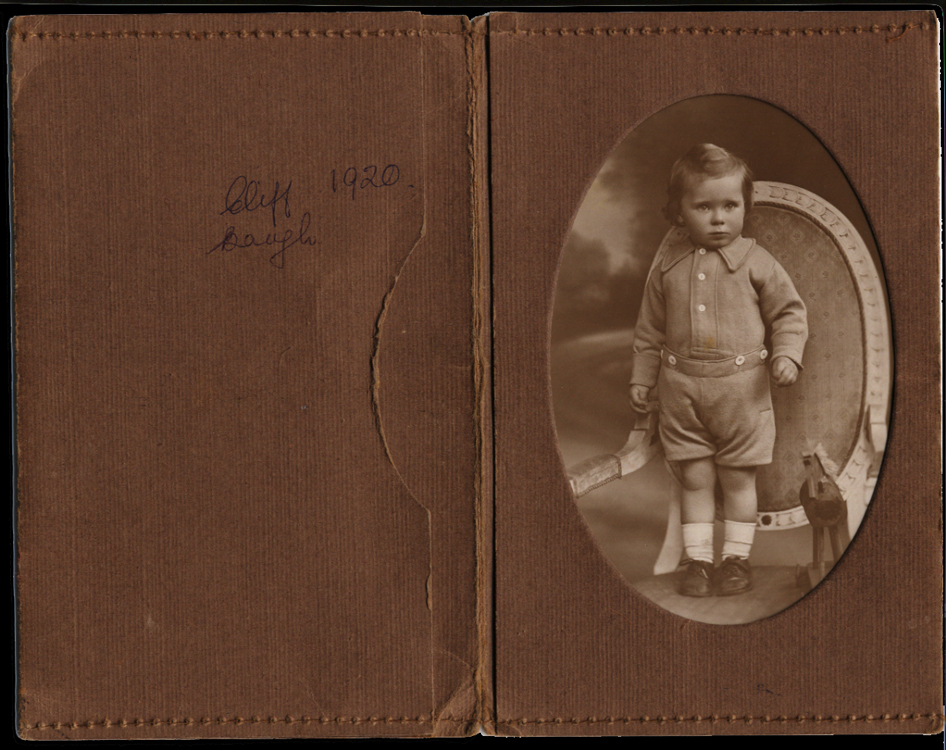
Dear Aunt Maggie used to look after me, and I have vivid memories of the day that she took me to see Mum at work. The noise was deafening and frightening. I was so sure my mother would be crushed to death by the huge looms running towards her and then back again. Backwards and forwards with every advance a threat to my mother.
One remembers painful things. One day someone left a pushbike outside Aunt Maggie’s door. It was under repair, resting upside down on its seat and handlebars. Young Clifford discovered that by turning the pedals the back wheel would turn, and so turn it he did, faster and faster. He then put his fingers on the chain where it engaged the large sprocket and in a flash they were firmly trapped between the sprocket and chain. My screams of agony can be readily imagined, and caused great consternation in Auntie and every neighbour within hearing. After a good deal of noise, debate, fuss and bother it was decided that the only way to free my fingers was to give the sprocket a full turn.
§
I have often heard tell of the night a German Zeppelin attempted to bomb the local ammunition factory, a few hundred yards away. The bomb did little damage but did bring the war close to the local population — and provided a talking point for me, that a bomb had exploded 200 yards from me during the First World War, although of course I have no memory of it.
§
Alongside the ammunition works was a large area of open ground used for sports and recreation. There we would go to watch Dad and Uncle Bill train for soccer. Wildflowers grew there in great profusion and as a child I found it fascinating. After bleak Seddon Street it was for me a touch of heaven. Buttercups, daisies, foxgloves, and my favourite, bluebells. 40 odd years later, everywhere we travelled it always pleased me to be able to stop and pick them from the side of a country road. I still felt a glow of childhood pleasure.
Was it on that ground that, with Mum, I watched a game of soccer in the cold, drizzling rain? Hurtling towards us on the sideline came two burly players chasing the ball. They collided, fell and slipped towards us in the mud, causing more than a little consternation as we hurried out of their way.
In the local vernacular, the’ aw fawd dawn in’t slutch! The’ were aw witchert! (They all fell down in the mud. They were all wet.)
§
I started school when I was four years old. I was often told that on my first day I went resplendent in a brand-new coat but arrived home with one that trailed around my ankles. My explanation was that I couldn’t find mine, so I took this one.
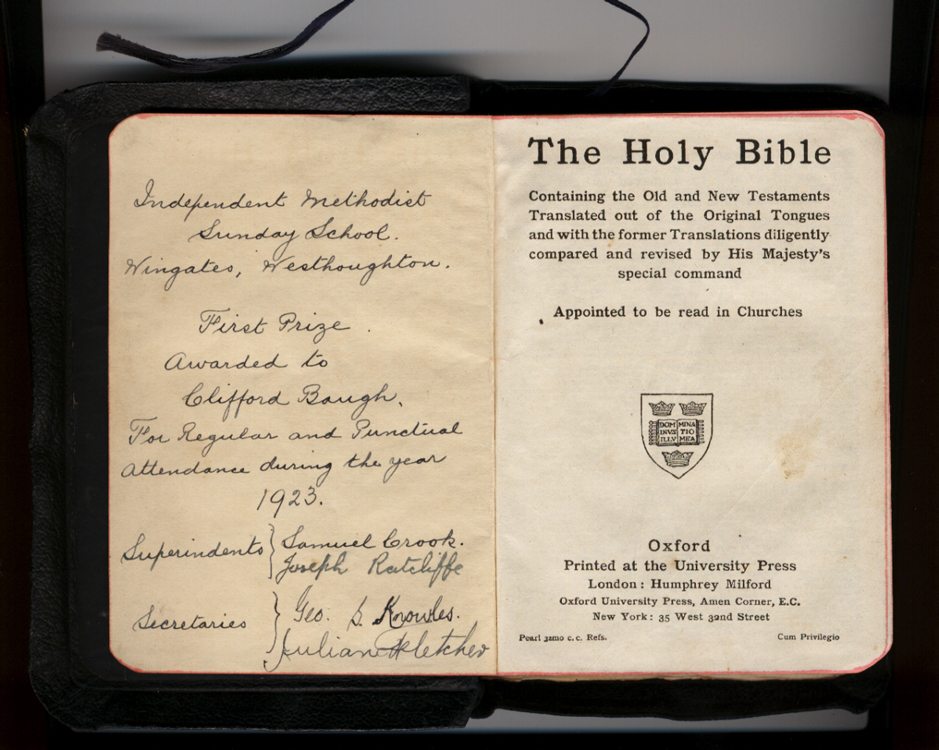
I was a regular attendee at Wingate Methodist Sunday school, evidenced by a Bible presented to me for punctual and regular attendance dated 1923. I also have faint recollections of being on a stage with others, singing, I hope, for the entertainment of our parents.
§
Thomas and Catherine Corness were my mother’s parents. Thomas was a coal miner and Katie, as she was called, also worked at the pit as a child1. Thomas had the reputation of a drunkard, and the family of thirteen children must have had a grim upbringing. We still have Thomas and Catherine’s photos, and certainly Thomas appears an unlikeable character.
To make matters worse the family was split by religious differences. Thomas was a Protestant and Catherine a Catholic, and judging by my mother’s reactions to Catholicism this must have caused many problems. Katie won, for Thomas was converted to become a Catholic on his deathbed, much to my mother’s annoyance. She had been forced to attend a Catholic school, and she detested Catholics.
I can dredge up a faint memory of my Corness grandparents’ kitchen with its flagged floor, and of Grandad’s pigeon loft in a larger-than-usual back yard, but alas no memory of my grandparents.
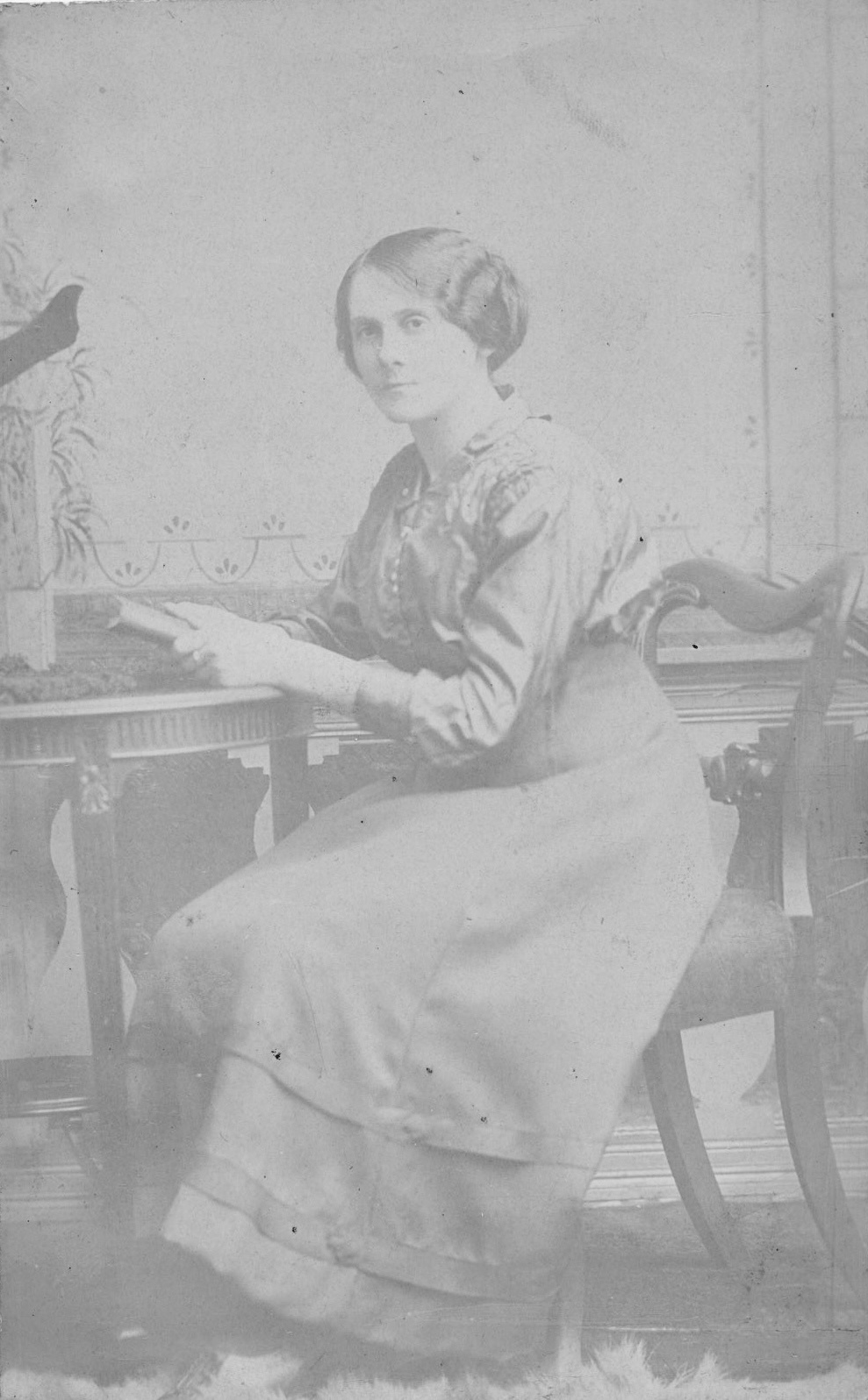
Mum spoke of having to bake the family’s bread from 10 years old and being beaten for small transgressions. I am left with a picture of a very poor family divided by continual arguments and petty jealousies.
§
Elsewhere Cliff wrote:
Grandma Corness had 13 children, of whom only eight were to survive. They were my mother Annie, Maggie, Ethel, Katie, Jack, Nellie, Thomas and George. Grandma was illiterate, a Catholic, and had spent some earlier years working in a coal mine.2 Grandpa Corness, who died six months after we arrived in New Zealand, was a coal miner and by all accounts a very difficult man. Like my paternal grandfather, he died of a lung disease.”
§
Regarding his Dad’s family, Cliff wrote:
I have only one very vague memory of my Grandma Baugh, Dad’s mother. I believe she still lived at 1 Wellington Street, where my father was born. It was there that I saw her during a family gathering before we left for New Zealand. I had obviously seen little of her, for I remember feeling hesitant when asked to go to speak to her. By all accounts it was a very pleasant occasion, tinged with a little sadness. I remember very vaguely Aunt Ethel singing for us. She had a lovely voice.
§

§
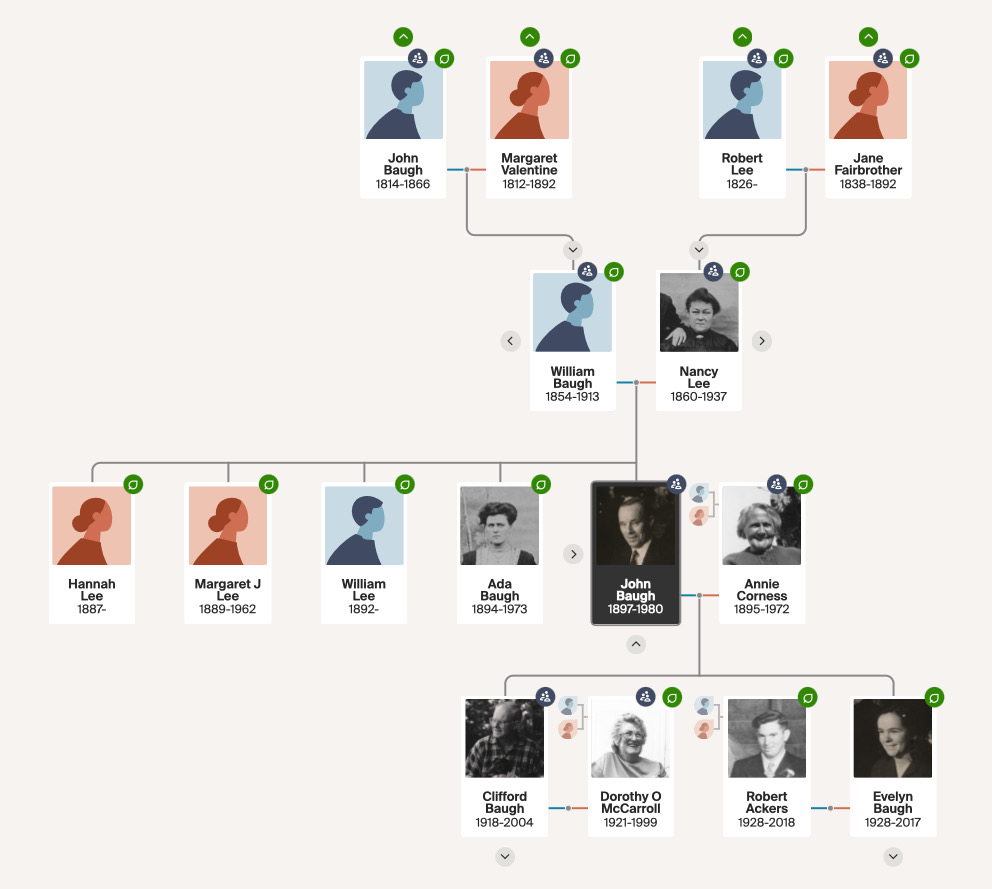
Cliff was hesitant to write about his father’s side of the family — Why was his father named John Baugh but John’s older brother called Bill Lee?
He was reluctant to ask his parents, but his mother Annie eventually told him that John’s grandmother, who owned a business, would not allow her son William to marry Nancy, John’s mother, because she was below his station.
According to Cliff, his Lee cousins were told a different story by their parents, that “Our first father was a good bloke, our second father a poor type — a drunkard, or words to that effect.” Elsewhere he says his cousins were told that Nancy had been married twice, hence the two names.
Whatever the truth of it, Cliff’s grandmother, Nancy Lee, was born in 1860 in Hindley, Lancs, the illiterate daughter of Robert Lee, a coal miner. The 1881 census recorded her as a 21 year old spinster cotton winder living in Blackrod, a few minutes northwest of Westhoughton. William Baugh, her future husband, was living with his 68 year old mother, born Margaret Valentine, at the Church Inn, Church St, Blackrod, where she was the innkeeper.
Three Lee children were born before Nancy finally married William, after his mother died in 1892. Nancy was described then as a charwoman and he as a coal miner. Cliff reasoned that because the “Lee” children inherited Baugh family names — William, Hannah and Margaret Jane — it was “fair to assume that my grandfather William Baugh sired them all.” I’ve accepted his logic in the family tree.
In any case, Cliff’s Aunt Ada was born after the marriage, and followed by his father John, the youngest, on 9 March 1897.
§
Cliff wrote: Of Dad’s family, Margaret (“Aunt Maggie”) and her two daughters Ada and Evelyn, are the ones who hold the most pleasant memories for me. For years after we came to New Zealand Aunt Maggie sent me regular supplies of four or five different comics. One day, as I was leaving the Post Office with my usual bundle of comics, I fell, and as I flattened out on the floor a stick of Blackpool Rock shot out from the bundle. A typical Aunt Maggie parcel. How I loved that lady. To me she was another Mum and she always called me “Our Clifford”.
§
Sadly Maggie and her husband Amos had passed away by the time Dorothy and Cliff visited in 1969, but they spent some time staying and travelling with other relations, including his Aunt Ada and her husband, Albert Fairclough. They were treated very warmly. The family were “wonderful people” who couldn’t have been kinder — “I was proud to call them family” — but it took a while to overcome the “class barrier”. The family were all from working class backgrounds, with Lancashire accents that contrasted with Cliff and Dorothy’s New Zealand ones. And Cliff was by then a Justice of the Peace, Councillor and a “wealthy farmer”. He was amused by their marked reluctance to drive their car on gravel surfaces, which would have been a severe limitation on the roads of the Hikurangi Riding.
When they visited in 1969 Dorothy and Cliff were in their early 50s, but Albert and Ada Fairclough would have been on pensions. And what different lives they must have lived. I can’t claim to know much about them, but for the 1911 census Albert was described as a 17-year old coal miner (hewer), the same as his Dad John. Like Cliff’s Dad too, working the coal face underground. In 1921 he was a coal miner (dataller) — meaning a casual worker hired day by day — working the Catock Pit in Westhoughton for the Wigan Coal and Iron Co but currently out of work. By then he was a 27 year-old with two kids, James and Minnie. He and Ada were living with Ada’s Mum. In the wartime 1939 England and Wales Register he was recorded as a general labourer (unemployed).
§
Dorothy and Cliff also met two of his Corness Uncles on that trip.
“Uncle George impressed me as being a thoroughly nice chap. Uncle Tom was an unpleasant and obviously mentally unbalanced man, the owner of a savage German Shepherd dog. Tom and his wife, who seemed a pleasant lady, were afraid of each other, and according to Tom the dog was to protect him from his wife. Shortly after our visit … Tom shot his dog and then himself. I was very thankful that that was all.
“Uncle Jack, his wife Nellie and their family I knew very well for we lived in close proximity during our early years in New Zealand. Uncle Jack was an avowed Communist, as I believe most of the old miners were…”
§
Departures
Cliff wrote of the family’s departure in the 1920s:
I remember Westhoughton Railway Station and a crowd on the platform singing the Red Flag with the engine and carriages heading towards the tunnel just a few yards away. The crowd was there for Uncle Jack Corness, a Communist, leaving to start a new life in New Zealand. 45 years on, the station hadn’t changed but that tunnel turned out to be an over-bridge under a main road.
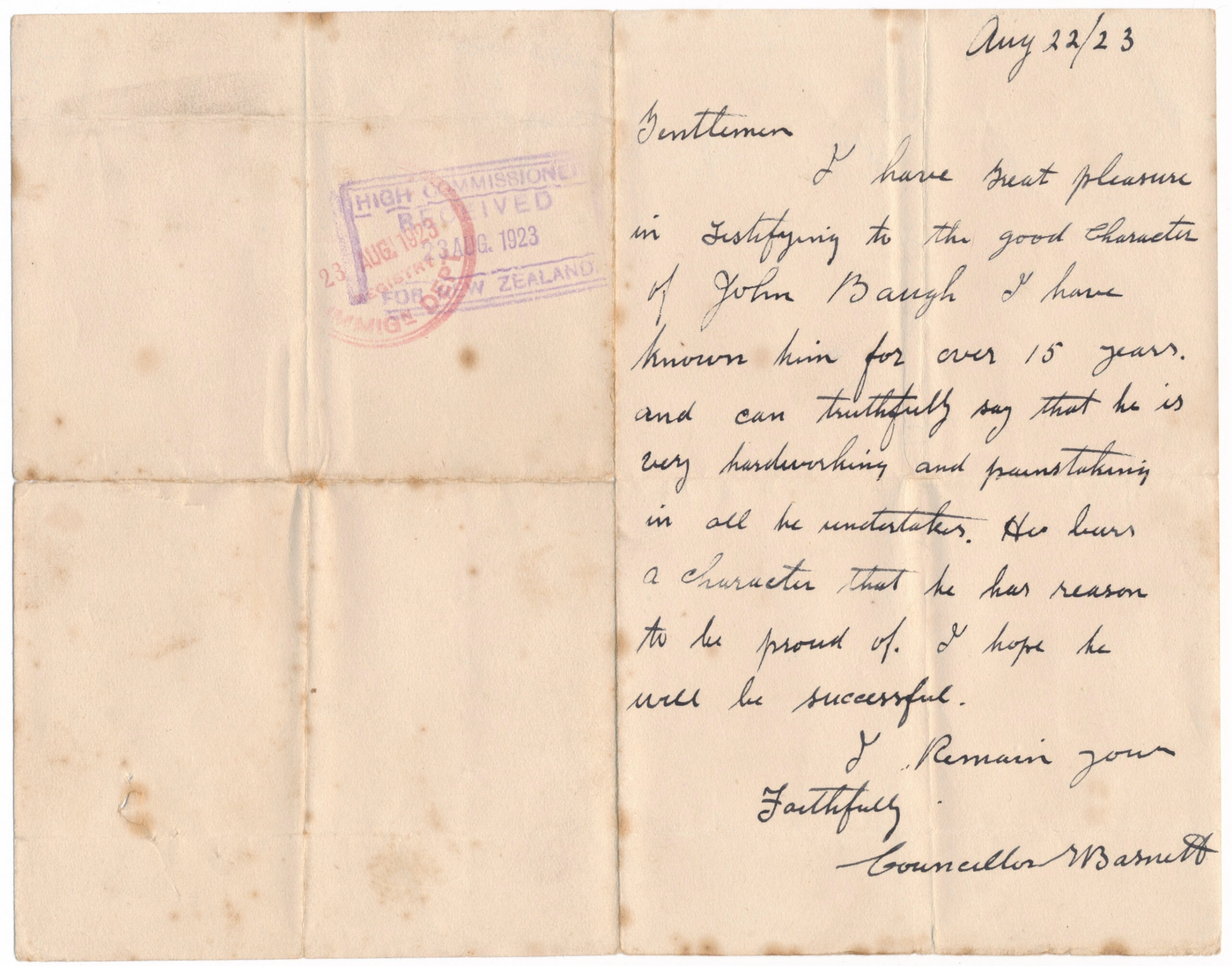
Mum and Dad obtained a passport on the 23 November 1920 with the intention of going to America, where Dad had relations. For some reason their plans changed. I have no idea who the relations were and sad to say I haven’t even tried to find out.
[Cliff’s father’s Aunt Margaret had migrated to the United States in the 1890s with her husband Lawrence Croston, another coal miner. In 1917 Lawrence was killed in a fall of rock in the Raub Coal Co mine, in Luzerne PA, a small mining town. Margaret died in Luzerne in 1930.]
I’m glad we didn’t go to America. In earlier years Hollywood films had influenced me to believe that America and its people were wonderful. Later experiences have changed all that.
My uncle Jack Corness came to New Zealand in 1922 on SS Ionic.
Aunt Nellie and my cousins Jack, Dennis, Tom and Winnie left on the Dorset in 1923. Jack reports that the journey took eight weeks and that he was sick for the first two. Once he came right he was rewarded with a lolly a day from the captain. He was seven years old.
Mum used to say that her father died six months after we arrived in New Zealand. He died on 6 April 1924, which means we must have arrived here in late September or early October 1923. I would have been five years old. The ship was the SS Ruapehu.
I remember a little of the journey. Mum, Dad and I, and Uncle Bill Lee, Aunt Ada and my cousin Ronald all travelled together. Mum, Ada, Ron and I shared a six berth cabin with two other ladies. Dad and Uncle Bill would have been in a similar cabin. We were “assisted immigrants” who’d entered into a contract to stay in New Zealand for five years, with the cost of our fares met by the New Zealand government. Ron and I occupied adjoining top bunks. Ron was lucky enough to have a porthole on his side. In between us in the corner of the cabin was a fan. To relieve the boredom we would pull out threads from cotton towels, join them together and string them around the cabin. This came to a sudden end when we got them tangled around the fan.
I have happy memories of Balboa and the Panama Canal, and a popular duet from a shipboard concert.
On yonder hill there stands a creature,
Who she is I do not know.
I’ll go and court her for her beauty;
She must answer Yes or No.
O No John! No John! No John! No!
Who’s who
Reading this back later I was mightily confused. Hadn’t Aunt Ada remained in England with her husband Albert, and met up with Cliff and Dorothy on the trip back home in 1969? How many Adas were there? And who was Uncle Bill?
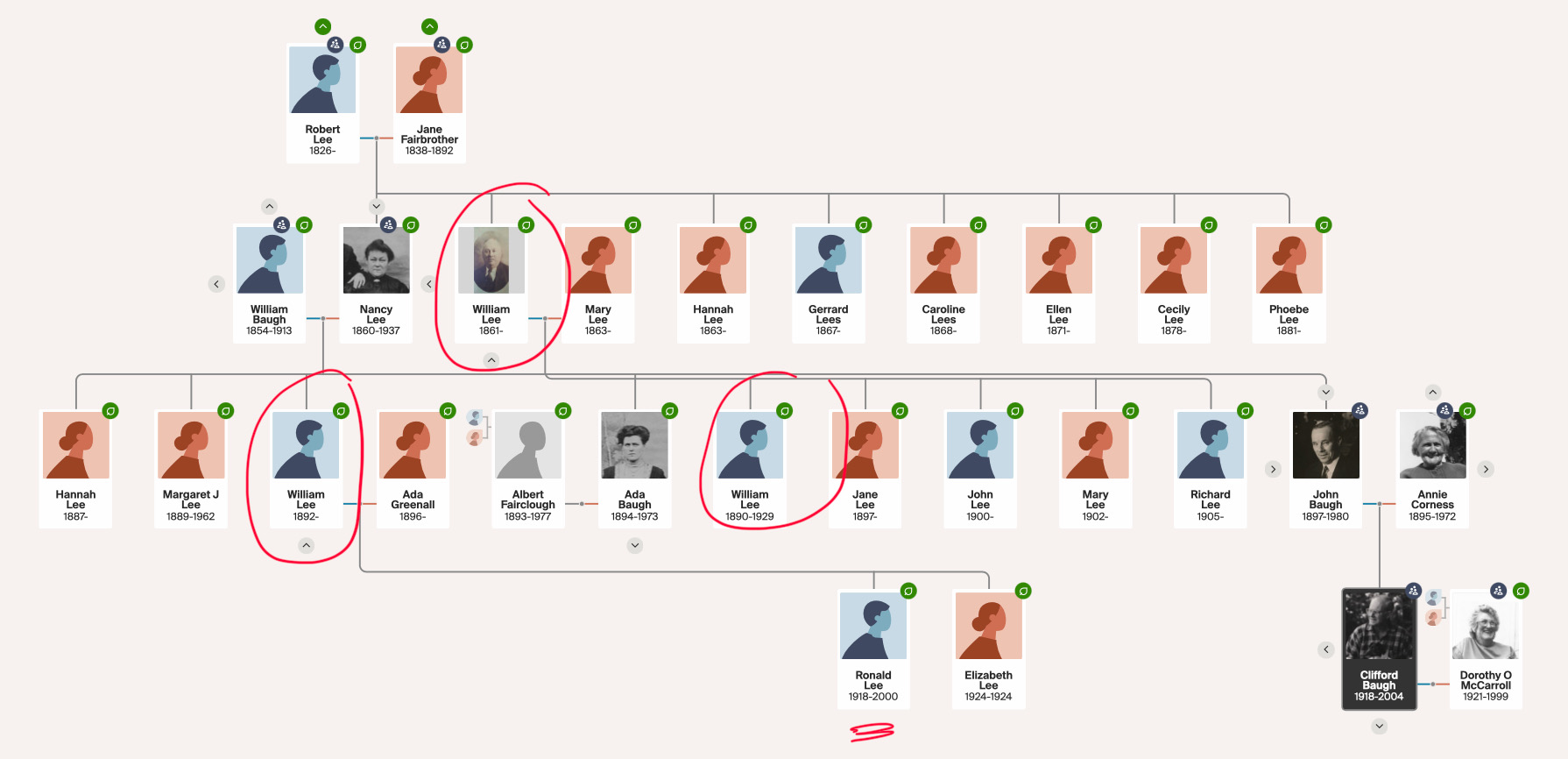
The short answer is that there were at least three William Lees in Cliff’s immediate family. Two of them could have been “Uncle Bill”, both of them from his father John’s side of the family. One was the son of his grandparents, William Baugh and Nancy Lee — but named William Lee for reasons I’ve tried to explain. The other was the son of Nancy Lee’s brother, who was himself called William Lee. I decided to go looking for the William Lees in the 1921 census.
§
Uncle Bill, Aunt Ada and Cousin Ronald
The William Lee on the Baugh side — my grandfather’s brother, that is — was a 29-year old married man living at 29 Manchester Road, Westhoughton, with his wife Ada Goodall and their 2-year old son Ronald. That seemed to answer my question — here were the Uncle Bill, Aunt Ada and Cousin Ronald who’d sailed to New Zealand with my father.3 What’s more, Cliff’s Mum and Dad were boarders in Bill and Ada’s house at the time, along with young Clifford himself, then going on 3. Both the men were coal miners (“hewers”) working for the Westhoughton Coal and Cannal Co, although currently “out of work”.
So the answer had proved fairly easy to come by. I thought it might be mildly amusing to talk about all the “Williams”, but instead I turned up another tragedy.
§
“Crushed by tubs“
The William Lee on the Lee side — my grandfather’s cousin that is — was a 31-year old single man living with his 59-year old father, also William, and mother, Mary Culshaw. William’s four grown siblings were also living with them — Jane (23), John (21), Mary (18) and Richard (16). Mary was a farm worker, the other two women doing domestic duties.
All four men were In the coal industry. Dad and John were both working underground. Dad was a Hewer, meaning a coal face worker who digs coal, loosening the coal with a pick. John was a Drawer or Hurrier — a person, usually a boy or young man, who pushes tubs of coal from the coal face to the pit eye. Tubs were wooden or iron vessels to carry coal. 16-year old Richard was a Tub Mender, working on the surface.4
And what of William? In 1921 he was recorded as a “Pensioner” and (struggling to read the handwritten form) an “Ex-Service Man”. If that means what it appears to mean — this is post-war after all — I can’t find any military record for him. But ten years earlier his occupation had been “coal miner, underground haulier”. So often you come across those words in these documents — coal miner and underground, and dataller (meaning casual work), and unemployed and out of work. And the grim lives they so often led, as Cliff records, and not just during the Depression — and not always in the warm family environment Cliff seems to have enjoyed.
And so often the deaths. A few years later, in 1929, William Lee Jnr made the news.
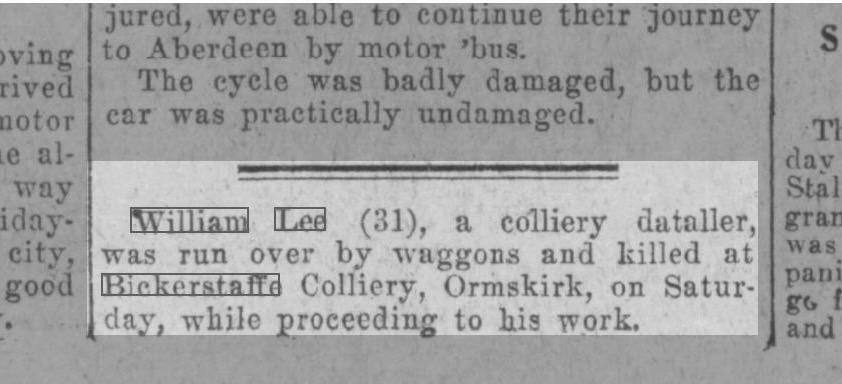
William Lee (31), a colliery dataller, was run over by wagons and killed at Bickerstafffe Colliery, Ormskirk, on Saturday, while proceeding to his work. — Aberdeen Press and Journal , 15 July 1929.
The UK Coal Mining Accidents and Deaths Index confirms that William had been killed on the 12th of July, “trapped by a set of tubs”.
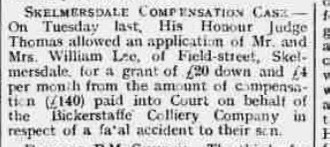
The Colliery seems to have been reluctant to accept any responsibility, as it took them five months to settle his parents’ claim for compensation:
And perhaps it’s no wonder that John, Annie, Uncle Bill and Aunt Ada took their kids, upped sticks and set sail for the other side of the world, hoping for a better life.
Skelmersdale Compensation Case — On Tuesday last, His Honour Judge Thomas allowed an application of Mr. and Mrs. William Lee, of Field-street, Skelmersdale, for a grant of £20 down and £4 per month from the amount of compensation (£140) paid into Court on behalf of the Bickerstaffe Colliery Company in respect of a fatal accident to their son. — Ormskirk Advertiser, 19 December 1929.
That’s about £11,500 in today’s money. It’s no wonder people like these elected a Labour government a few years later, and lobbied for unionisation, workplace reform, safer conditions and better wages.
§
Arrival
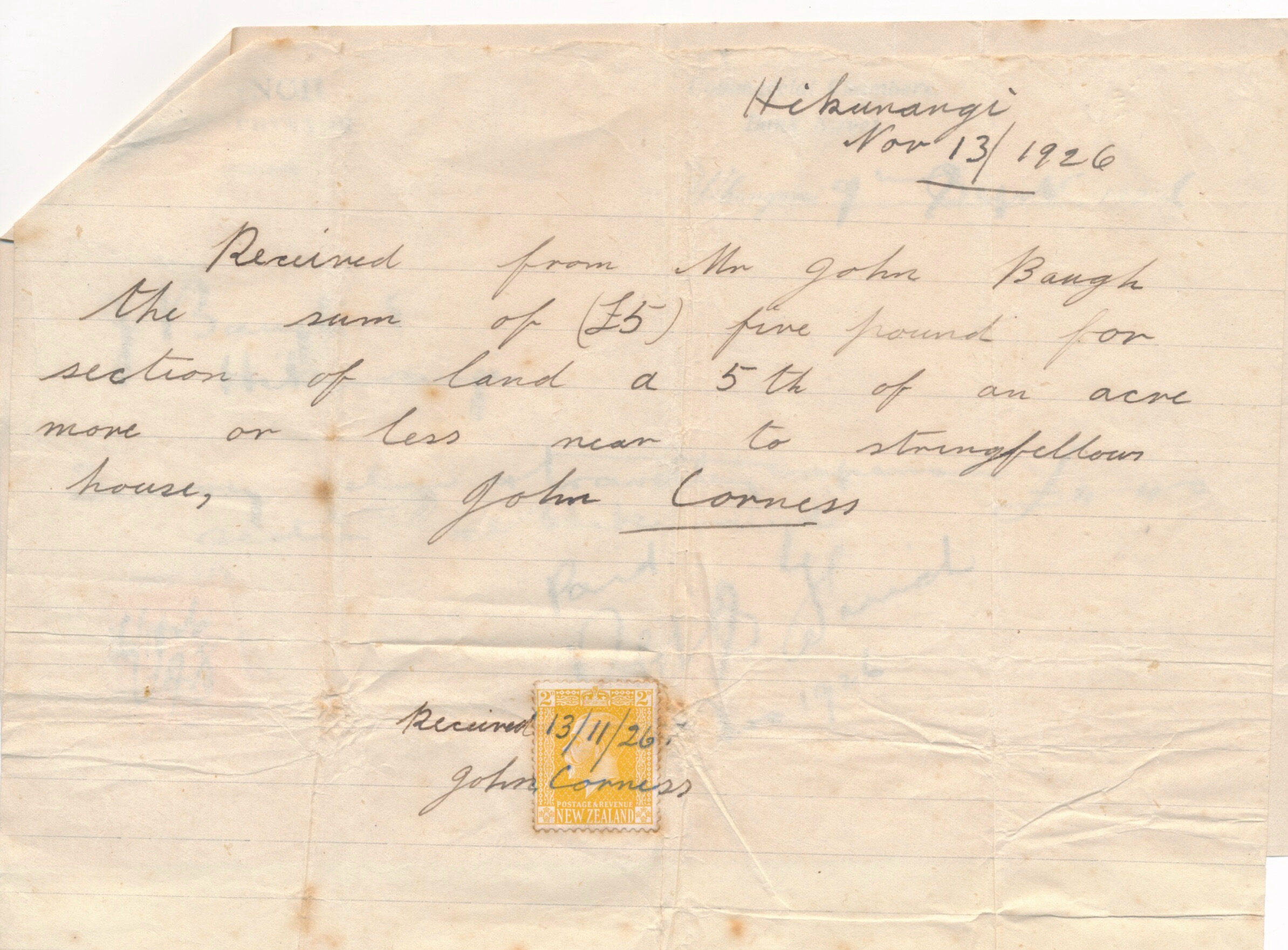
In Auckland Cliff and his parents trans-shipped from the Ruapehu to the SS Manaia for the overnight trip up the coast to Whangarei. They landed at the Onerahi Wharf the following morning and travelled by train to Hikurangi, then by horse and cart to Uncle Jack’s little cottage on Carters’ Road where they lived until they could move into their own house down and opposite the Waro Rocks.
The train they travelled on from Onerahi ran into Whangarei along a causeway down the harbour edge. By the 1990s the rails and sleepers were long gone and only the causeway and bridges remained — turned into a walking track by the council, and beautified by a retired couple who planted and nurtured trees along its length.
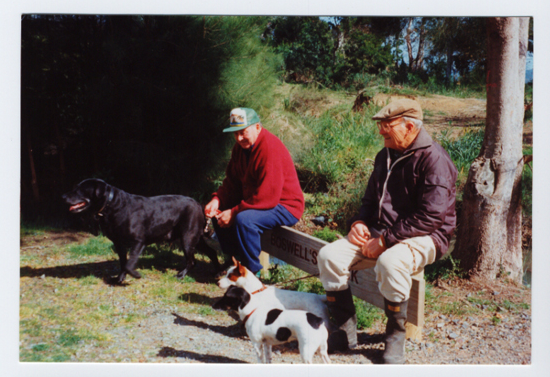
Before their 1969 visit to England and Europe, Dorothy and Cliff bought a house on George Point Road above the causeway — so Mum would know, Colleen says, what she’d be coming home to. After a lifetime in the country she was very anxious about their move into town.
In the 1990s Cliff would walk his Jack Russell Toni to the end of their road, down to the causeway and along to the Onerahi end of the track. He’d stop along the way for a fag while he talked to friends, and look across the mangrove inlets where the shags were fishing. Dorothy would pick him up by car — him ungrateful if she was late — and drive him back home.
Footnotes
- Cliff was wrong about this. The couple were raised and married in Liverpool, with no connection to mining. Cliff also thought it was “possible” that his mother’s grandparents had “worked down the mine as children”. That was pure speculation. In any case, before they were even born the Mines Act 1842 had made it illegal for women and girls of any age, and boys under 10, to work underground. The Cornesses had also been described as rope makers and the like for a generation or two by then. Wendy Hollis says Annie’s father Thomas worked as a roper as a young man, only becoming a miner in the 1880s. Thanks to Wendy for pointing all this out.
↩︎ - Wendy also disagrees that Annie’s mother Catherine Daley was illiterate, and I think she’s right. On the marriage register it’s Catherine who signs with her name, Thomas with his mark.
↩︎ - Cliff seems to have lost touch with his Aunt and Uncle’s family, but they appear to have worked on NZ’s West Coast before settling in Christchurch. As so often in this narrative, I’d love to fill in the blanks.
↩︎ - Glossary of coal mining terminology
↩︎