Written partly in the first person by Cliff, the rest in the third by me ~ Ian
“There is a splinter of shrapnel in the back of my neck somewhere. My neck isn’t stiff or anything and the doctor, Major Wells, says he may decide to leave it there.”
Cliff had been lucky at Alamein. He’d lost a lot of blood, been patched up by his C.O, manned his set bravely for a couple more hours, walked back under his own steam to the MDS, looked for breaks in the phone line on the way — but if the shrapnel in his neck had hit him an inch to the front or an inch or two higher he’d probably have been badly incapacitated if not dead. And he’d missed most of the battle and plenty more opportunities to die.
§
He’d written to Dorothy twice in October. His first letter, dated the 2nd, was while on leave in Alex. His mood was downbeat. A family friend had died in action and the McCarrolls had found it hard consoling his widow. More friends had died or been taken prisoner, including his mate George from Sidi Rezegh. He complained about not getting promoted and the poor quality of some of the NCOs. On the other hand there were officers who’d come through as Signalmen or NCOs and were generally pretty good. He talked about girls they’d met. One of them was an Italian with two sisters married to soldiers — and one of them, she’d said, was in prison.
POW probably. That sort of took the glamour off it when I remembered the way that they had treated me.
Such is war.1
He signed off asking Dorothy, as usual, to keep smiling. “I may have changed a lot when I get home. I rather think I have already but I pray it is for the best. I have learned a whole lot, some good and some bad and I must sort out the good…”
§
Another letter dated 15th October wasn’t posted before the battle, so he added to it in hospital. Even then, judging by the days and dates mentioned it wasn’t mailed until at least Sunday November 1st — a week after he got to the hospital — and it would have been weeks more before it was delivered by sea.
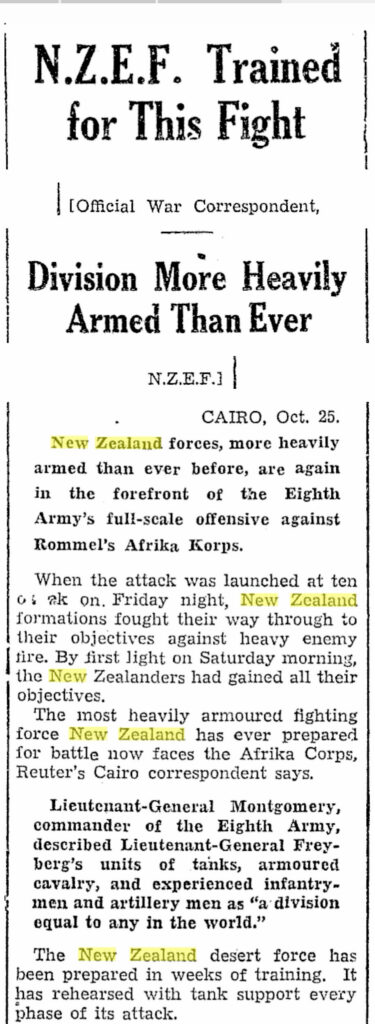
Meanwhile, imagine the anxiety in thousands of New Zealand households who knew their men were front line troops in 2NZEF, listening to the radio and reading foreboding newspaper stories about the coming and ongoing battle.
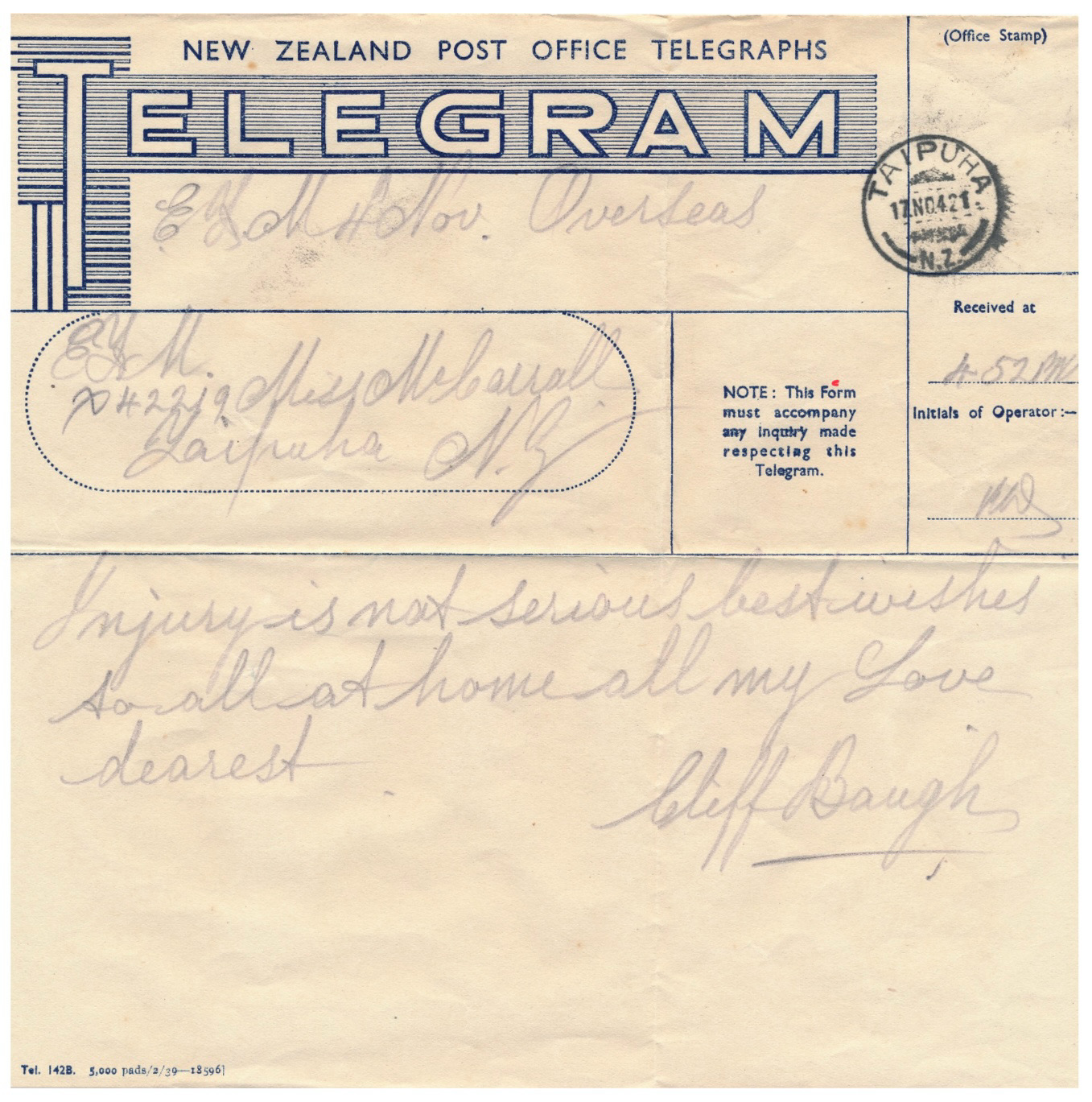
Like a thousand or more others, Cliff’s parents and Dorothy will have received the standard telegram regretting to inform them that a soldier had been killed or wounded in action, or was missing or a prisoner of war. Dorothy would have known he’d been wounded but probably not the extent of his injuries. Perhaps she’d heard more through his friends in the Div, but either way she’d have been relieved to hear from Cliff himself by telegram, weeks after the battle, that his wounds weren’t serious.
The battle was costly indeed, and after Minquar Qaim and Ruweisat Ridge 2NZEF had been well under strength even before it began.
More than 1,700 New Zealanders became casualties during this second battle of El Alamein. More than a third of these casualties, some 651, had occurred in the first twenty-four hours of the battle, the highest number suffered amongst the five infantry divisions used on the opening night. Among the 7,350 graves of Allied servicemen in the Alamein cemetery are those of 1,049 known and fifty-six unknown New Zealanders…2
§
As it turns out, once Major Reid had managed to stem the bleeding maybe Cliff’s injury wasn’t so serious — not as serious anyway as 11 months earlier when he’d nearly died after Sidi Rezegh. But he’d been bloody lucky.
On October 26th, only a couple of days after the battle, he found himself some “hospital blues” and declared himself an “up patient”, and over the next few days he finished that letter to Dorothy. It covers the same ground as his later retelling of the battle, beginning on the night of the 19th October when he and Johnny got back to camp at Maadi to be told they’d be heading to Div HQ in the morning. Johnny wanted to go drinking, but not Cliff, who went to the pictures instead. When the movie was interrupted by air raid warnings someone played piano while the boys had a singsong during the breaks.
It’s all told in a remarkably matter-of-fact tone — had a few days off in Alex, had a good time, posted back to the front, got wounded, back in hospital now but everything’s fine. Just another letter from a bloke to his girlfriend telling her about his week. And how fluently he writes — a few crossings out on the page, occasional scribbles from the censor — but as a vivid next-day account I think it’s worth posting here. Click here if you’d prefer to skip it. ~ Ian
§
From Cliff’s letter to Dorothy:
We slept under the verandas that night with all our gear packed ready for a quick take off. Had breakfast at some unearthly hour and set forth in trucks. Arrived at Div HQ that afternoon. We had a notion that there was going to be something doing up in the desert, and found out for sure when we arrived. On the way we passed scores of planes, fighters and bombers, and things looked unhealthy for Jerry in that line. We slept that night on a lovely white sand hill on the shores of the Medi. The following morning we were posted and went to our respective sections. Johnny went to K and I to L…
I know a lot of chaps in L and was surprised to find my old friend Ken Prime there… Jimmy Grant was back there too. I was allotted a wireless truck and my cobber was to be Len Brooks. Our job was… with main Brigade HQ. We got things “jacked up” on the truck by the afternoon and Jimmy Grant and I had enough time after tea to hop over the hill for a dip in the Medi. It was lovely. Jimmy’s job was the Brig’s Recce.
That night we set off in convoy towards the Alamein front. It was a lovely drive in the moonlight, and one could imagine we were travelling along a peaceful country road back in New Zealand. Jimmy and I sat on top of the truck, Ken Prime drove, and our OC sat in front with them (Mr Hislop). Len Brooks travelled in the ACV (Armoured Control Vehicle). After a few miles, we could see the flames of the guns in the distance ahead of us, but the night was beautiful otherwise. After a few hours we had tea, dispersed and dug in, and settled down for the night. Mr Hislop came to light with a bottle of gin which we sampled. Bad lad aren’t I? We were still about 15 miles, perhaps more, behind the lines, so had a good sleep.
The following day we expected a Stuka raid or two but were lucky. That day I was told of another job I had to do during the attack, after which I was to return to Brigade HQ with my set and provide a link there. The job was to go with the Engineers during the attack and help provide communications for them along with a line truck (a Jeep), which was to run a line through the gap as the engineers made it. Their line would be available for the use of the Sappers also. The idea was to send word back when the mines were cleared so that the armour could follow through. We always have to try and provide two means of communication in case one breaks down. By the way, I carried a signal lamp too that night, just in case we needed it.
An advance party went forward at dusk that night to set up Brigade signal office behind the existing lines. During the afternoon Jimmy and I worked installing Jimmy’s set into a Jeep, and mine into a Bren carrier, which was provided with a driver from the 24th battalion. Len was to stay back at Brigade HQ until I returned from my job with the Sappers. The driver of our carrier was Eric Driver and we slept the night together under his Bren.
The following day we had little to do except eat and sleep and we did quite a lot of both. That was Friday 23rd October.
We left that position to go forward at 7:20pm, Staff Captain leading, Jimmy Grant, us, and then the rest of Brigade HQ. Arrived at our signal office about 8:45, dispersed and waited. Everything was very, very quiet and you wouldn’t have thought we were in frontline positions, ready for a large scale attack. Not a shot and not a flare. Dead quiet. The infantry and engineers moved up from behind us, infantry on foot, engineers also on foot but with one or two trucks. The infantry spread out ready to get going, the engineers more in a bunch, also ready to get cracking.
At XXX or approximately every gun on our side of the line opened up at once and there were hundreds of them. They were well up and the nearest were about two chains (40m) behind this. What a row. You’ve never heard anything like it. You had to yell to make yourself heard. After about 15 minutes the infantry got up and started walking. Long lines of them with bayonets fixed. After another wait of about 15 minutes, we (the engineers) started on our way. I can’t give you too many details or I will get in trouble with the censor. I don’t think I’ve overstepped the mark so far.
It was fairly easy going for a start through our own minefield where we lost a Sergeant and a Sapper. Our infantry seemed to be making good progress, although we couldn’t see much for dust and smoke. It took some time to get through Jerry’s first field and after that we struck scattered mines before the second one. Taking up the mines is no child’s play, and there are plenty of booby-traps, and I didn’t envy the engineers their job. That was supplemented by quite a good deal of crossfire from pockets of enemy machine gun and of course shell fire. Jerry shell fire was fairly scattered though and I don’t think it would do much damage. A shell got our first two casualties and we had a few more as we went ahead. Two were blown up by a mine. Quite a lot of the time we couldn’t see very far for the dust and smoke of our barrage.
I think we got a bit ahead of ourselves going through the scattered mines for we came under 25-pounder fire. Our line truck got a direct hit and the driver Cliff Hume (in the next bed to me) was lucky to get away with concussion. We were stopped at the time, and I think he was probably lying down alongside the Jeep. I didn’t find out about the truck until quite a few minutes later, for I got hit about the same time. I was sitting in the carrier operating, had sent quite a few messages by them and re-transmitted some for different units. Just didn’t keep my head down far enough. Something hit me in the back of the neck. (Sorry, my pen has run dry and I have no more ink — [he changed to hard-to-decipher pencil]. I bled like a stuck pig. Thought I was going to bleed to death for a moment. I yelled out to Eric to give me a hand to put a dressing on it, but before he had time to move good old XXXXXXX was on the job. He bound me up and I hopped back in the carrier with instructions to send back a message to get the 25 pounder fire off us.
I got the message away all right and they must have got on the job smartly for the barrage soon lifted. I can imagine how thankful everyone was, but personally I wasn’t feeling very interested. I felt pretty sick for quite a while. The bleeding took some time to stop and had me a bit worried, but it did stop, as you see, in about half an hour. I was feeling pretty good again. The Major got about halfway through sending a message by line when it went out, so I sent it. It requested a new line truck and a replacement for me. I was the only operator and the only means of communication so I kept going. XXXXX is a great chap and did a very good job there. Things were pretty tough in spots, but he didn’t get down, and he kept this men at it the whole time. Our line Corporal Matt Gordon was pretty good also. Calm, cool and collected.
Len Brooks arrived with another jeep about an hour and a half later. Len took over from me. We were then about halfway, possibly more, through Jerry’s minefields. The armoured stuff was all crammed up behind and ready to go through. The infantry were on their objectives. I gathered my personal gear together and rifle etc. and started off to walk out. Followed our line out to look for breaks. Found two on the home side of our fields and was trying to borrow some pliers to fix it up when Peter Williams, and Lorchie(?) arrived on job. After that, it was the usual story. A dressing at the ADS and back to MDS. There I found Colin Bell who gave me a tin of oysters, which I rapidly disposed of, and Lisette’s telephone number in case I went to Alex. Both very acceptable. From there to a Tommy CCS where we slept the afternoon. From there to the XXXXX CCS where we slept the night. On the way there our XXXXX Tommy driver tipped us over a 15 foot bank. He was travelling slow, luckily. All being wounded, we all got hurt but no extra damage was done.
The following morning I met with Cliff Hume. He was feeling alright. Hadn’t come to until he was in the ADS, and didn’t know what hit him. We left there, caught the hospital train and arrived here about 1 pm on Sunday night [the 25th]. Got some blues the following morning 26th and made myself an up-patient. Cliff Hume is confined to bed but is feeling okay. I had an x-ray on Friday the 30th. There is a splinter of shrapnel in the back of my neck somewhere. My neck isn’t stiff or anything and the doctor, Major Wells, says he may decide to leave it there. He’s going to have a look at the plates this morning. He is one of the doctors who operated on me in Helmiah and is a good man at his job.
Well sweetheart, that’s the end of the news and I bet my boots you are cursing this pencil. I’m looking forward to getting some more letters from you for I hear there is a mail in. Also hoping you have sent me a photo. Had to destroy all your letters before we went in so I won’t be able to answer them properly. Another trial of your patience.
§
He signed off wishing Dorothy God’s blessing, and oceans of love.
Footnotes
- It’s worth reflecting on time passing here. This is October 1942, eleven months after his experience as a P.O.W. under the Italians at Whistling Wadi, and about 2-1/2 years before he finally got home.
↩︎ - …After the October battle, the New Zealand Division was now below strength by 3,600 men, a deficiency felt especially keenly in the infantry, the artillery, and the engineer corps. It had commenced the long campaign in June with nearly 20,000 men. In November 1942, its strength had almost reached 13,000 again. — war history.org
↩︎