Written partly in the first person by Cliff, the rest in the third by me ~ Ian
Cliff had last written to Dorothy from Maadi, outside Alexandria, on Christmas Eve 1942. His next letter was dated the 10th of January and written from “somewhere in Tripolitania” while “sitting on a blanket in the sun clad in his undies”. In the three months since he’d been wounded at Alamein, just 60 miles or so from Alexandria, 8th Army had driven the enemy back 1100 miles (1800km) or more. They were now on the verge of taking Tripoli and about to pursue Rommel on into Tunisia. Meanwhile, back in November the Americans had landed further to the West, in Morocco and Algeria, and the Vichy French had swapped sides — meaning the Axis forces were being attacked from both directions.

§
The contingent Cliff was part of had left Maadi on Boxing Day, spent two days at Ameria en route, then boarded HMS Antwerp on the 29th, bound for Benghazi. They’d had good quarters and good meals, but feeling a bit seasick slept on deck. Altogether it was a good trip, although his first job was as lookout manning a heavy machine gun he had no idea how to use.
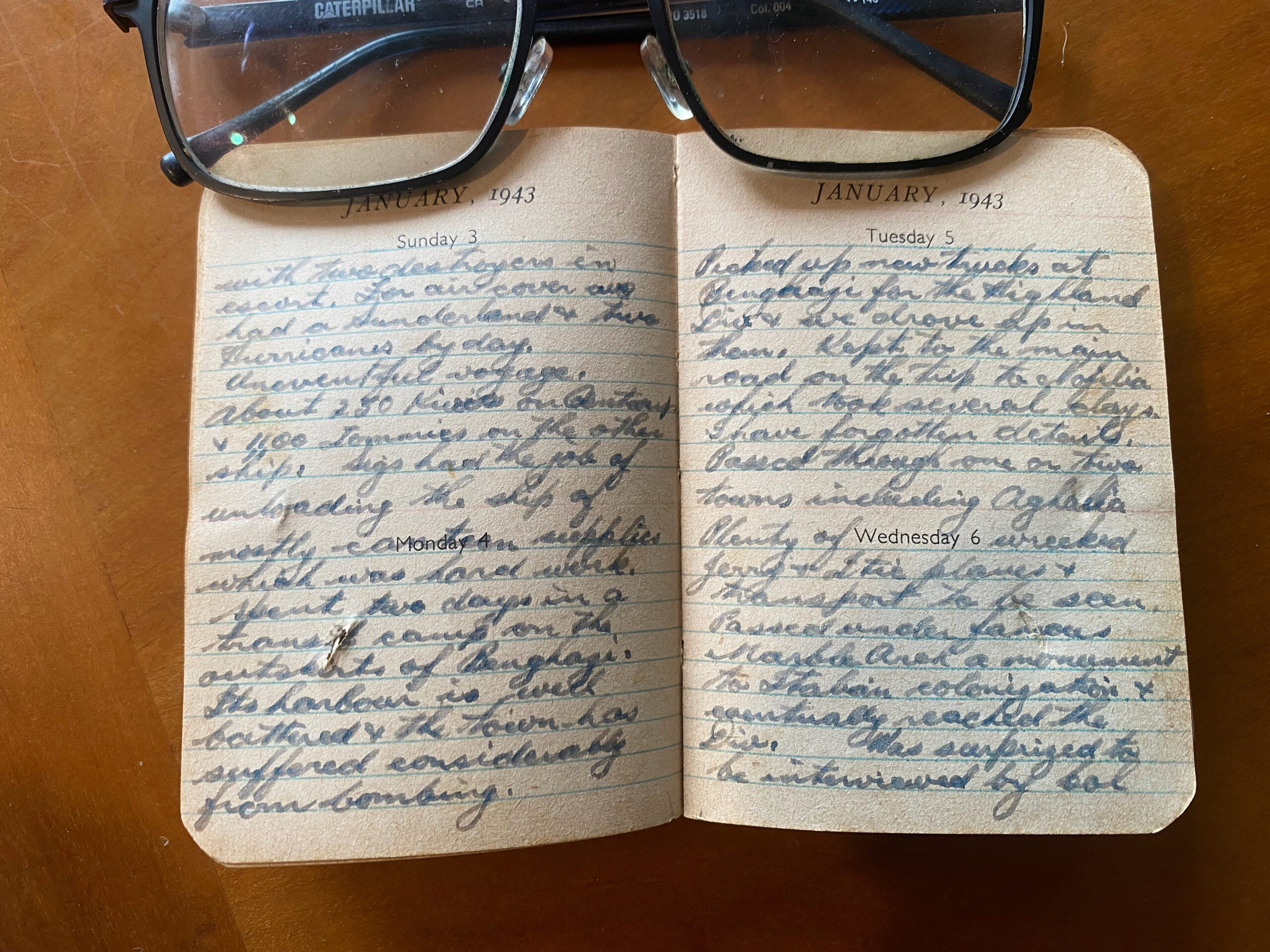
Luckily we didn’t sight a submarine or an aircraft but at one stage there was a great flash of flame over the horizon. A tanker blowing up I expect…
There were two troop ships in our convoy with two destroyers as escorts. By day we had cover from one Sunderland and two Hurricane planes.
§
Gun play
After the war, Cliff wrote:
We spent two days at a transit camp on the outskirts of Benghazi, housed in bivvie tents — the Americans called them pup tents. In a bare desert area there had been a German gun emplacement. Captured guns and ammunition lay around everywhere. This was a source of entertainment for some, who obviously had experience with guns. The guns and ammunition were I think 75mm and I became quite disturbed to see what a few were doing with the ammunition. The cartridge cases and the projectiles were in one piece. Holding the projectile end, with the whole thing at an angle, they dropped the shell casing end repeatedly on the ground in order to separate the two. I fully expected an explosion but to my great relief nothing happened. With the projector and shell casing separated, long narrow strips of cordite about as thick as spaghetti became available. 4 gallon flimsy petrol cans lay around. Perhaps something could be done with them. A few sticks of cordite were broken up and stuffed down the opening at the bottom of one tin and the end of a long piece of cordite left protruding from it. Then, with the tin facing in the right direction, a match was used to light the exposed end. The result was quite spectacular. The exploding gases turned the tin into a rocket. Great fun, for the tin changed direction each time it hit the ground, providing much-needed entertainment. Again and again this was done until the inevitable happened. A tin rocketed into a bivvie tent, setting it on fire.
Could a gun provide entertainment? Stuff a few sticks of cordite down the barrel. Follow up with a heap of dirt, leaving one stick protruding from the barrel. Light that stick and see what happens. A great success. The camp forward of the gun was showered with dirt. This was done again with additional dirt. More success. A third effort and again more dirt. A man lit the protruding cordite and retired with his mates to the back of the gun. Bang! The breach of the gun was blown off, but by the greatest good fortune nobody was hurt.
§
Those two days in Benghazi gave them plenty of time to look around. The harbour was battered about and there were a few sunken ships. The town too was badly knocked about by the bombing.

Cliff wrote, “…some humorous person had artistically painted certain items of ladies’ underwear on one of the two nude statues that adorn it, which looked quite funny.” Photo: Gift in Memory of L.A. Rogers, from the Collection of The National WWII Museum.
A group of them drove new trucks for delivery to the Highland Division at Nofaliya. They kept to the main road on the trip, which took several days, passing through one or two towns including El Agheila, site of a unsuccessful attempt in December to trap the retreating Axis forces, in which NZ troops were involved.
Plenty of wrecked German planes and transport were to be seen as they drove through. “The RAF has been doing a good job.” They passed under the famous Marble Arch, a monument to Italian colonisation designed and built in the 1930s, and eventually reached Division.
§
Keep your head down!
When we arrived at HQ, Uncle Brian (Sgt Maj.)1 made us carry all our swag, quite a lot of it, unnecessarily for about a mile, and I was full of hate and rage, cursing the army in general, and Uncle Brian in particular when quite unexpectedly Col Agar, our O.C, arrived on the scene and called out for Signalman Baugh. I wasn’t in the mood for saluting, but fortunately I flung him a snappy one. I was in an unpleasant frame of mind when he began to speak, and the more he said the greater my confusion became, so that by the time he had finished, I felt pretty foolish. He asked me where I got wounded and how I felt in such a sympathetic tone that it almost unbalanced me, and then he began to lay the praise on thick, which finished me off.
“What you have done has greatly enhanced the reputation of Divisional Signals…“ And so on, I couldn’t stand it.
All that I could manage was to mumble “Thank you, sir”, and that was that. Later on our Company Commander told me to keep my head down next time. He said that it was a bloody good show that I put on etc.
§
Cliff reckoned he now had the safest job available — but then he’d had the same job when the last affair was planned, “and you know how that turned out”. He didn’t want to spend another Christmas in hospital.
“I was lucky to join L section again,” he wrote. “Mr Hislop asked me what job I would like to do “and by that time I was almost overcome with kindness.”
Mr Hislop had been his C.O. at Alamein. He was less impressed with the next, who conducted a kit inspection and made him pay for a lost beret.
§
Back with the Engineers
They left for Tripoli shortly afterwards, Cliff travelling with his transmitter in a pick up truck behind the Intelligence Officer, Mr Ball, who was tasked with finding a safe route west for 6th Brigade. There were two interesting days, the first when they were shelled by an enemy rearguard, and the other spent with 8th Field Company Engineers clearing mines for the advance:
We spent a day with the Engineers on the way up for old time’s sake and had a hectic time tearing around locating and disposing of mines in our track and preparing the road etc. It is remarkable the way these chaps can locate them. They seem to scent them. We would be tearing along at 30mph in a cloud of dust when the Major’s pickup would jam on its brakes and out pile the Sappers to smell them out. Occasionally they didn’t find any, but mostly they knew the spots where they were likely to be found. It is a tricky, dangerous job and it is easy to get caught, but they sail into the work without any apparent care.
When a truck strikes a mine, they say philosophically, “That’s another, we don’t have to find.”
Jerry is using a particularly fiendish mine called the “3” mine. It goes off with a few pounds of pressure (it is sufficient to put your foot on it). It has two explosions. The first sends it straight up into the air, where another explosion sends out hundreds of pellets about the size of a ball bearing. Quite a nasty bit of work…
§
Cliff would follow the wheel marks of the Captain‘s lead truck very carefully, expecting an explosion at any second. That officer could smell mines, he reckoned, and knew how to avoid them.
Imagine the last time he was with the Engineers, when they were doing this same job in the dark, under enemy fire, at Alamein.
Some time later Cliff was sent back to Brigade by himself on some mission or other. He’d driven more than 200 yards down a road running alongside a raised embankment when he met a group of Sappers sweeping for and locating mines. They were working towards him, not away, and it turned out the road he’d driven over was heavily mined. His mission was urgent and he couldn’t wait for them to finish the job, so with great care he turned his truck around on the embankment and followed his wheel tracks out without triggering an explosion. It was a hair racing experience, and a relief to find an alternative route out.
§
One day General Freyberg, Brigadier Gentry, the Staff Captain and others went on a recce. They got too cheeky and ran into a German ambush. The Brigadier’s driver, Cliff’s friend Jimmy Grant and another man were shot up. The driver died and the other man’s condition was serious.
“Jimmy can’t sit down yet,” Cliff wrote, “with 16 small shell splinters in his behind. The rest were very lucky to escape.”
§
Italian colonial farmers
They next camped outside Bianchi2, where they spent two weeks. On Monday 26th January, a fewof days after Tripoli fell, he wrote:
At present we are camped in a locality inhabited by Italian farmers, at least I suppose that’s what they are. The land is very poor, and goodness knows how they get a living. The houses look quite nice, and nicely whitewashed. Almost every one had a white flag flying from the roof as we passed. Most of the menfolk and one or two women were on the road to welcome us. Some were enthusiastic, some looked unsure of themselves, and others definitely glum looking. We ourselves stopped quite close to a well and reservoir, so as soon as possible we were right in for water for washing ourselves and our clothes.
A few womenfolk who were close by seemed very frightened and uncertain about our good intentions for the first day, but as soon as they saw that we only wanted water, they cheered up immensely and volunteered to do washing for us in return for bully beef etc. Yesterday they were singing over their wash tubs and happy as can be. I fancy our arrival has been a windfall for them as they appear to be very poor. Today our Roman Catholics are having a Mass at the local church, so we are doing fairly well and the people are friendly enough. I wouldn’t be surprised if we received greater hospitality from the people in Tripoli than we received in Cairo. I hope there are still plenty of Jerry mouth organs left in the shops there, for that is one of its main attractions for me.
§
Victory Parades
Their next move was to Suani Ben Adem, South West of Tripoli. From there on 23rd January they’d taken part in the 8th Army Victory Parade before General Montgomery. Heading back to the trucks after the parade Cliff and his mates dodged into the crowd to check out the city. Overall they weren’t impressed, and most of the shops were boarded up.

Later they were told there would be another parade on February the 3rd, with Winston Churchill attending. Cliff marched with 25 Bn, and with a bayonet for the first time in two years. He wrote home describing Churchill in disparaging terms and calling his speech “baloney”.3
§
Letters
His letters to Dorothy from Tripoli have a random air to them — writing about the day to day because there’s little else to do. Writing to maintain the bond with Dorothy, To tell her how much he loves her, misses her. He asks for photos. One day he tells her sadly that after two years it’s becoming harder even to remember what she looks like, and her smile, and all the little things she did to make him love her.
He’d only known her for two months before being called up, and even then they’d often been apart. She’d been 19 then, now her 22nd birthday was coming up.
It was Clark Gable who said, if you write a letter to a woman at night and read it in the morning you will burn it. I read this through, and I’m too lazy to rewrite it and I won’t burn it.
§
It’s a pleasant morning in early February, apparently still at Souani, and they’re surrounded by fresh green grassland dotted with fruit trees, trucks and a line of gums. They’ve traded some sugar for four eggs and cooked bacon and eggs for breakfast.
And then, with little sense of how or when one episode ends and the next begins, they’re living in the basement servants’ quarters of the Governor’s palace in Tripoli — with 25 Bn and officers on the floors above — and with hot showers, and beds for most to sleep in.
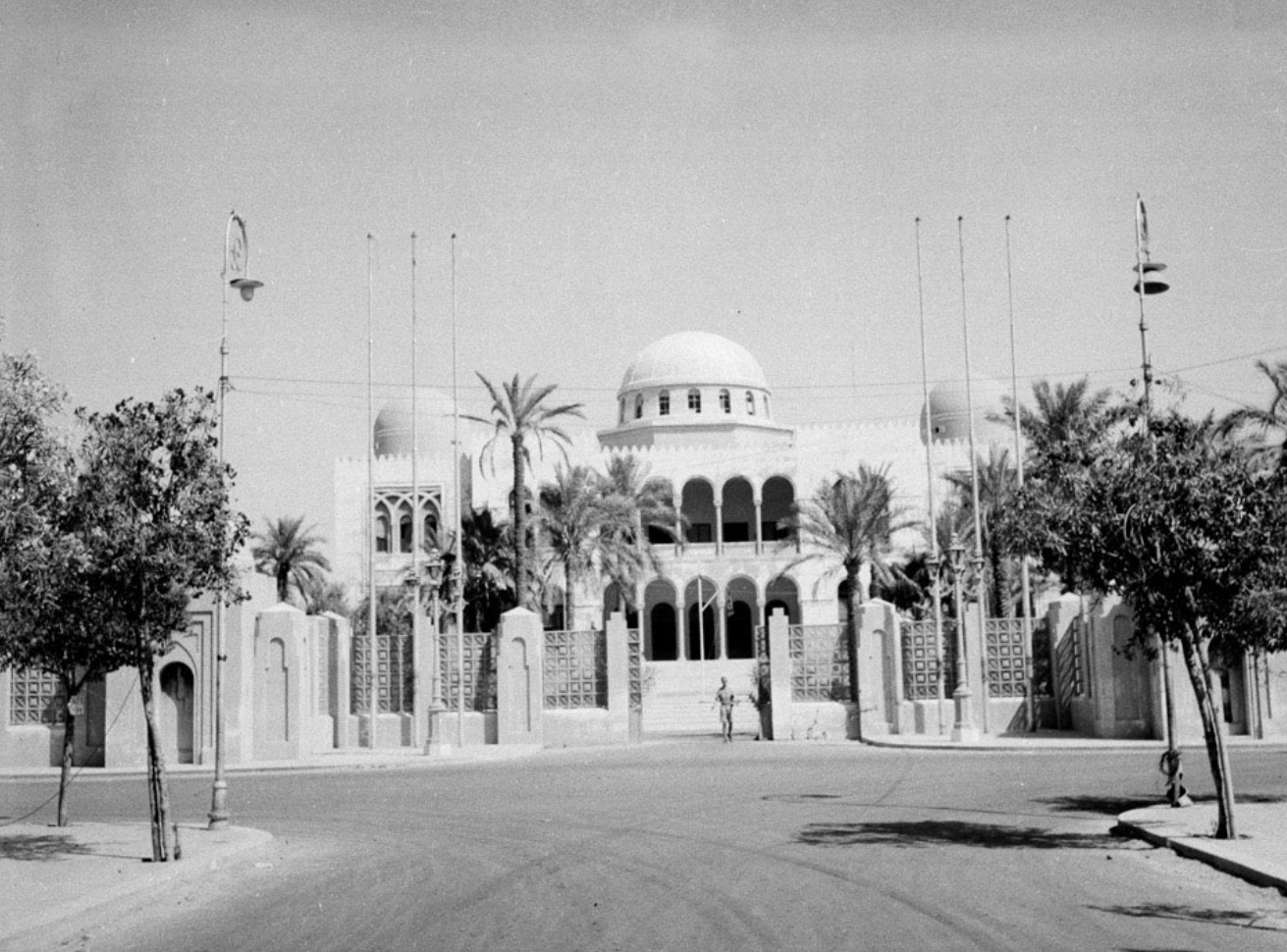
It’s a huge, beautiful three storey building, very decorative with marble pillars and five domes… Each time I make an effort to explore I get lost. Some of the rooms are huge. You open the door and look in to see a wide open space, and when your eyes get in focus you see an officer sitting at a desk in the distance.”
§
There were letters to answer, lots of them, congratulations on his M.M., and parcels to thank people for. And there were walks with mates down town — more welcoming now but nothing to send home — and a game of rugby between Div Sigs and the Maoris, and a few days with 24 Bn, apparently on the docks.
German bombing and anti aircraft fire get the odd mention:
By Jove, there is a racket from Tripoli. The guns are blazing away like one thing. They brought a bomber down the other night.
Air raid tonight. Blast of a bomb blew windows in. Landed 1/2 mile away. Must have been a big one.
§
The air raids didn’t bother Cliff too much except the noise:
Nothing exciting has been happening except that we get an air raid at night occasionally. There are a few guns quite close to here and the concussion shakes the earth. I usually turn over and try to go to sleep again, but there isn’t much hope with such a din.
Ron and Dink and I were out for a walk one night when an air raid came off and the barrage was going up full blast. The bombs don’t worry us much, but what goes up must come down, and there were a lot of shells going up and tons of shrap coming down, and it was sending up sparks off the pavement when it landed. We crouched under a wall for a start, but that didn’t seem too safe so when we spied a small building across the road with a marble slab roof, we made a dash for it. From there we could look out at the fireworks in comparative safety, and it was a great sight. You haven’t seen such a colourful display as can be seen in an AA barrage. One usually can’t fully appreciate it, but it looks really pretty.
They’d found shelter in a public lavatory. “I’ve never thought of using one as an AA shelter before,” Cliff said.
Footnotes
- Sergeant Major Brian Farquhar, “so called because he used to conduct the 2ZB children’s programme”.
↩︎ - Bianchi was one of several agricultural villages established by the Italian colonisers during the late 1930s but damaged and sometimes abandoned during the war. A few survived until the 1960s.
↩︎ - After the war he wrote:
Before the march past we were paraded and addressed by him in his usual manner, telling us what good soldiers we were and lionising General Freyberg. To us the entire show seemed to be quite ridiculous and stupidly risky. There were about half a dozen slit trenches behind the raised stand where Churchill, Freyberg and one or two others were standing. The entire Division were exposed to the risk of a possible air attack, for the German lines were less than 30 miles away. As we marched past, if looks could have killed, Churchill would have died many deaths.
By that stage he was very unpopular with New Zealand troops. Later, in Italy, we were told that Churchill was about to drive past at a certain time on a certain road, and we were invited to go and give him a wave. Not one of us went.
Maybe his working class, Methodist background was part of it, but Cliff had a built-in dislike for what he saw as pomposity. If you’ve been reading along, you may recall his disdain for the British officer type who lacked the egalitarian streak of his Kiwi counterpart.
↩︎