James Grossart Sharp (1848-1928) and Margaret Linklater (1853-1911)
Heather’s great-grandparents.
As I worked my way down through the generations I kept wondering what the distaff side brought to the mix. What did Agnes Mitchell and Isabel Dall contribute, back in the first half of the 18th Century? Janet Grosart’s family looks like it may have had a commercial bent, but what about Thomas’s wife, Mary Marshall? I haven’t found out much about Maggie Linklater or her family either — except that they’d changed their name from Linkletter — but we do know that, like Great-Grannie Sands in the previous generation, Maggie was going to have a big impact on the family fortunes.

If you read the tea leaves of census data and other public records, as I’ve tried to, you might conclude that James Grossart, Thomas and Mary’s oldest son, was a multi-talented extrovert who had a varied career — happy to stand up and perform — but what did he do and what was he like? Given how people posed for the camera back then, what does the photo suggest about him? A little pompous, a bit of swagger, a sense of humour? All three, or none of them? I’d be curious to find out.
The first reference I found to him was in the census of 1851, when he was a three year old living with his parents, Thomas and Mary, at Possil Road. He was still there in 1861, a “message boy and scholar”, and there again in 1871, when he was a 23-year old “engine pattern maker” — a skilled trade creating wooden models, or patterns, used to make the moulds from which engine parts were cast in foundries.

In ‘71 his future wife Margaret Linklater was a seventeen year old dairy maid living in, or at, “Butler’s Kirk”, an address I can’t locate.
More significant is the previous census, 1861, when 7-year old Maggie was living at Batterflatts, Stirling, an address that looms large in the Sharpe story. Back then she was living with her grandmother, 89-year old Janet McGregor, the head of the household, and her mother, 50-year old Margaret Miller.
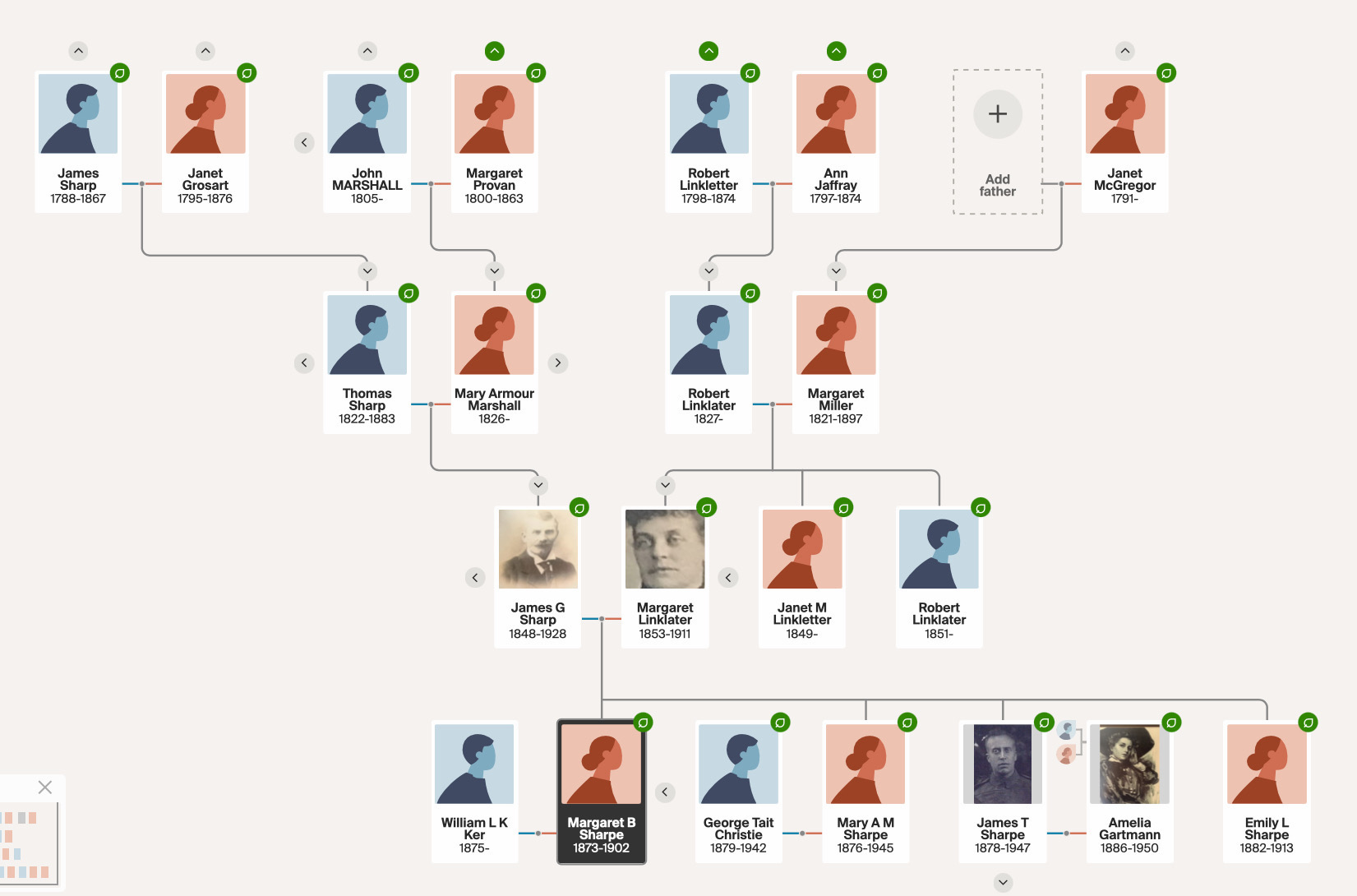
I assume there was a Mr Miller, Janet McGregor’s married name, but if so he isn’t identified in ancestry.com, and neither he nor their daughter’s husband Robert Linklater was in the house for the 1871 census. In fact the only male in the household that day was Margaret Linklater’s brother. What does all that mean? Maybe nothing, but what will certainly become significant is that the Batterflatts property clearly came down from the Linklater side of the family, not the Sharpes’.
§
Curiouser and curiouser
Where James Grossart and Margaret Linklater lived after they married in September 1873 I don’t know, but the 1881 census found them somewhere in Glasgow. His occupation then was “commercial traveller”, like his father Thomas. You might wonder from that whether he was going to take over the family business, whatever that was, but Thomas died a couple of years later, and in 1891 — just a few years further on — James Grossart’s occupation was recorded as “professional vocalist”.
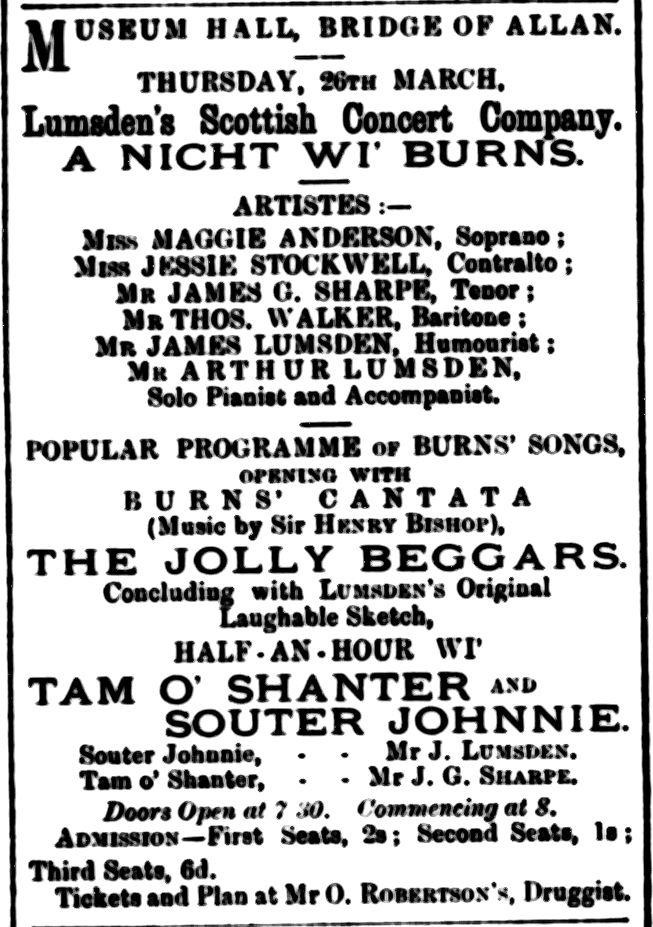
James had sung to his wife on their wedding day, so he could obviously carry a tune, but this was the first suggestion that he’d turned professional. I soon found out there were family stories along the same lines, but all in all I still took the “professional” idea rather dismissively, even after Heather came up with this Nicht wi’ Burns advertisement.
Amateur dramatics and light opera were pretty strong even in our life times, but this would have been, not just a popular program, but fairly ambitious. Robbie Burns, Scotland’s national poet, wrote mainly in a “light Scots dialect” that made his work (more) accessible to wider English-speaking audiences, like Gilbert and Sullivan types and the Scots diaspora. Not that it would have mattered much to the Bridge of Allan folk, north of Stirling. Henry Bishop and James Lumsden, amongst others, had set Rabbie Burns’ work to music and adapted it for theatrical performances — and here Lumsden himself was taking part. So yes, this was a professional undertaking.
James Grossart‘s grandson Duncan also remembers the family story of him singing tenor in the Glasgow Cathedral Choir, but “in those days the gentlemen of the choir were unpaid and he would have continued in his regular job.” For all those reasons I still doubt he was feeding a family from his musical talents, but then, if I could tell the census that I was a writer and publisher in my twenties (strictly true, even if it brought in little cash), I can hardly criticise James Grossart for doing something similar in his prime.
Whatever the case, he was certainly versatile. When his daughter Mary married in 1912 James Grossart was listed as a retired publican.
By and large, then I’ve got the impression that Thomas and his son were an entrepreneurial pair, but not in the sense of building a business. And yes, I accept that James sang professionally.
§
Batterflatts

There’s a puzzling family story, which I’ll get to, about Batterflatts in Stirling. But regardless of that, in the 1891 census James Grossart was recorded as head of household at “Batterflatts Dairy”, resident along with his wife Margaret and four children aged between 8 and 17 — Maggie, Mary, James Thomas and Emily. The fact that he was “head of household” didn’t mean he owned the property however. At that time the owner would presumably have been Maggie’s father Robert.
Nor was the property what we think of as Batterflatts today, a large Category B listed building. Batterflatts House was built a couple of years later, in 1893. But who financed the building of it? Maybe the Linklaters. Or maybe James Grossart was a wealthy man who tipped the money in but never registered an interest in the property. Because it seems, somehow, to have come down to Robert Linklater’s youngest child, Maggie, James Grossart’s wife. And how that came to pass I don’t know.
§
The daughters
It’s Maggie and James Gossart’s son that we’re primarily concerned with, but what of their three daughters? Two of them died young, Margaret first, in February 1902. The first record I found was probate for a Margaret Burns Sharpe Ker, wife of James Gouldie Ker, Hotel Keeper at the Corn Exchange Hotel, Stirling, who died intestate on 10 February 1902. The couple had five children, and the death record makes it clear that Margaret died with the birth of her fifth1. Some contact was kept for a while between the Kers and the rest of the family, although some of the Kers migrated to Australia.
The other girl to die young was Emily Linklater Sharpe, who Angus says died, unmarried, of heart failure on 27 April 1913.
The third daughter was Mary Armour Marshall Sharpe, who married George Tait Christie, a railway stationmaster of Wigtown, a coastal town in the South West of Scotland. The Sharpe kids called them Uncle George and Aunt Polly, and they kept in regular contact through their Scottish holidays. James Gossart seems to have lived with them in his old age. Mary died in 1945.
§
Manor Steps and Kennetpans

Meanwhile, at the time of the 1901 census Maggie’s father Robert Linklater, aged 72, was living with the Sharps following the death of his wife Mary a few years earlier — and the household had moved to Manor Steps.
It’s an interesting side note that, Batterflatts aside, the Sharps rented their homes back then. Angus said they had no idea why, although the practice continued into the next generation. Manor Steps was in the Parish of Logie, a few miles North East of Stirling. I can’t find a family photo, but Google gives a contemporary idea of the place. It’s where the Sharp family were living at the time of the 1901 census.
Their big household then included James Grossart, a commercial traveller once more, his wife Maggie, their two younger daughters Mary (24, dairy keeper help) and Emily (17, mother’s help) and their 22-year old art student son, James Thomas. Also there were Maggie’s father Robert Linklater, Janet McGregor (a visitor), three female boarders in their 40s and 50s (all “living on own means”) and four servants — a domestic, a gardener and two cattlemen. So like Batterflatts, Manorsteps clearly included a dairy farm.
§
Another residence was Kennetpans, on the Northern bank of the Forth, downstream from Alloa. Kennetpans has had a long and chequered history. “Pans” refers to salt panning activity on the banks of the river in the Middle Ages. Kennetpans Distillery claimed to be the first commercial scale Scottish whisky distillery, and was associated with some famous names and brands in the whisky industry. It’s thought the Steins — local farmers — first learned the art of distilling from the friars of the old Kennetpans monastery, and by the 1730s theirs was the largest distillery in Scotland. In 1751 a John Haig married a Stein girl, and their five sons went on to found Haigs, the biggest-selling Scotch in the mid 20th Century. Another branch of the family established Jamesons, the leading Irish whiskey.

Kennetpans House was built next to the distillery in the mid 1770s, and extended in the early 19th Century. “A two-storeyed west wing with a bow front was added. This provided a fine large dining-room, curved at one end and lighted by a Palladian window and others, with a floor shaped like the deck of a ship, and above it on the first floor, a large drawing-room with a high ceiling enriched with a moulded plaster medallion in the centre and a decorated cornice.”
In the 1860s it became a reformatory —
…for individuals who, having led a somewhat intemperate life, have come hither of their own accord, or been placed here by friends, in the hope that the retirement of the locality, the exclusion from scenes of excitement or dissipation, and the salutary regulations of the establishment, may unite in effecting not only a moral but a physical reformation.
The recent owners don’t seem to know what happened to the property after that — at least not until the 1930s, when it was occupied by a family who converted the distillery into a jam making factory, with the land used to grow raspberries.

But somewhere around the turn of the century this rather grand establishment was rented by James Grossart and Margaret Sharpe, whose son James used to regale his sons Douglas and Angus with stories of childhood japes here and at Batterflatts and Manor Steps.
He told ghost stories of a lady seen on the stairs at Kennetpans, and the mysterious sound of a coach and four horses heard occasionally in the evening. “It may have been true,” Angus said, “but Dad had a wonderful imagination and perhaps those were some of his special fabrications.”
Kennetpans is an interesting story of boom and bust. These days the distillery is a national monument, but in ruin. The house was demolished in 1945 and the “rubble and stones … used to bolster up the foundations of Pier 19 of the Kincardine Bridge.”
§
Maggie’s legacy
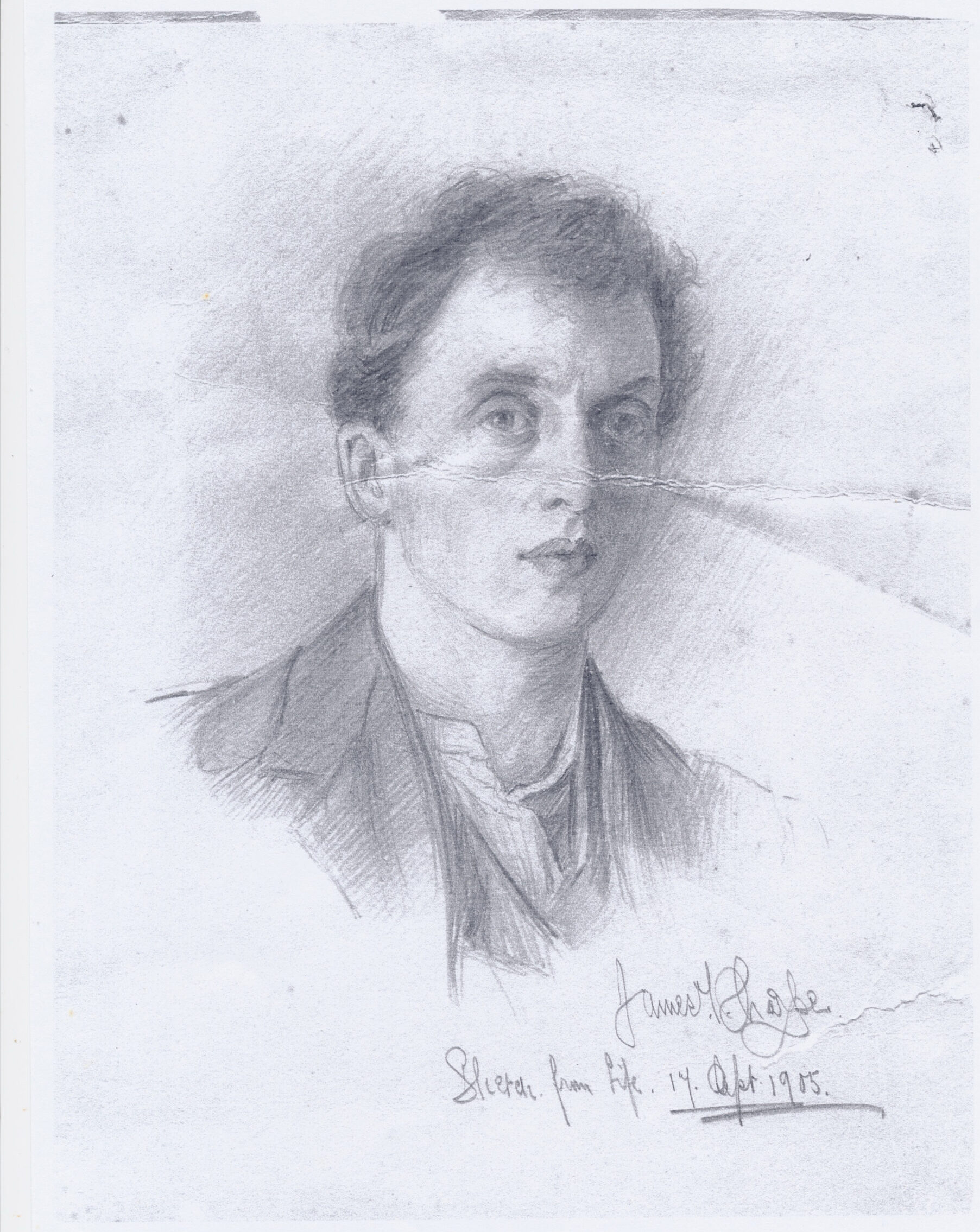
As I said earlier, how Batterflatts and its 4-1/2 acres became Maggie Linklater’s to bequeath I don’t know. Nor do I know why she decided to disinherit her own family and leave a legacy to the Church of Scotland instead — the house, and
four and a half acres of land plus thirty thousand pounds cash to be used for the benefit of the deaconesses of the said Church.
Rumour has it, however, that it was due to the misdemeanours of her only son, James Thomas Sharpe, Angus’s Dad and Heather’s Grandfather.
§
Angus wrote that if she passed any other benefits on to her children, they (the grandchildren) didn’t knew about them. In fact he wouldn’t have known about the legacy to the church were it not for a 1911 cutting in the Stirling Newspaper that was discovered by Douglas among old records found after their sister Maggie died and the house was being sold.
He said that when Margaret Linklater died in 1911, her husband James Grossart, apparently now a “Spirit Merchant”, wasn’t there to sign the death certificate — he may have been travelling at the time. Her son James, although by then living in South London, was present and signed instead. James Grossart lived another 17 years, and when he died, as I said earlier, was staying with his surviving daughter Mary and her husband George Christie, the Station Master.
§
But wait…
What I’ve been telling you is the family story, and now I’m not sure it’s true! Because Heather recently came across a website about a May 2017 exhibition regarding Batterflatts and its architect, John Allan, which states:
the Batterflats mansion, built for a member of the Drummond family, 1893-5, on Polmaise Road [shows] the incredible range of his design skills… In 1929, the house was bequeathed to the Church of Scotland as a residential home. In 1954 it was sold to Stirling Council for use as an old folk’s home, accommodating 30 people. In the 1980s it was converted to private housing, and the six acre site is now covered with a housing development.
The last sentence is doubtless true, and we agree about the construction date, but what about the rest of it?
Obviously, more digging into the records is necessary. One of us must be wrong, and if it’s the family story, as I suspect it is, we may also need to think again about the relationship between Margaret Linklater and her son, whether too much shade has been cast on the boy — and what it may all imply for the family’s wellbeing and prosperity at the time. Maybe I need to expunge the 1911 newspaper clipping that Angus discovered — which I’m sure I’ve seen somewhere — from my memory.
§
Angus met his Grandfather not long before he died. It was on the family’s Summer holiday in Scotland. “I recall being on the bank of the local stream at Lady Mary’s Walk, where brother Norman was standing in the water trying to fish, and Grandfather James Grossart came down wearing a funny wee Turkish style hat.” Angus says this was his earliest memory. “We were probably staying in a local hotel, as Uncle George and Aunt Mary Christie (Aunt Polly) couldn’t have accommodated our family of parents and seven children aged between eighteen and the youngest — me, age three.”

Lady Mary’s Walk is outside Crieff, where Douglas, too, described family holidays beside the River Earn and being “welcomed by Auntie Polly, Uncle George and Cousin Margaret”.
But wait a minute! — I want to ask them — didn’t Polly and George and Cousin Margaret, and, by then, Grandfather James Grossart too, all live 130 miles away in Wigtown? Did the London Sharpes holiday in South West Scotland too? Did they all holiday together? It would be nice to think that they did.
Like so often in these posts, as many questions as answers. Ask them while you’ve still got them.
Footnotes
- “Nervous Exhaustion consequent on Parturition Haematemosis as certified by John Drew M.D.”
↩︎