“…Suddenly there is a sound like heavy breathing, and ever so faintly about three musical notes waft from the loud-speaker and then fade.”
The attic workshop was used for many purposes apart from a steam producing, engine running area. The tools and machines were used for making lots of articles and models, and Sonny produced some very nice work over the years. I’m afraid I tended to make a lot of very useless stuff and had to make it out of range of my Dad, who did not approve of “wasting your talents” on some obscure object.
To be fair, he did show me the value of using tools in the correct manner. He once had me make, with a file and a hacksaw, a 3/4 inch mild steel cube out of 1-1/8 inch round steel, and the sides had to be flat, parallel and square. It took me a long time. I was only a small boy but I could use a file very well at the finish.

Dad didn’t give praise easily but I do believe he was genuinely impressed by the end result. My indulgences with my own rubbish did at least keep me occupied and allowed me to use tools for enjoyment as well as for necessity.
The workshop certainly functioned as a retreat for my father and me at the weekend, and regularly during Sunday afternoons or evenings my brother Angus would join us and we would sit by the fire (always on deck-chairs, presumably because they could be folded and stacked when not in use) and listen to a few chapters of whatever was the ongoing narrative at the time.
My father had a fascinating way of telling stories and was also an extremely good reader. His delivery had a sincerity about it that almost fooled you into believing that he, himself, was the author. He had a clever way of holding our attention, and every once in a while, at a critical moment in the story, would stop to fill and light his pipe (Tam- O’ Shanter tobacco, gone now-a-days) or replenish the fire. This always brought shouts of “Go on Daddy” from his audience. Although he had a Scots voice he would somehow manage to project the London personality of say, Sam Weller or the cunning of Mr. Jingle ( characters in Dicken’s Pickwick Papers) without basically altering his own accent or being at all theatrical about it.
In this manner we would be treated to most of Dicken’s novels, Scott’s Waverley novels and The Lady of the Lake, Kenneth Graeme’s The Wind in the Willows, Captain Scott’s Antarctic tragedy, Kipling’s The Jungle Books, R.L. Stevenson’s Treasure Island and Catriona, Rider Haggard’s She, Ayesha, King Solomon’s Mines and Allan Quartermain, Longfellow’s Hiawatha, and many, many more. Nearer to Christmas we would vote for A Christmas Carol — one of our special favourites, just short enough to be completed in one evening, and with Dicken’s graphic descriptions of fog and frost at Christmas time, just the thing to get the imagination stirring in time for the festivities. The opening of “Marley was dead to begin with” gave me an eerie feeling of anticipation since I loved tales about ghosts. Reading A Christmas Carol to myself is something that I still enjoy doing at every Christmastide, and it always transports me back to those grand old times by the fire in the workshop.
The readings were interspersed with stories of his own boyhood in Scotland and in particular, tales of childhood escapades in three homes, Manor Steps Farm, near Bridge of Allan, Stirling, Kennetpans, near Alloa, and Batterflats near the King’s Park, Stirling. School days at Stirling High School provided another source of entertainment when recounted in his own inimitable way.
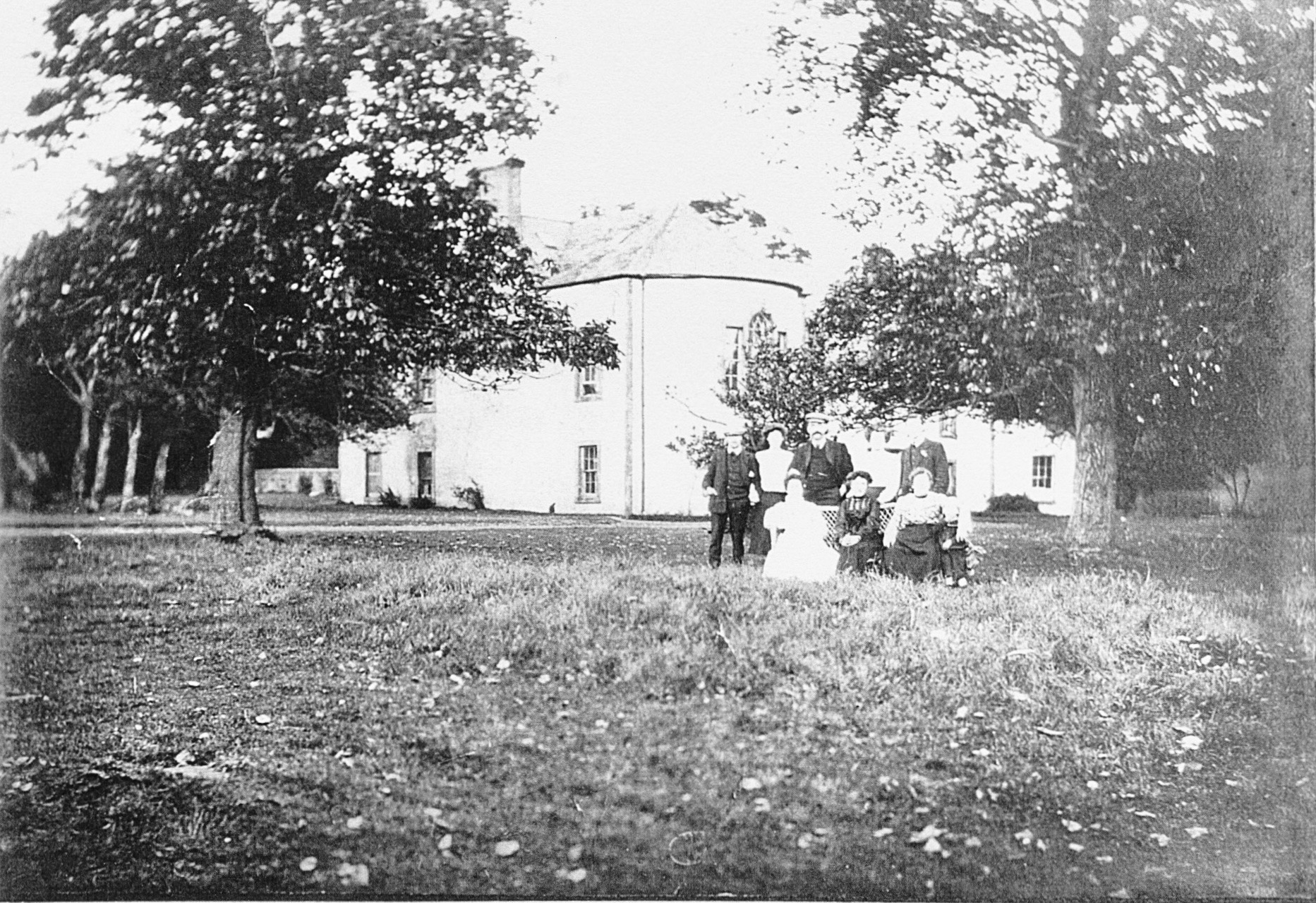

Other favourite anecdotes concerned his apprenticeship in Marine Engineering at D and W. Henderson’s shipyard at Meadowside on the Clyde near Glasgow. Hendersons had taken over the Meadowside yard from Tod and MacGregor in 1872 and were one of the yards instrumental in firmly establishing the Clyde as the world’s leading shipbuilding river. In my father’s day, to be an apprentice at a leading shipyard one’s family had to fork out a premium of £500, a lot of money in those days and it was a seven year stint. His tales of the fun and hard work they had at the yard, made me love the old riveters, plate-makers, boiler-makers, forge-masters and all the rest of the craftsman at the one-time builders of Anchor Liners and ships for the Japanese Nippon Usan Kaisha Line. His descriptions of machine-shops driven throughout by overhead shafting and belts (all unguarded), with power supplied by steam engines of great size, were brought to life by my father’s unique narrative skill. At the time of his apprenticeship there were still many famous yards like – William Denny and Bros. of Dumbarton, Alexander Stephen of Linthouse, Barclay Curle, Fairfield Shipbuilding, Beardmores, Browns, Yarrows, and Scotts of Greenock. Some of these yards were eventually “taken over” by the Royal Navy and contributed to a lot of specialised war tonnage. Just prior to the war in 1914 there were I believe, about thirty-eight yards on the Clyde between Glasgow and Greenock. A lot of them were casualties of the depression years between the two wars of 1914-1918 and 1939-1945, and so alas! the days when “Clyde- built” really conveyed a sense of marine perfection have long since gone and the proud ship-yards that once lined miles of the Clyde have become fading memories in the minds of the few old craftsmen left to reminisce. As an artist my father could, and did, embellish many a tale with glorious little sketches, which in a few deft strokes, suddenly enhanced one’s understanding to a remarkable degree.
§
He loved the old Highland beliefs and customs and once, when I had read a reference to the land of Tir-nan-Og I asked him about it and he explained it as follows:
There is a beautiful legend very dear to the Celtic heart, which foretells that at his last hour the Gael will find himself upon a Western shore, gazing towards the sinking sun burnishing the water. Swiftly and silently over the sea of gold will come to him a beautiful white galley. Without rudder, sail or oars, the vessel will be drawn in to the shore by the great longing that is in the heart of the beholder, to be borne over the sea by her to the mystic fairy-land of all desire, Tir-nan-Og, the Isle of Youth, The Land of the Ever Young. The Gaelic version of Paradise.
Let’s hope that both he and my mother got there.
§
At some time during the evening we would be summoned downstairs to the drawing-room, where usually, the evening would develop into the Sunday night sing-song. My father would be a major entertainer because we would request him, not for any reasons of self aggrandisement. He had a very good ear for music and could busk reasonably competently on the piano.
We would give vent to many Scots songs especially Jacobite songs like Sound the Pibroch, Will ye no’ come back again?, A wee birdie cam’, The Standard on the Braes o’ Mar, Bonnie Dundee. Others like The lea-rig, Flow gently sweet Afton, My love is like a red, red rose, Caller Herrin’, Ca’ the Yowes, March of the Cameron men, Battle of Stirling Bridge, Bonnie Mary of Argyle, Ho Ro My Nut-Brown Maiden, Ae Fond Kiss1 (one of the loveliest songs of parting) and songs from Gilbert and Sullivan operas, with The Yeomen of the Guard and The Gondoliers well to the fore. Old ballads like For All Eternity, Rosalie the Prairie Flower, The Nightingale of Lincoln’s Inn, The Midshipmite, Turn Ye to Me, The Road To Mandalay, Juanita and many old music-hall ditties like Gus Elen’s It’s A Great Big Shame, Knocked ‘Em In The Old Kent Road, To Brighton, Away Went Polly, Henery The Eighth2, If It Wasn’t For The ‘Ouses In Between3, By The Sad Sea Waves, and dozens more. We weren’t too bad when it came to hymns, although my mother usually took over the piano for those. I’m not for one moment suggesting that we were exactly up to Sound of Music standard, but we could all hold a tune and I have quite often seen people in the street outside, stop for a moment or two and listen — and I don’t suppose they would have bothered if the rendition had been all that terrible. Visitors too were always encouraged to render a song — I recollect a Major Harland who possessed a very fine baritone voice entertaining us on several evenings.
§
I’ve no idea what the neighbours thought about it all (maybe they sang along with us!) but they certainly never complained. Of course, there wasn’t any television, and wind-up gramophones simply couldn’t compete with healthily delivered live music.
We did have a wireless set, but by modern standards it was a most complicated piece of equipment to operate, and the results were pretty unpredictable to say the least. It had been bought as a natural progression from the crystal and cat’s whisker sets which proliferated in many homes at the dawn of broadcasting. (As a wee boy I can remember feeling vaguely sorry for all those indignant, whiskerless cats which I thought were running about). I believe it was called a “Blackadder” and it had valves which glowed like low-powered electric lamps, mounted on top of an ebonite control panel. There was a tuning knob and another labelled “Reaction”. God knows what that was really for but it would produce the most awful screeches from the loud-speaker if not set just right. There were numerous coils which plugged into sockets and there was a grid-bias battery of 9 volts with a little wander-plug which had to be moved to a different battery socket as the supply gradually became discharged. A glass accumulator type of cell of 2 volts for heating up the valve filaments required charging by the local wireless shop or garage once or twice a week, so everyone bought two of them and always left one on charge at the shop. The set also needed a high-tension battery of 120 volts which did, actually, last for a considerable period – just as well because it certainly wasn’t a cheap item. Wires and switches abounded everywhere to connect all the bits and pieces, and the whole conglomeration was joined to an aerial running the complete length of the garden, from the top of the house to tall lime trees, at the end of the garden, and suspended by little porcelain insulators. A good earth connection was essential and usually meant a lead being clipped permanently to the nearest water or gas pipe.
Listening-in was a pretty hit and miss event and the sounds (not necessarily intelligible) could be heard through either headphones or the loud-speaker. Of course things didn’t always work out quite as planned and sometimes, when everyone was gathered around the wonder of wireless ready to experience whatever thrills broadcasting had to offer, the event would degenerate into an hilarious affair – especially if an odd joker was in the party! Possibly something akin to the following:
The valves on the set already heated up and glowing, the accumulator fully charged and the grid-bias battery apparently biasing the grids. The Oracle in charge of the tuning knob gives a little twiddle or two, and suddenly the sound of what appears to be a dog-fight pours forth from the great black horn of the loud-speaker — one dog is obviously having a terrible time, or maybe it’s two dogs with uncontrollable diarrhoea! Just as suddenly, it all changes to two snakes heavily hissing at one another, or perhaps the dogs have found a lamp-post and have got uncontrollable incontinence!
“What on earth is that?” from the fringe of the party.
“I reckon that’s probably Oslo,” says he with his hand on the tuning knob.
1st joker: “Oslo, that’s a funny name for a dog”.
“Quiet, I think I’ve got Hilversum.”
2nd joker: “Sounds very painful, I just hope it’s not catching.”
At this point the loud-speaker sounds like a fire-work display, or possibly a grouse shooting exhibition.
Oracle on the tuner: “I think it needs a bit more grid-bias, (always a good excuse if not sure what to do) or maybe a trifle more reaction”. Absolutely fatal! and all noises resolve into a stag-in-rut simulation which rapidly becomesa plop-plop-plop with the odd raspberry thrown in (could be stag-on-toilet) and pronounced by the Oracle as “motorboating”.
“It’s quite critical you know. I’m looking for the Marconi station’s call sign. It’s 2L0”.
1st. Joker: “Hello, Hello, there you are – saves you twiddling with that knob.”
Suddenly there is a sound like heavy breathing, and ever so faintly about three musical notes waft from the loud-speaker and then fade.
2nd. joker. “Well, that was a very quick concert, I must say. I think I’d rather hear the dog-fight again.”
Oracle, pompously: “You don’t seem to appreciate that these broadcasts are coming to us through the air, without the use of wires. That’s why it’s called wireless“.
1st. joker: “I presume that you are joking of course, I’ve never seen so many wires on anything”.
After the “Blackadder” we progressed through various set-ups to a Lissen Skyscraper Four, which had all the bits and pieces housed in one wooden cabinet and I believe, used a screened-grid pre-amplifier stage, detector stage, intermediate amplifier and a pentode output stage. At any rate it was far more powerful and easier to use than the old set, although it still needed the various high-tension, grid-bias and 2 volt batteries. The Lissen was purchased as a kit and was assembled by my brother Norman. It was really a very good kit, well thought out and required no soldering. All the terminals were nutted and the complete chassis was housed, together with the loud-speaker (which by this time had assumed a much neater appearance), in a handsome wooden cabinet. The various stations were printed by name on the tuning panel and a pointer indicated each one as the tuning knob was turned — quite different from the old “Blackadder” system which used a tuning scale marked in degrees. Strange that modern transistor sets seem to have reverted to a numerical scale, albeit in kilo-hertz or mega-hertz markings. We could only receive medium and long wave transmissions, but with a nice long aerial such as we had, it was good fun to hear the stations from distant place proclaiming themselves, as the tuning knob was manipulated.
I became quite taken with the mysteries of crystal sets and one-valve receivers. My bedroom was rigged with aerials, tuning coils, condensers and batteries, which sometimes managed to produce a few anaemic syllables or notes through the headphones.
Actually, rapid progress was made with receiving sets and soon there were a lot of sets on the market with names that would become famous for many years – McMichael, Murphy, Cossor, Pye, Ekco, Bush, Marconi, HMV, etc. which quickly became an essential part of most households.
Mind you, there was the odd outpost of the Empire that took longer than most to get up to date. One such place was my uncle George’s house in Wemyss Bay in Scotland. I remember in 1939 when I was on holiday there (I would have been fifteen at the time), trying to listen to the Declaration of War in the company of my cousin, my aunt and uncle and my brother on a so-called “portable” wireless set. Oh, very droll!
The portable set consisted of two quite large wooden containers, hinged together along one edge. The lower box contained all the valves, tuning gear and the three batteries, 120 volt high-tension, 9 volt grid-bias and the usual glass accumulator. The top box, which in the receiving position would be opened at right-angles to the lower box, housed the loud speaker and frame aerial. The whole lot was very, very weighty and should have included a mobile crane in the purchase price! The complete contraption had to be turned about so as to present the frame aerial in the best position to receive the loudest signals. Naturally, such a move could end up with the loud-speaker facing the wall, sort of self-defeating in fact. However, during the period of trying to catch what Mr Chamberlain was announcing, someone remarked that the portable set did not seem to be very efficient. This prompted the rejoinder from my cousin, “It should be, you know, it’s a Beethoven!” (quite a well-known portable set manufacturer). I suppose I ought to have been impressed but at the time it did cross my mind that if old Beethoven had stuck to symphonies and not strained himself trying to listen to his portable wireless set, he probably wouldn’t have lost his hearing! Just a thought of course.
Footnotes
- Ae Fond Kiss
Watch on Youtube
Ae fond kiss and then we sever,
Ae fareweel, alas, forever!
Deep in heart-wrung tears I’ll pledge thee
Warring sighs and groans I’ll wage thee.
Who shall say that fortune grieves him
While the star of hope she leaves him
Me, nae cheerful twinkle lights me
Dark despair around benights me
I’ll ne’er blame my partial fancy
Nothing could resist my Nancy
But to see her, was to love her
Love but her and love for ever
Had we never loved sae kindly
Had we never loved sae blindly
Never met or never parted
We had ne’er been broken-hearted
Fare thee weel,thou first and fairest,
Fare thee weel, thou best and dearest.
Thine be ilka joy and treasure
Peace, enjoyment, love and pleasure
Ae fond kiss and then we sever
Ae fareweel, alas, forever
Deep in heart-wrung tears I’ll pledge thee
Warring sighs and groans I’ll wage thee.
— Robert Burns
↩︎ - Henery The Eight was a music hall favourite that became a hit for Herman’s Hermits in the 1960s, although all they did was sing the chorus three times!
↩︎ - If It Wasn’t For The ‘Ouses In Between
Watch on Youtube
If you saw my little backyard,”What a pretty spot” you’ld cry
It’s a picture on a sunny, summer day
Wiv the turnip-tops and cabbages wot people doesn’t buy
I makes it on a Sunday all look gay.
The neighbours finks I grow ’em and you’ld fancy you’re in Kent
Or at Epsom, if you gaze into the mews
It’s a wonder that the landlord doesn’t want to raise the rent
Because we’ve got such nobby, distant views.
Chorus. It really is a very, pretty garden
And Chingford to the eastward could be seen
Wiv a ladder and some glasses, you could see to Hackney Marshes
If it wasn’t for the houses in between.
Though the gas-works isn’t violets they improve the rural scene
And for mountains they would very nicely pass
There’s the mushrooms in the dust-hole with the cucumbers so green
It only wants a bit of hot-house glass
I wear this milk-man’s night-shirt and I sits outside all day
Like the plough-boy cove what’s mizzled o’er the lea
And when I goes indoors at night they dunno what to say
‘Cause my language gets as yokel as can be.
Chorus. It really is a very pretty garden
And the soap-works from the house-tops could be seen
If I got a rope and pulley, I’d enjoy the breeze more fully
If it wasn’t for the houses in between.
There’s a bunny shares his egg-box wiv a cross-eyed cock and hen
Though they ‘as got the pip and him the morf;
In a dog’s-house on the line-post there was pigeons nine or ten
Till someone took a brick and knocked it orf.
The dust-cart, though it seldom comes, is just like harvest-home
And we mean to rig a dairy up,somehow,
Put the donkey in the wash-house wiv some imitation ‘orns
For we’re teaching him to moo just like a cow.
Chorus. It really is a very pretty garden
And Hendon to the westwerd could be seen
And by clinging to the chimbley, you could see across to Wembley
If it wasn’t for the houses in between
— Gus Elen, music hall singer and comedian. ↩︎