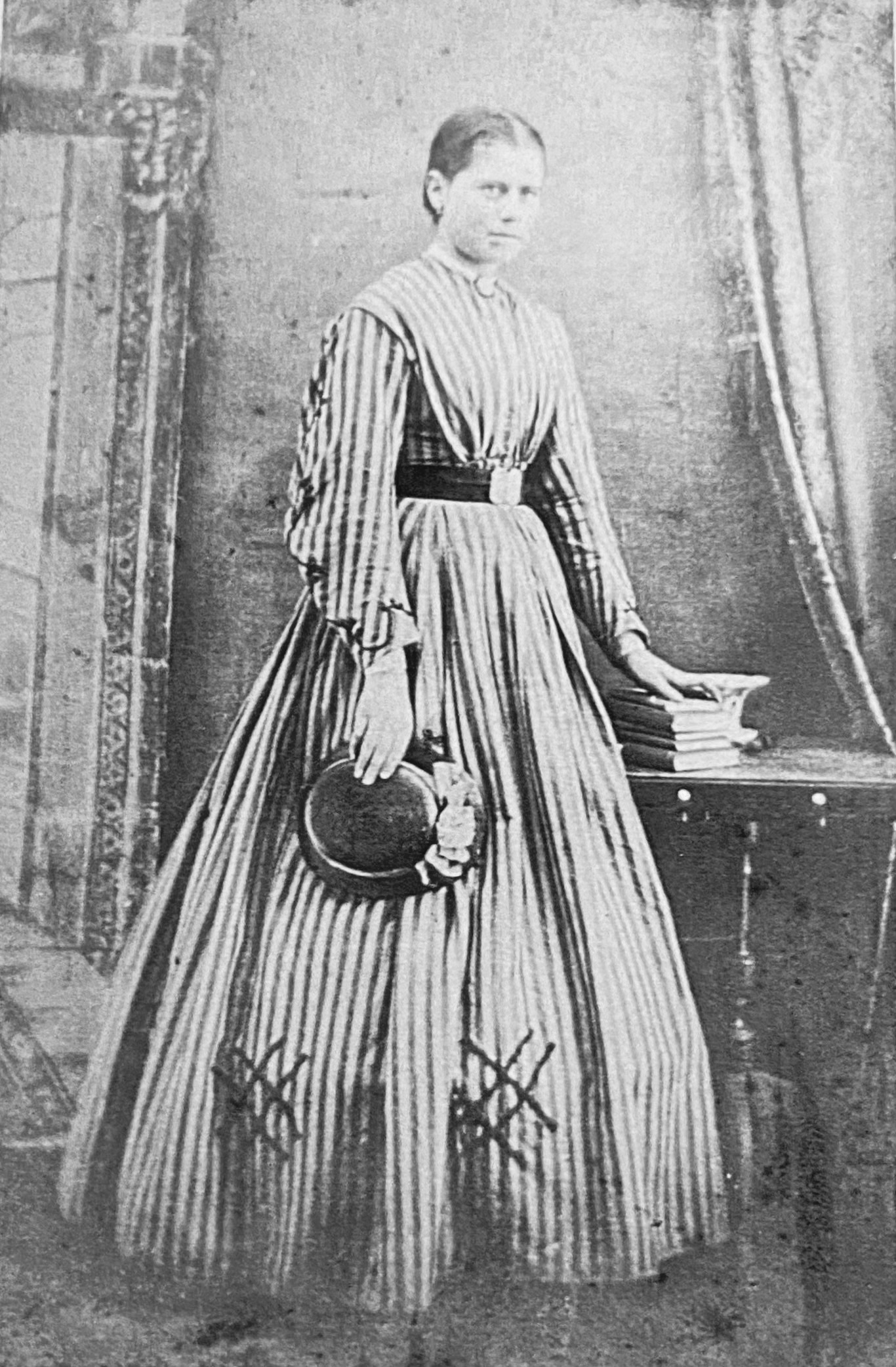
I started out as a rank amateur researching family history, and I certainly don’t claim to be an expert now — but what quickly becomes clear is how dependent we are on the public record when it comes to families with whom we no longer have a close connection, or perhaps never had more than a glancing one.
On Heather’s side of the family the Seymours and Ricketts rarely pop into view except through the public record, which is why I wanted to start with those two families, move on to the Gartmanns, and only then face up to the Sharpes, because otherwise they risk being overwhelmed!
Fortunately in the case of the Ricketts, and more so the Gartmanns, there are a few family stories and photos to add colour to the record. Beyond that, I suppose, the upside is that in their absence there’s more room for our imagination! I hope I haven’t exercised my own too much.~ Ian
§
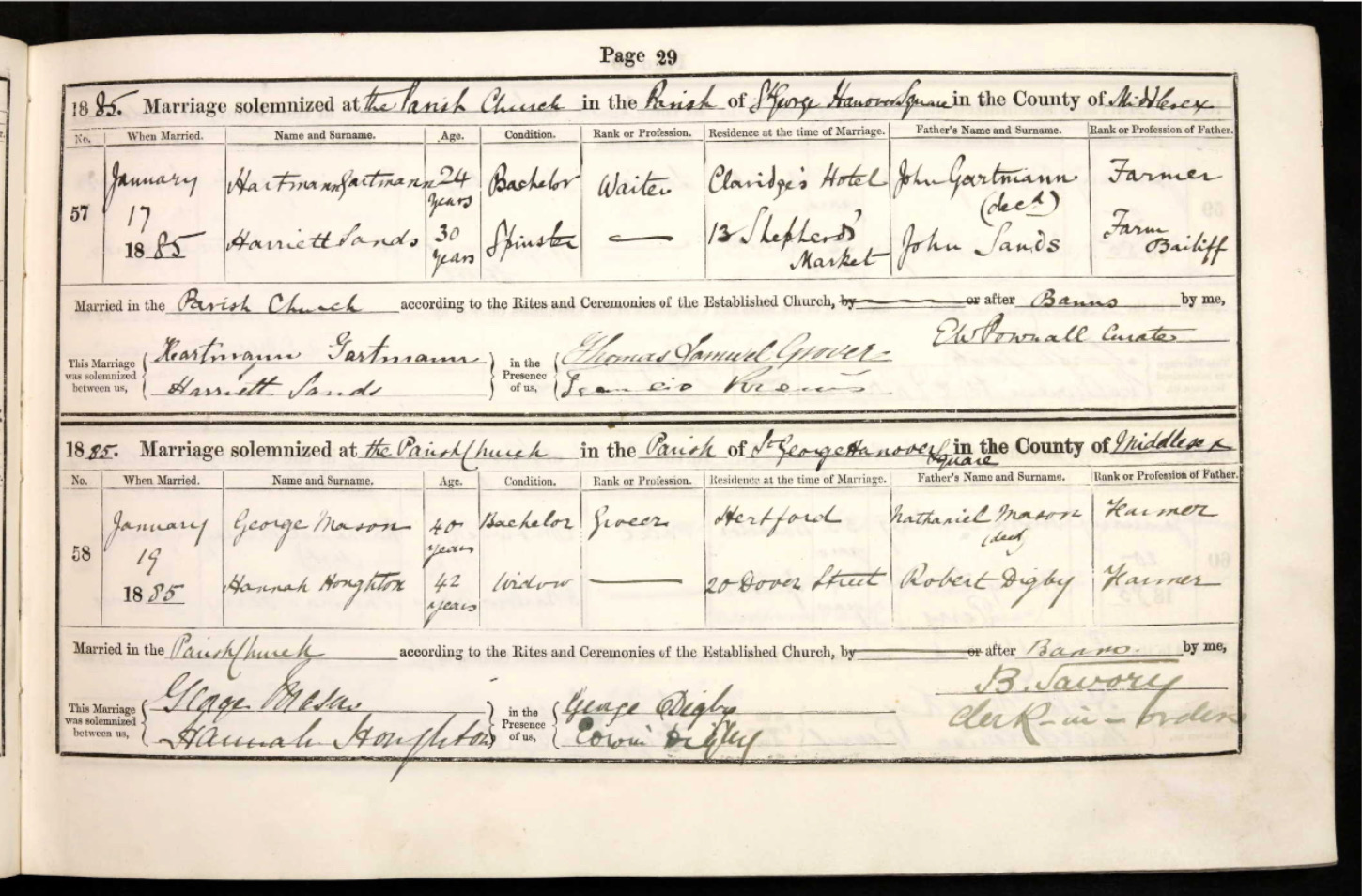
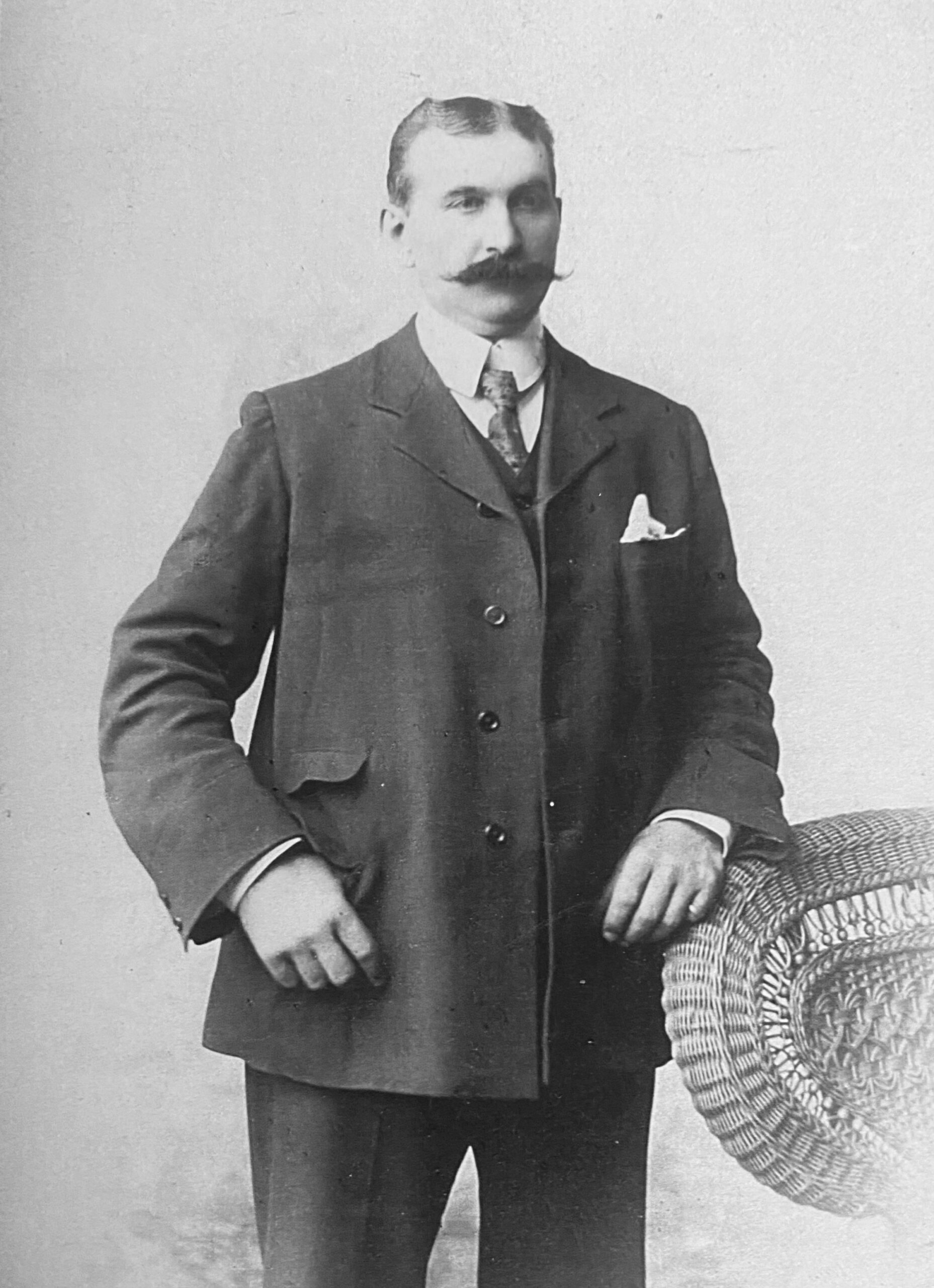
Maybe the best time to introduce this side of the family is 17th January 1885, when Hartmann Gartmann1, 24, married Harriet Sands in the Parish Church of St George’s, Hanover Square. Hartmann was a Swiss national working as a waiter at Claridges, the story being that people were being recruited from the continent because of the shortage of kitchen and wait staff. Hartmann’s father, John Hartmann, was a farmer, presumably back in Switzerland, but in any case by then deceased.
Harriet, 30, was about six years older than Hartmann and described as a spinster, that old fashioned word, living at 13 Shepherd’s Market, now a genteel shopping precinct. Harriet’s father was a man called John Sands, described as a farm bailiff. Farm bailiffs were generally responsible for ensuring that tenant farmers worked their farms well and kept their rent up to date — but farm managers, not farm owners.
§
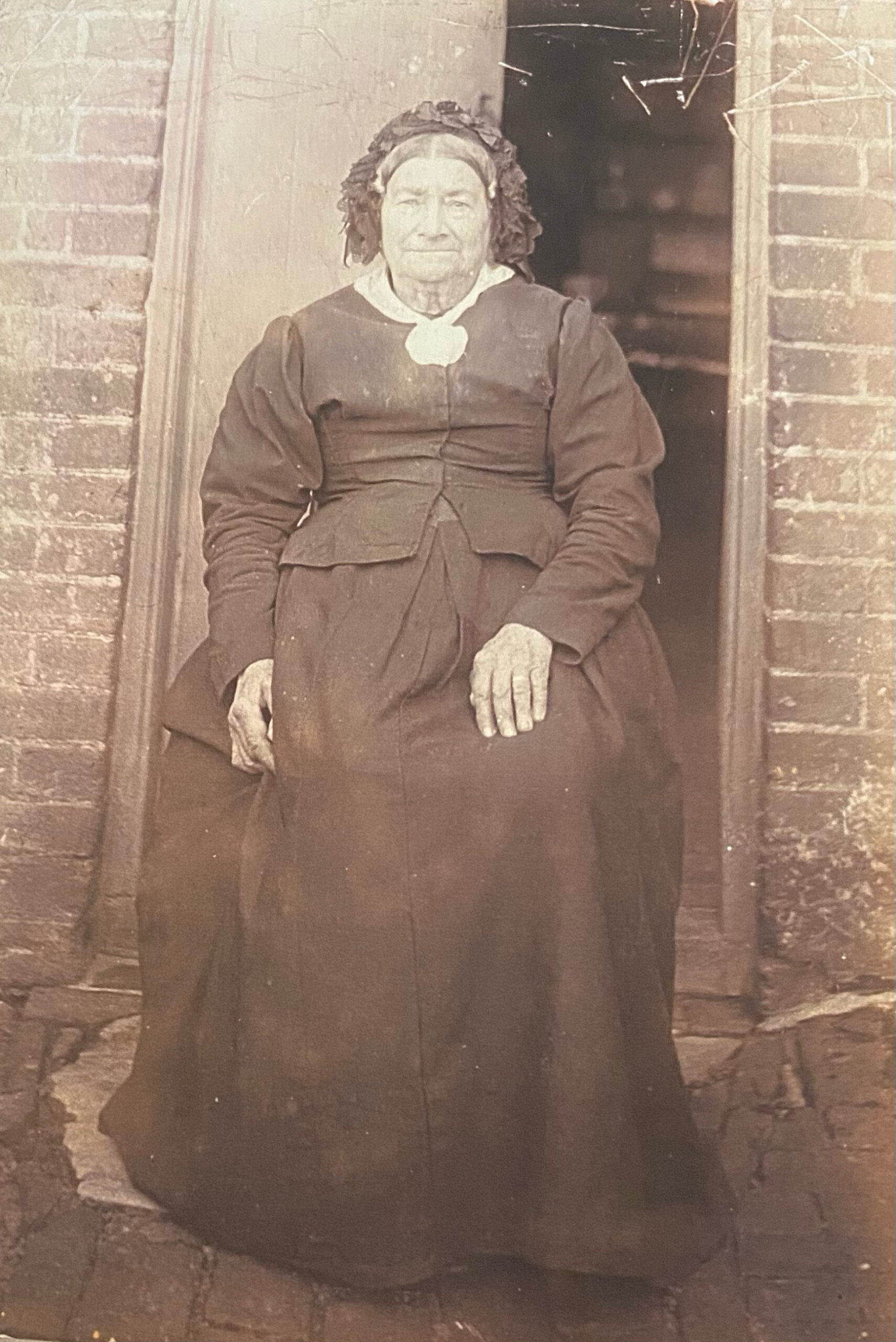
If you’re like me you’re already trying to colour in the picture. Who owned the properties John Sands was managing? According to Sharpe family lore, it could have been the Sands family, maybe Mr Sands himself, maybe his wife — the woman the Sharpes called Great-Grannie Sands.
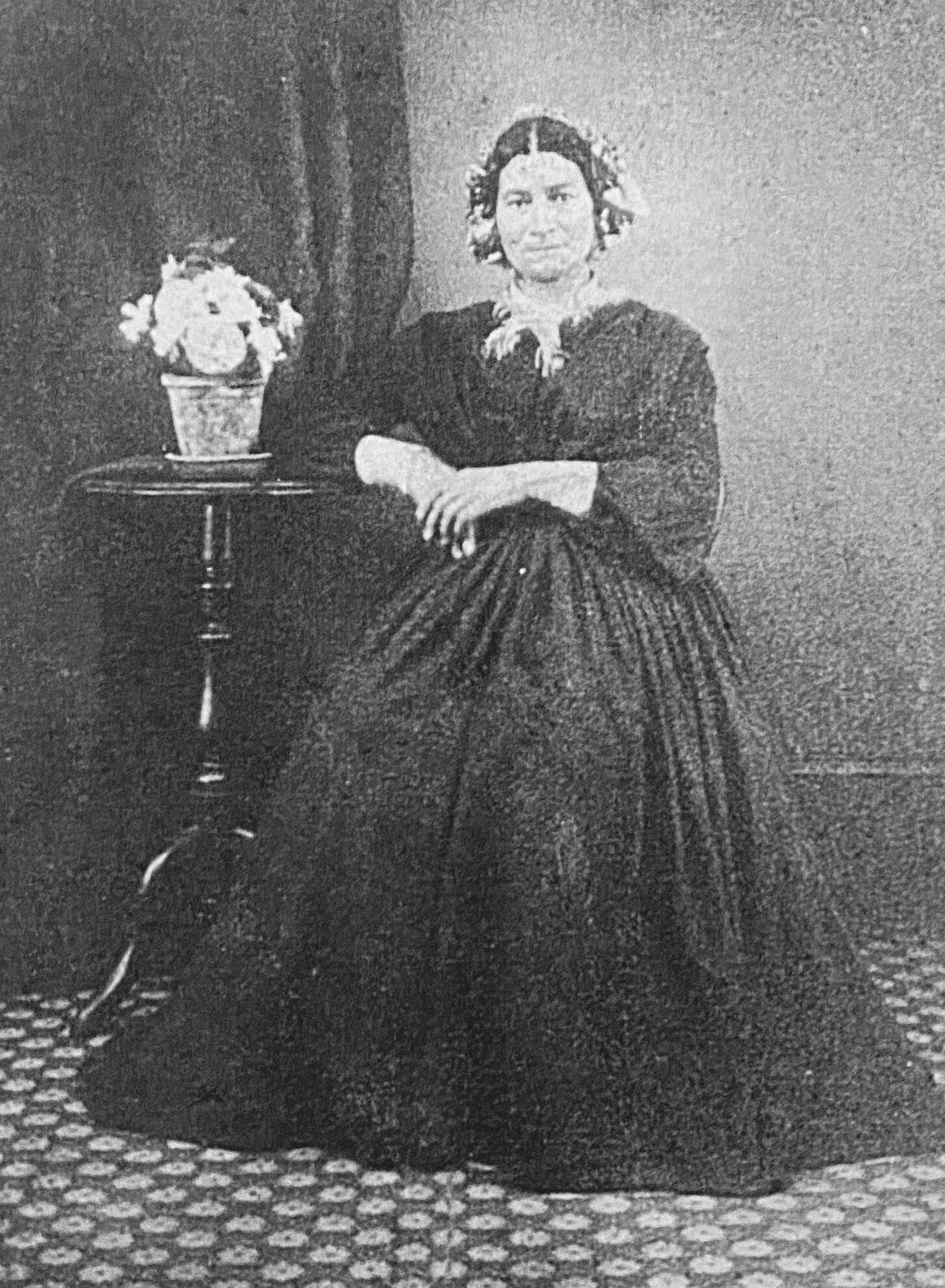
For once, ancestry.com is mute. The old woman sitting in front of a brick building, brick path or alleyway, puddled concrete step — dressed in full-length black dress and buttoned-up long sleeved jacket, work-hardened face and hands — doesn’t even have a name yet.
Ironically, for her husband John I have a name but no photograph, and, except for Harriet’s marriage registration, not a single mention of either of her parents in the official record.
§
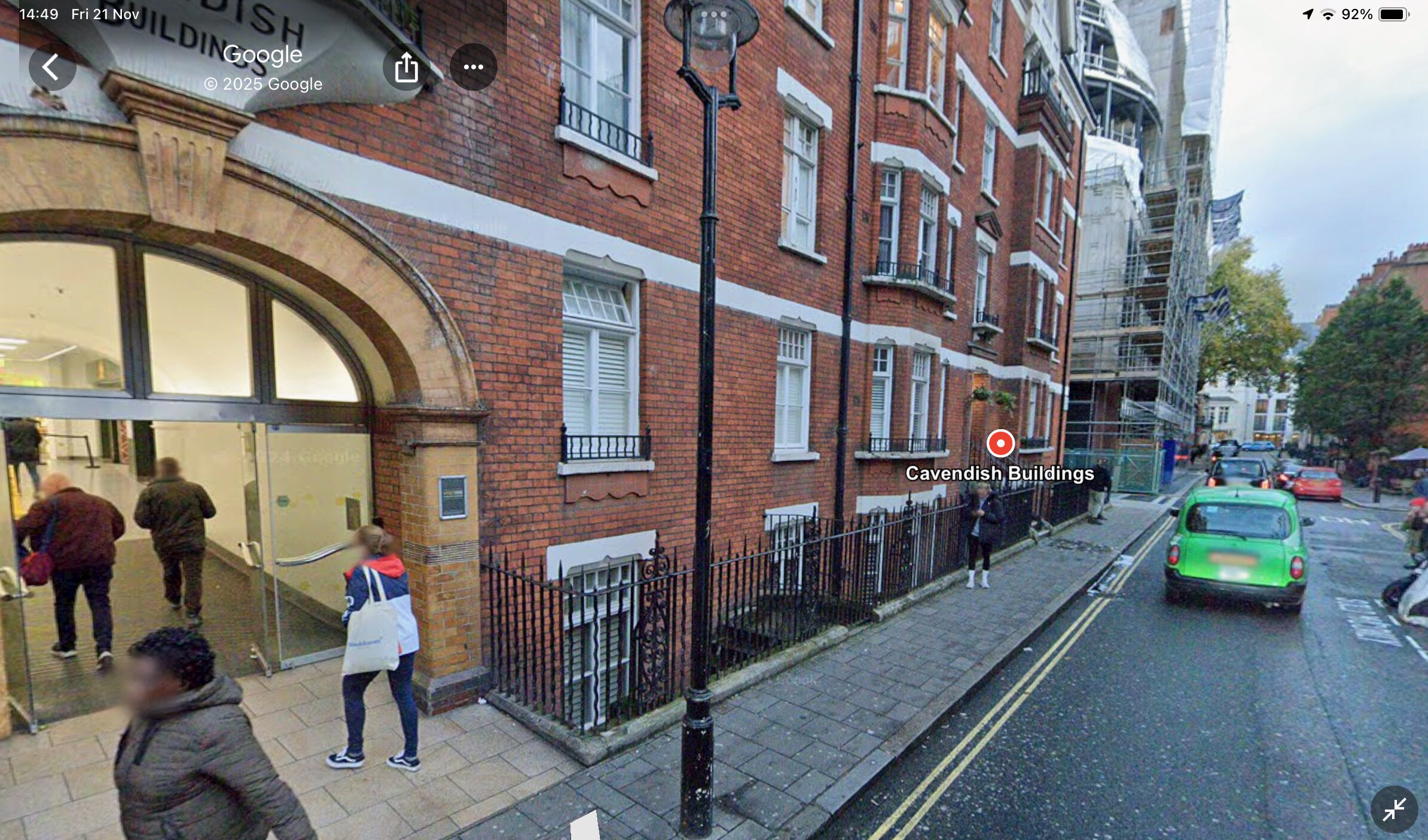
The next record I found was the christening of Hartmann and Harriett’s two daughters. This was on 16 December 1888, at St Thomas Parish Church, Portman Square, a ten minute walk away from where they were (probably) living at the time, a flat in the Cavendish Buildings, which is a large apartment block still extant on Gilbert St, London.
I say “probably” because Hartmann had been living-in at Claridges when they married, and he’d presumably have needed to move somewhere new with his bride. They were certainly living in the Cavendish Buildings three years later, for the 1891 census.
Although the two girls were christened together in December 1888, the record shows that Amelia was born a year earlier, on 2 December 1887, and her sister Emmeline 2-1/2 years before that, on 10th May 1885 — suggesting Harriet was a few months pregnant when she and Hartmann married. In the christening record Hartmann is again described as a waiter.
It was their younger daughter, Amelia, Heather’s maternal grandmother, who entered the Sharpe family when she married James Thomas Sharpe in 1911.
§
As well as confirming Hartmann and Harriett’s residence in the Cavendish Buildings on Gilbert St, the 1891 census records Hartmann as a 31 year old Swiss hotel waiter and Harriett a 37 year old Englishwoman born in Worthing, Sussex — no clue as to what what she was doing before they married or how they met. Emmeline was 6, Amelia 3, and they had a boarder, a “milk carrier”.
Ten years later, for the 1901 census, they were still in the Cavendish Buildings. Hartmann was 40, a hotel waiter, Harriett was 48, Emmeline 15, Amelia 12, and they still had a boarder, this time a draper’s assistant.
So the data varies a bit, but the records in 1891 and 1901 both indicate that Hartmann was born about 1860 and Harriett about 1854.
§
In that 1911 census record, Hartmann Gartmann was a 50 year old “Head Hall Porter” and Harriett, 62, had “Boarding House” down as her occupation. That entry had been crossed out, but three male boarders, all in their 20s, all “tailors”, suggest that the house was fairly large, and that running a boarding house may indeed be what she was doing. Of the girls, Emmeline (25) was “assisting at home” while Amelia (23) was a shorthand typist.
§
§
By 1911 they’d moved, and were living at 8 Burton Rd, Brixton. Gilbert Street is to the north of the city centre, whereas Brixton is about 5 miles away and to the south of the Thames.
For those times, that move might have been quite significant. Brixton had begun to develop rapidly in the second half of the 19th century, with the development of infrastructure like the Vauxhall Bridge across the Thames, sewerage and rail services, and the containment of the Effra river. It had grown then as a vibrant middle class suburb, which is what the Gartmanns may have experienced, but It trended working class over the 20th century, and bombing in the Second World War, urban decay and slum clearance all helped change its nature. Its population is now largely from the Caribbean.
The Western end of Burton Road, between Brixton and Knatchbull Roads, appears to have been re-designed, and is no longer a continuous length. The area around No. 8 has been completely demolished and replaced with industrial buildings. However, if you move across to the next parallel street, Loughborough Road, you find quite nice looking brick row houses with narrow frontages but four storeys. Small frontages but no back garden.
But — did you notice that Harriet was now twelve years older than her husband, not six? That could be shrugged off as a simple error on their part, or the person recording the data (yes, I did double check the scanned documents), but the next census, on the 19th June 1921, says the same. Normally held in April, it had been delayed by industrial action. They were still living at 8 Burton Rd, Brixton, and Hartmann was now a 61 year old Hall Porter whose wife Harriett was now 72yrs 6 mths! In other words, although Hartmann was born in 1860 — no change there — Harriett had in fact entered the world in about 1849, not 1854.
The twelve-year age difference is confirmed on their death certificates. Hartmann’s death at age 63 in Q2 1924 (April-June) implies he was born in 1861, but Harriet’s, aged 88 in Q2 1937, implies 1849.
So — what’s going on there? Your guess is as good as mine.
§
The 1921 census is also curious because in the house that night, together with her parents and her sister (Emmeline, 35, single, living at home and assisting in housework), there were Amelia (33-1/2 years old) and her 41 year old husband, James Thomas Sharpe. Presumably they were just visiting, as they’d been married for a few years by then and had four children, who weren’t listed amongst the occupants. There were no boarders either.
§
There are ten year intervals between those census snapshots, and nothing much to fill them with but more questions.
They continue to describe Hartmann in more or less the same way, as a waiter, porter, hall porter or some such, but, as we’ll see, the family story told about him is quite different.
And how did his daughter Amelia meet James, the bright but rather wayward Scotsman from a posh family — who’d done an apprenticeship in marine engineering on the Clyde, then gone to art school in Glasgow, then moved to London and set up as a commercial artist? Amelia had been training as a shorthand typist, so perhaps the commercial artist met her in an office somewhere?
Angus thought they married in 1908-9, when James would have been about 30 and Amelia maybe 20. But that contradicts the April 1911 census, which has Amelia a single woman living at home with her parents. One assumes they married not long after that as their first son was born the following June. Either way, how well established in business was James by then?
Then, Hartmann’s death in 1924, aged only 63, left Emmeline and her mother alone. How did they cope, with Harriett already in her mid-70s? Is that when they moved into the Sharpe household with Amelia and her husband?
1924 was about the time that Douglas and Angus were born — James and Amelia’s sixth and seventh kids. The two little boys shared a bedroom on the top floor of what Douglas described as “an old Victorian semi-detached in south London, which served as our family home when I was a wee boy”.
Harriett and Emmeline were part of the big, bustling household that Douglas and Angus describe. Harriett was the boys’ grandmother, known as Grannie Sands — “very deaf” and “all bombazine and lace” — and Emmeline was their maiden aunt, whom the family called Topsy.
§
So you could say James got three for the price of one when he married Amelia. And they moved into what was, by every account, a happy family. Douglas, the sixth born, wrote rhapsodic descriptions of his parents, of the charmed childhood they gave their kids and the busy household their mother presided over.
Angus was just as fulsome:
My dear mother was without doubt the strength in the household with her amazing ability to cook and feed nine people every day, and often 13 mouths sat around the dining table when grandparents were alive or when aunts arrived to stay. Then washing and ironing for everyone (we always had clean clothes), making curtains, loose covers on the dining suites, making clothes for the girls and carrying bags of shopping for miles when funds were being saved for holidays… A wonderful lady and sadly missed by us all. They don’t make them like her any more.
§
How Hartmann Gartmann features in Sharpe family stories raises still more questions. Angus wrote — for the benefit of his “ever inquisitive” children and grandchildren2 — that his grandfather Hartmann had married Harriett Sands, the daughter of Thomas Sands, a prosperous Sussex farmer, that the Sands had several small farms in Sussex County, and that Hartmann “drank himself to death at the Sands expense” — meaning that only one farm was left to their “Uncle Wilfred”, who was presumably Harriett’s brother.
You’d imagine it would take a truly dedicated drinker to consume the worth of “several small farms”, especially if, as the censuses seem to say, Hartmann went on working as a waiter/porter in Brixton and played no apparent role in their management, or mismanagement.
But in a photo album that Angus also left behind he included a few pages of text with a rather different story — that after the birth of his daughters Hartmann “went into the Liquor trade, and is reputed to have been the landlord of the coaching house ‘The Swan’ at Stockwell”. The Swan, on the corner of Clapham and Stockwell Roads, is still extant, and only a few minutes away from where the Gartmanns lived at 8 Burton Road.
I was told that he borrowed much money from his mother-in-law, that of seven small farmlets she owned, there was only one fifteen acre block left when she died before 1939, which she left to a nephew, and where brother Douglas (18 months my senior) and I spent a pleasant ten days prior to going to Scotland for an extended holiday at the end of August. That was really sad, as on Sunday morning the 3rd of September the nation was put on a war footing.
So was Hartmann a drinker? An unsuccessful businessman? Or maybe both?
Angus’s photo album does help clear up one confusion. Hartmann’s mother-in-law, John Sand’s wife, wasn’t the woman that he and the Sharpes called Grannie Sands — that was Harriet, John’s daughter — but the so far nameless Great-Grannie Sands. Which begs more questions: Why did Great-Grannie Sands commit so much of her family’s wealth to her son-in-law? And why was it hers to lend and bequeath, rather than her husband’s? Did he die first and leave it to her? Or did the farms come from her side of the family, and John Sands, the farm bailiff, just “marry into money”?
There are lots of unanswered questions to stumble over in the fog. For now all that’s certain is that, as Angus remembers:
The last farm was Rickards Farm, where Douglas and I enjoyed a brief holiday in 1939 before WW2 was declared.
§
If you have feedback, corrections, photos, or can help fill in the gaps on these family pages, please email or let me know in the comments — thanks!
I probably haven’t been consistent, but by and large I’ve called the women by their “maiden” names — e.g. Amelia Gartmann, not Amelia Sharpe.
Footnotes
- , Whether Hartmann’s names are spelt with two “n”s or one seems to depend on either the form filler’s whim or his own.
↩︎ - At the behest of “tenacious” Heather and Murray (his niece and nephew), Angus wrote a 7,000 word document for his “ever inquisitive” children and grandchildren, with the benefit also of stories told by his father and brother, and with “some input” from his sisters, Maggie, Dorothy and Kath. Unlike his brother Douglas’s account, it covers not just their childhood, but the wider family, and includes brief histories of his brothers and sisters in later life, as well as their offspring.
↩︎