
Heather’s Mum Joyce loved her mother-in-law Amelia — was in awe of her, I think. She called her “Mrs Sharpe” when she talked about her, never Nana, and never “Mum”, which is what I called Joyce.
But Mr Sharpe was an enigma — an expressionless, stony face staring back at me from two photos, that’s it. He was in many ways a remarkable man. But where did he come from, and what made him tick?
What was his family like, and what about their family before that? Who were these people who put him through a marine engineering apprenticeship, and then supported him when he blithely sidestepped into arts? Were they well off? And if so, how did they make their money? As we used to say, how did they earn a crust?
Family history is easy today compared with even 20 years ago, when Heather got to know the helpful archivist in the Stirling library. People drew family trees by hand that I can barely conceive how to lay out now. But it’s still a tedious business, and it’s hard, as I’ve found out — and said too often — to add flesh to the dry bones of names and dates. But you have to try.
§
Forebears
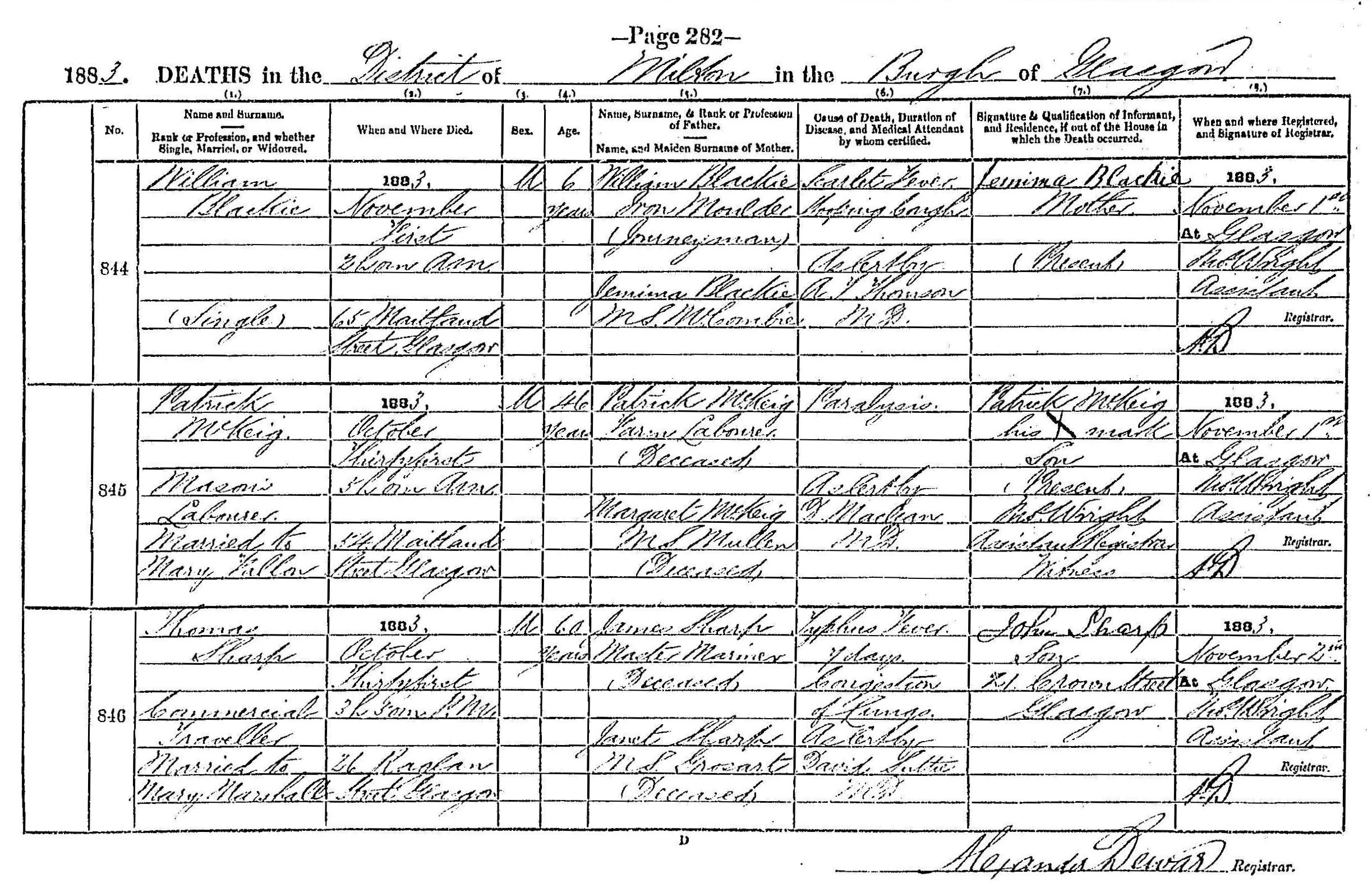
The first useful document I came across was the death certificate of a Thomas Sharp who died on 31 October 1883. Thomas was Heather’s grandfather’s grandfather. He died aged 60 of typhus and congestion of the lungs, an old fashioned way to die. But what’s handy about the death certificate is that it tells us he was married to a Mary Marshall, that his father was James Sharp, a master mariner, and that his mother’s maiden name was Janet Grosart. Which is enough information to take us back to the 18th Century.

James — James the elder that is, Thomas’s father, the master mariner — was born about 1793, and his wife Janet Grossart a few years later. Both were dead by the time Thomas died.
And if we decide to play the “begat” game for another generation we come to John Sharp, James’s father, who was born in Cults, Fife, a country area North East of Edinburgh, in 1750. He married his wife Agnes Mitchell in 1783 in Polmont, which is a village between Glasgow and Edinburgh, near the Firth of Forth.
And John’s father, wouldn’t you know it, is another James Sharp who was born in 1720 and married Isobel Dall. And his father — and trust me, this is as far as I’m going — was another James. Whom he married I don’t yet know.
That lineage, to be clear, is just a series of best guesses from ancestry.com, but the names and dates are consistent, and they seem to have lived and died within a tight geographical area. All of which convinces me that Heather and Uncle Angus are right — that the Sharpes certainly have a decent claim to Scots ancestry. But whether to Rob Roy MacGregor remains to be seen.
By the way, the Sharp name was always recorded without the “e” until, I think, the mysterious James Thomas changed his name to “Sharpe”.
§
James Sharp (1788-1867) and Janet Grosart (1795-1876)
Heather’s great-great-great-grandparents (so you can keep up!)
But apart from the names, places and dates, what do we know so far about these people? Strictly speaking, only that Thomas’s death certificate described him as a commercial traveller, and his father, James, as a master mariner — which given where he lived, on the Firth of Forth, wouldn’t be surprising.
The Firth of Forth is a major fiord, or estuary, on the south east coast of Scotland — where the Forth and other rivers flow into the sea. Fishing villages had existed on both the northern and southern banks since medieval times, and ferries operated between them. In the 18th and 19th Century a string of little ports like Bo’ness and Alloa operated on it, and the river was navigable all the way to Stirling. The Forth and Clyde Canal opened in 1790 and linked Edinburgh on the east coast to Glasgow and the Clyde on the west. Grangemouth — where James Sharp and Janet Grosart lived — remains one of the UK’s major container ports, but smaller ports like Alloa — where Angus’s parents lived for a while at a property called Kennetpans — became uncompetitive, and the canal itself fell into disuse as ships became too big to use it.
The 1851 census describes James (1788-1867) as born in Polmont, the village outside Grangemouth where his parents married, if you remember. He’d married Janet Grosart in October 1819, and in ’51 they were living on Grange St in Grangemouth. The Grosart family may have been involved in business — at least there was a “James Grosart and Sons, Cartage Contractors”, in the General Directory. That particular James is likely to be Janet’s brother. Between 1820 and 1842 James and Janet produced ten children, and In 1851 three of the seven girls were still living at home, Janet 22, Catherine 13 and Mary 9.
Ten years later James was recorded as a supernumerary tide waiter, which I assumed was a typo until I read somewhere that it meant he was a temporary or part time customs compliance officer, probably a good job now that he was 68 — but again, with a link to the marine industry. Catherine and their youngest son (also called James!) were both in the house, at least for the night, and so was a granddaughter.
By then their second son Thomas had six children of his own, aged between two and thirteen. He’ll be the next link in our story, but meanwhile his dad James died of “old age” on the 4th of December 1867, aged about 79, and Janet followed him in 1876. James’s death certificate introduces us to his parents, John Sharp and Agnes Mitchell, born in the 1750s — but besides acknowledging them, let’s not go there. I’m sure you’re grateful.
§
Thomas Sharp (1822-1883) and Mary Armour Marshall (1826-)
Heather’s great-great-grandparents

For most of their lives Thomas Sharp (1822-1883) and Mary Marshall (born 1826) lived in Glasgow, on Possil Road, where an aqueduct carried the Forth and Clyde Canal over the road. They were only 30-odd miles from where Thomas’s parents had lived in Grangemouth.
Back in the 1851 census, Thomas, a young man with three little boys, had been described as a “senior storekeeper”. By 1861 he’d been elevated to “book and store keeper”, presumably indicating an accounts function. But then I wonder if he goes out on his own, because in 1871 he’s recorded (apparent typos aside) as a commercial traveller in ship’s chandlery. In 1881 he’s still a commercial traveler, still in the same residence, with two of the kids, Thomas and Margaret, still at home, and a boarder in her early 20s, Elizabeth Hamilton, who’s been with the family for at least ten years.
§
Thomas is the first person for whom we can colour in some personal details.
“Thomas had an Aunt Nell at Mollinburn, Annathill, where he often spent school holidays,” we’re told. Aunt Nell was presumably his mother’s younger sister Helen. Mollinburn Road runs through the little village of Annathill between Glasgow and Falkirk. “He saw the old stage coaches Carl o’ Mar and Auld Defence before the rail came.” Which makes sense as the passenger rail network between Glasgow and Edinburgh didn’t start operating until Thomas was in his late 20s. “Carriers told stories by the fire place”, so it appears his aunt had an inn or small hotel.
“Thomas was a saddler by trade but worked at a warehouse as a storeman, doing private leatherwork at home.” Again, this is consistent with the census data, and it left Heather emotional when she first read it with her Uncle Angus. She felt the connection in her bones. “I’ve always thought about leather,” she says.
Finally we’re told that Thomas left the warehouse in 1873 “to seek a better living down by the Broomielaw,” And he was “dead against slavery of the Negroes.” The American Abolitionist movement and Civil War would have been major political stories in Thomas’s adult life.
§
I’m imagining Thomas as an enterprising man whom Heather and I could relate to. What did it mean that he was a commercial traveller in ship’s chandlery? I don’t know. Was it an indication that he was building his own business? I don’t know — but it reminds me that I was a commercial traveller in wedding albums, and that’s what we were doing. And if he was building a business, what was it? I don’t know that either, but again this is version 1.0, and I hope I can find out.
Whatever the truth of all that, the Broomielaw was certainly the place to be if you wanted to be part of the shipping action. The Broomielaw was a street that ran alongside the first commercial quay to be built in Glasgow — 80 years previously, when the Forth to Clyde Canal was coming into operation — and it was a hive of activity in the 1870s. There were shipbuilding operations large and small along the Clyde, including D&W Henderson on the far bank, where Heather’s grandfather would be an apprentice as a kid. If you want a sense of it, go to the amazing Glasgow History site, run by a man called Chris Jones (I’ve just told you everything I know about him). His page on the Broomielaw has masses of photos. I chose this one because it’s from 1876, when Thomas would have been involved, and you can see the quay and the boats extending into the distance, and the masses of people awaiting their trip to the Clyde resorts.
