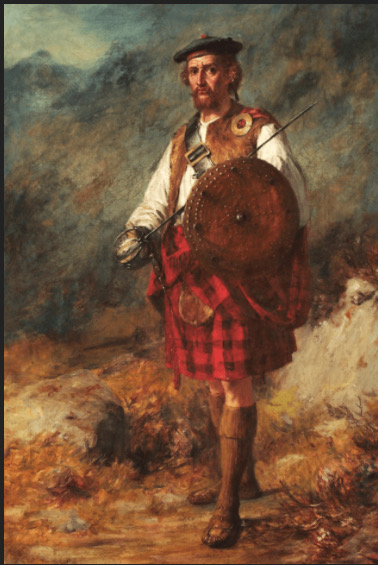
The Sharpes are Scots who trace their lineage, and certainly their familial loyalties, back to Rob Roy and Clan MacGregor.
Rob Roy is one of those romanticised figures like Robin Hood, Jesses James, Billy the Kid, Ned Kelly and so on who live outside the law, maybe do some good for the downtrodden along the way, and become folk heroes.
But Rob Roy was a latecomer to the MacGregor — or Clan Gregor — story. By his time the entire clan had been outlawed for decades, even though the clan’s motto, “My blood is royal”, reflected its claim to royal descent from the old Scottish kings.
Scottish history had been one of feudal conflict between the various clans, and in the 16th century the MacGregors were big losers, to the Campbells in particular, resulting in ongoing disputes, the loss of their lands and their gradual retreat into the highlands. When Clan Colquhoun was granted a royal commission to suppress them, the murder of two MacGregor men instigated a major battle between the two clans at Glen Fruin in 1603. It ended in devastating defeat for the Colquhouns and the death of over 200 of their men. What followed in 1604 was the hanging of Clan Chief Alasdair MacGregor with eleven other clan leaders, and prohibition of the very names ‘Gregor’ and ‘MacGregor’ under pain of death. The clan was scattered, often taking other names to avoid persecution, and they were “hunted like animals and flushed out of the heather by bloodhounds”. Survival depended on concealment in the mountains and glens of the central Highlands. Despite this savage treatment, the MacGregors fought for the king in the Scottish Civil Wars (1639-1652) and as a result, the prohibition against the MacGregors was eventually lifted, at least for a while.
§
Robert MacGregor (1671-1734) first came into conflict with the powers that be when he and his father fought for the Jacobites in opposition to the 1688 Glorious Revolution in England. This had seen the Catholic King James II and his court forced into exile due to Protestant concern that a Catholic dynasty was being imposed on England by the Stuart family dynasty.1
When the Jacobites were eventually defeated, Robert’s father Duncan was imprisoned for two years, but Robert became a respected cattleman for a while — albeit under a different set of rules to today’s — but when he defaulted on his loans he was declared an outlaw and fled. Unfortunately his main creditor was the Loyalist Duke of Montrose, and according to the Sharpe family story, the Duke’s men evicted his family, burned down his house and raped his wife, inflaming his rebellion. If that’s the case, the rape isn’t mentioned in Wikipedia, and it’s possible that these tales have been coloured by later romanticising. But leaving aside what may have happened to Mary, either the Duke was diddled by Rob Roy, or Rob Roy was diddled by his chief herdsman (who apparently ran off with the money) or they were both diddled by that man. It’s certainly claimed by some that Rob Roy had no intention of repaying the Duke.
The alternative argument is that the Loyalist Duke’s actions were simply payback for Robert’s support of the Stuart dynasty. But it does seem to have been at least partly driven by more personal animosity, as Robert was specifically excluded from the 1717 general pardon of the Jacobites, and the Clan MacGregor and its tartan were again for a time prohibited, forcing Robert to go by his mother’s name, Campbell, for a while2.
In a sense all this hardly matters. Like modern politics, you pick a side and tell the stories that support it.
§
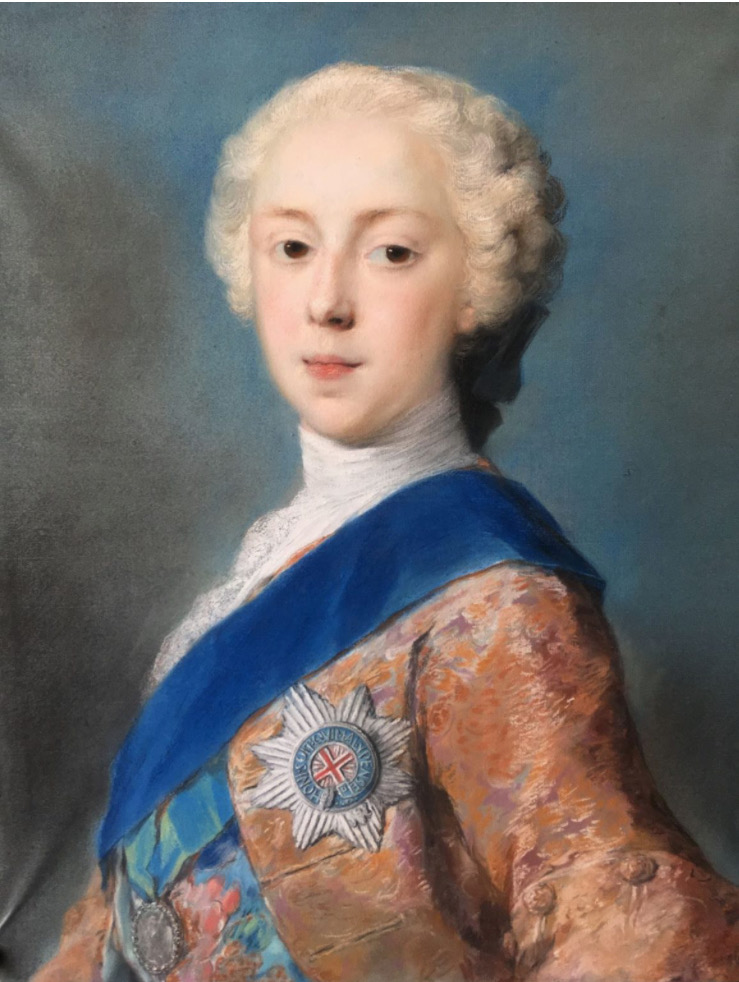
The Jacobite resistance was particularly strong in Ireland, the Western Scottish Highlands, Perthshire and Aberdeenshire, so it made sense that when “Bonnie Prince Charlie”, James II’s grandson, attempted to reclaim the throne for the Stuarts almost sixty years later — long after Robert’s death — he landed his force in Scotland. But that second Jacobite adventure, after some initial success, failed like the first.
One consequence was that the prohibition of the MacGregors was reimposed by the new protestant King, William of Orange, and lasted for another 91 years.
As I said, it hardly matters what you think of all these wars and prosecutions. What does matter is that the Sharpes knew which side they were on. Their family story comes with this frisson of rebellious resistance associated with the MacGregor history, and the embrace of noble defeat that attaches to the Bonnie Prince.
§
The Sharpe family story, as it has come down to Heather, is that Rob Roy had four wives, and that, given the average family size of the time, it’s quite likely a fair percentage of the population could be his progeny — so the Sharpe’s claim to be his descendants isn’t unreasonable! In fact it seems that Robert had just one wife, Mary, who bore him four sons, James Mor MacGregor, Ranald, Coll and Robert (Robìn Òig or Young Rob). If there were any girls they weren’t mentioned.
It became the Sharpe custom to name the first son born in a family James MacGregor, as Heather’s brother is named, as was his father before him.
But how do you translate these myths and stories into real people who lived and died?
If there are links to Rob Roy, the proofs seem to have been lost in the midst of time. At least in our branch of the family, active curiosity goes back only as far as Heather’s great-grandfather, James Grossart Sharpe, and his wife Margaret Linklater. There are relatively few public records easily accessible and they’re not very informative. The most useful I came across is the 1883 death certificate of one Thomas Sharp, James Grossarts’ father, and that makes a good starting point for this story.
§
Balquhidder
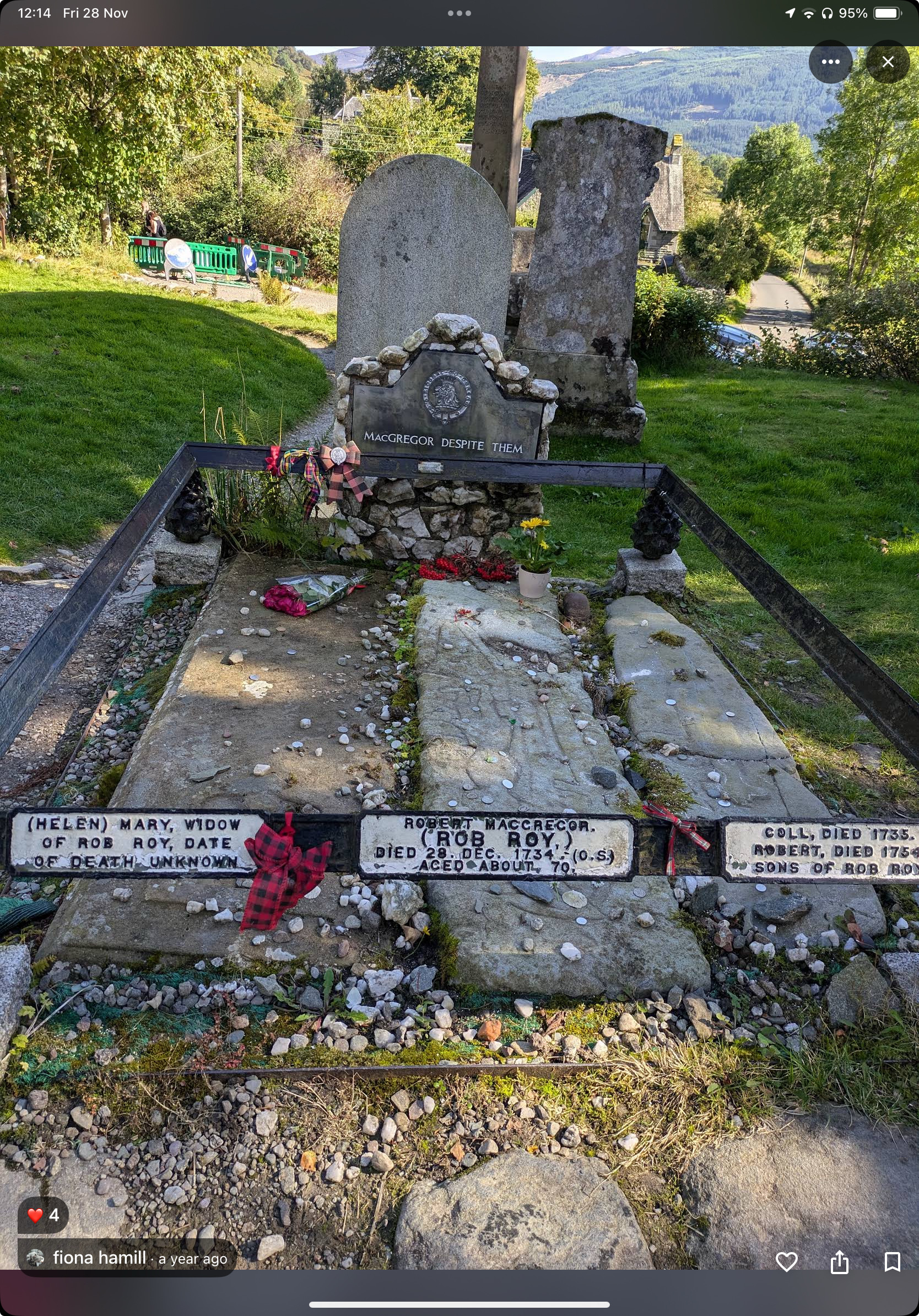
Heather, Angus and I spent a few days in Scotland in 2009, visiting Edinburgh and old Sharpe haunts, like Batterflatts, in and around Stirling. We then headed North West along narrow roads into what seemed fairly remote country to visit Rob Roy’s grave at Balquhidder. The place names in Douglas’s story of family holidays in Scotland came alive on the map as we drove — St Fillans, Lochearnhead, Crieff and the River Earn. After the several monuments we’d seen to William Wallace, we were a little surprised to find just a simple family grave with the remains of Robert MacGregor, his wife Mary and two of their sons in an old church yard, with a view over the Glen below.
We had the place to ourselves.
Footnotes
- Beyond the immediate political issues, what was at stake was the relationship between the throne and parliament, and the place of Catholicism in British society and government. The result was to definitively establish the primacy of parliament over the crown, and it wasn’t until the 1800s that Catholics were able to hold civil or military office, or seats in Parliament.
↩︎ - It’s interesting that that Robert’s wife Mary was one of the Campbells, their chief adversaries in the 16th Century.
↩︎