James (Sonny)
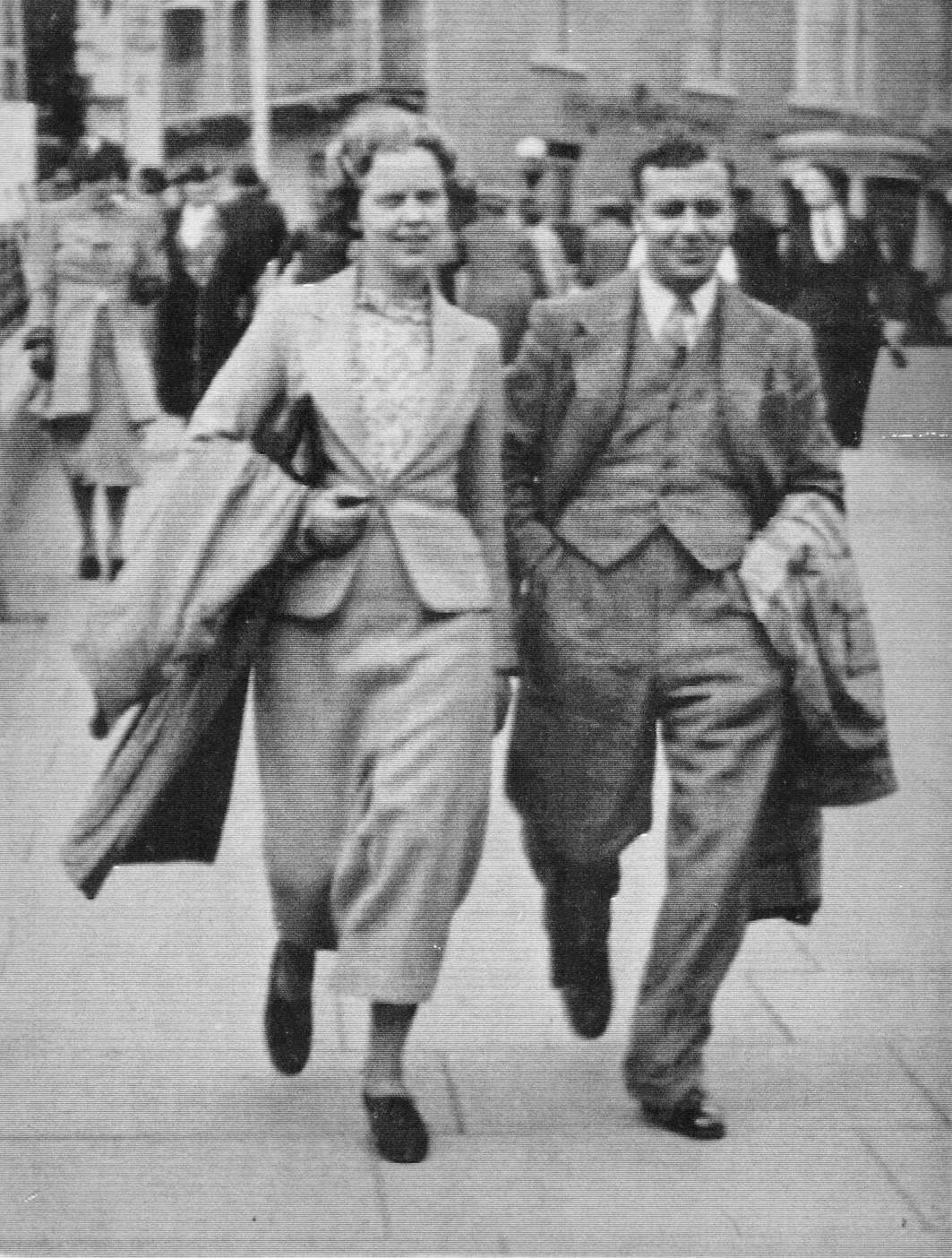
Sonny, the oldest of James and Amelia’s children, was twenty-seven at the outbreak of the war. He’d married Joyce in 1937. Their son Jim was born in October 1944 with Heather following in September 1947.
Angus and Douglas were full of praise for their brother’s artistic talents — “he was a superb sculptor and modeller, with a marvellous artistic bent“1 — but Sonny was the entrepreneurial type at heart. He acquired a grocery business in Sanderstead, an old village area south of Croydon — the southern extremity of the London metropolitan area. This was very handy to Purley, where his brother Norman lived before the war, and where their parents and two of their sisters were living at its outbreak.
After Angus was demobilised he went to work for Sonny, and to begin with business was good.
“Heather was just born and things were going well,” Angus writes, “when for some reason Sonny decided to sell up and buy another place in the Balham markets”. This was much closer to the centre of the city, south of the Thames. His specialty was coffee roasting, six blends in all — “but after about one year things were not going so well”.
Angus left when Sonny — “deciding that he could not continue” — quit the shop, and, as Angus writes, “in the interests of Joyce and the two children took up an engineering job in Canada, where they were happy for some time.” Canada would have looked promising to someone like Sonny, as it had developed a thriving aviation industry after the war, and also played a major role in wartime production and training, including firearms and munitions. Angus himself had done much of his wartime training in Manitoba.
Sonny had presumably worked as an engineer during the war, and he certainly had no trouble getting work in Canada. He’d majored in sculpture at the Regent Street Polytechnic, an institution that had — for a hundred years or so, and through various guises — offered classes across a range of science, engineering, art, technical and trade fields, as well as in emerging professional and commercial disciplines. The Polytechnic eventually became part of what is now the University of Westminster, and it sounds to me like it was just the ticket for a boy from this family of art and engineering enthusiasts.
Joyce and the kids sailed on the Clyde-built Empress of France in 1953, Sonny having gone ahead of them to look for work. Their original destination was Edmonton, Alberta, one of the major wartime aviation centres, but the story goes that on the Atlantic crossing, Sonny, having been talked out of the cold hell of Edmonton by a Canadian passenger, decided he should head for the cold of Montréal instead. Montréal, along with Toronto, being other major aviation and industrial hubs.
The family ended up living in the village of Stanbridge East in the English-speaking Eastern Townships area of Québéc, near the American border. Sonny would spend the week in Montréal and come home for weekends. It must have been miserable for Joyce, the Londoner, alone in the back of beyond, with no friends, two little kids harassing her, and dependent — as she was all her life, since she didn’t drive — on public transport and what my mother used to call Shanks’s Pony. The kids haven’t forgotten Stanbridge East, even though they moved soon enough to Toronto — just as cold in Winter, but at least in the familiarity of a bustling city life.
In Toronto they lived near Angus and his family in Port Credit and other nearby lakeside suburbs. Heather remembers her Dad working for Canadian Arsenals Ltd, a government-owned corporation that seems to have done a lot of work that might have suited someone with his talents, from developing prototypes to maintaining and modifying existing tools and equipment. It’s possible he worked for the same organisation at Longueuil in Montréal.
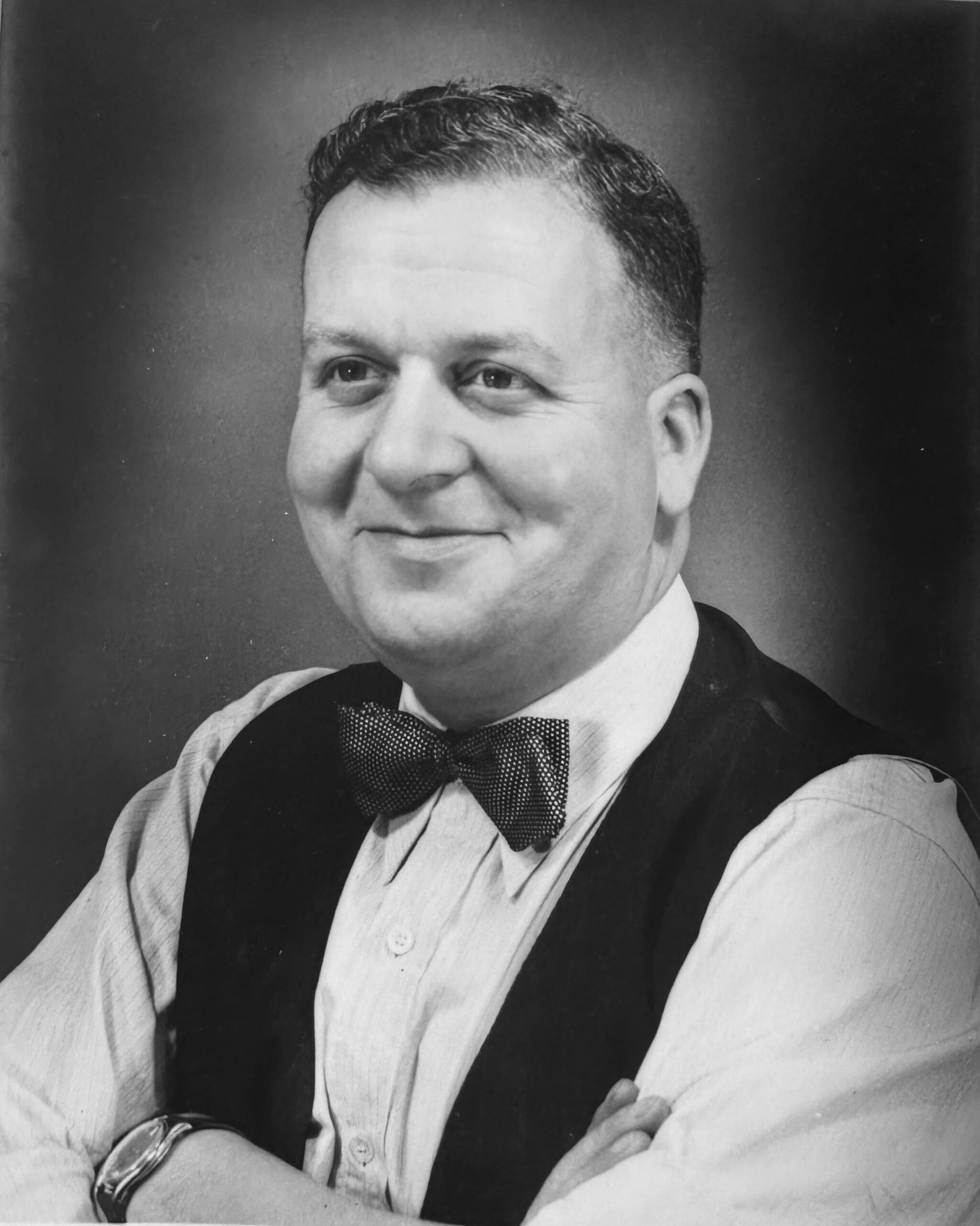
I’ll leave the rest for Heather to tell, but Angus wraps up Sonny’s story briefly. He and Joyce:
were able to give Jimmy and Heather a good education, and a great way of life for youngsters. Sadly Sonny had a heart attack whilst working for his family and died at age 49 years. Joyce, Jimmy and Heather then decided to move to New Zealand, as I and my family were scheduled to in the same year. They were very happy with the move, although Canada always draws one’s heart strings.
§
Norman
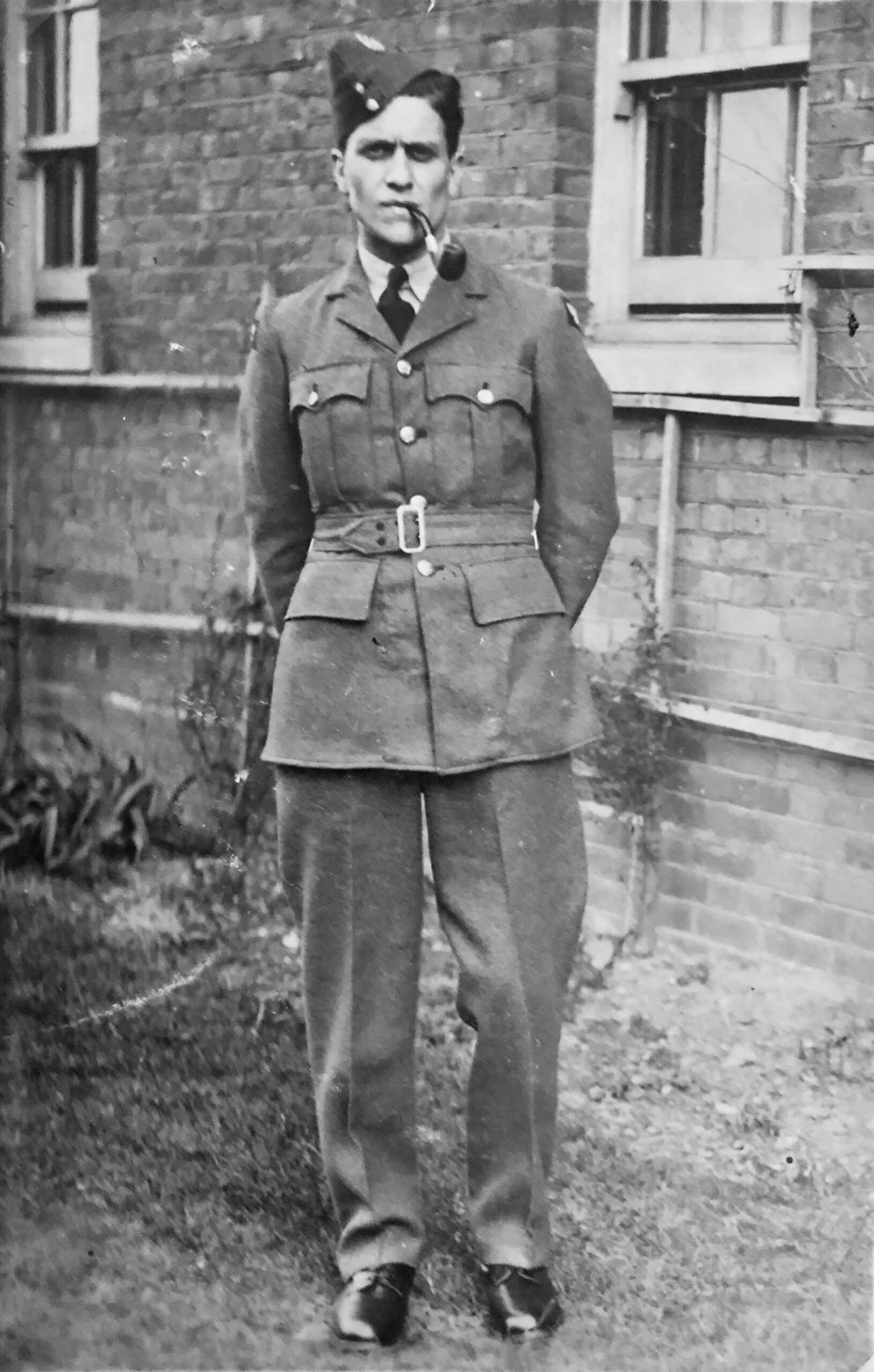
Norman was born in 1915 and enrolled in the military early in the war. There’s a photo of him in uniform in 1940, looking too young to be smoking a pipe. Dorothy used it as the basis for a sketch. Like Angus, Norman trained as a Bomb-aimer, although Maggie’s son Duncan reckons he also had his Navigator’s Wing. Like Angus his final rank was Flight Sergeant.
According to Douglas he was easily the best looking of the Sharpe boys, dark and olive skinned, and, even when little, brave almost to the point of foolhardiness, with artistic and practical abilities that were often hidden by an outgoing, fun-loving, generous approach to life. “His rather risque, outrageous sense of humour could send Mamma into fits of laughter like none of the rest of us could do.”
In 1937 he married a nurse, Olive Goodall, with whom he had a daughter called Jennifer. Before enlisting he was living in Purley and working with a partner in a building and painting business — shades of Angus’s description of Norman’s “clever wallpapering and decorating, immaculate work at terrific speed.”
At the outbreak of war Norman’s wife Olive was living-in at a hospital in Epsom and Ewell, about 10 miles west of 68 Purley Downs Road. In another reflection of the Sharpes’ nomadic life, this is where James and Amelia were living at the outbreak of the war, along with Dorothy, Margaret (recently married) and someone else who was younger and unnamed in the records. According to the previous year’s electoral rolls, Norman had been living there in ’38, but with Olive’s parents, the Goodalls, and a couple of Olive’s mother’s female relatives. By October ‘39 the Goodalls had moved to the relative safety of Sevenoaks in Kent and were living with Olive’s grandparents-in-law.
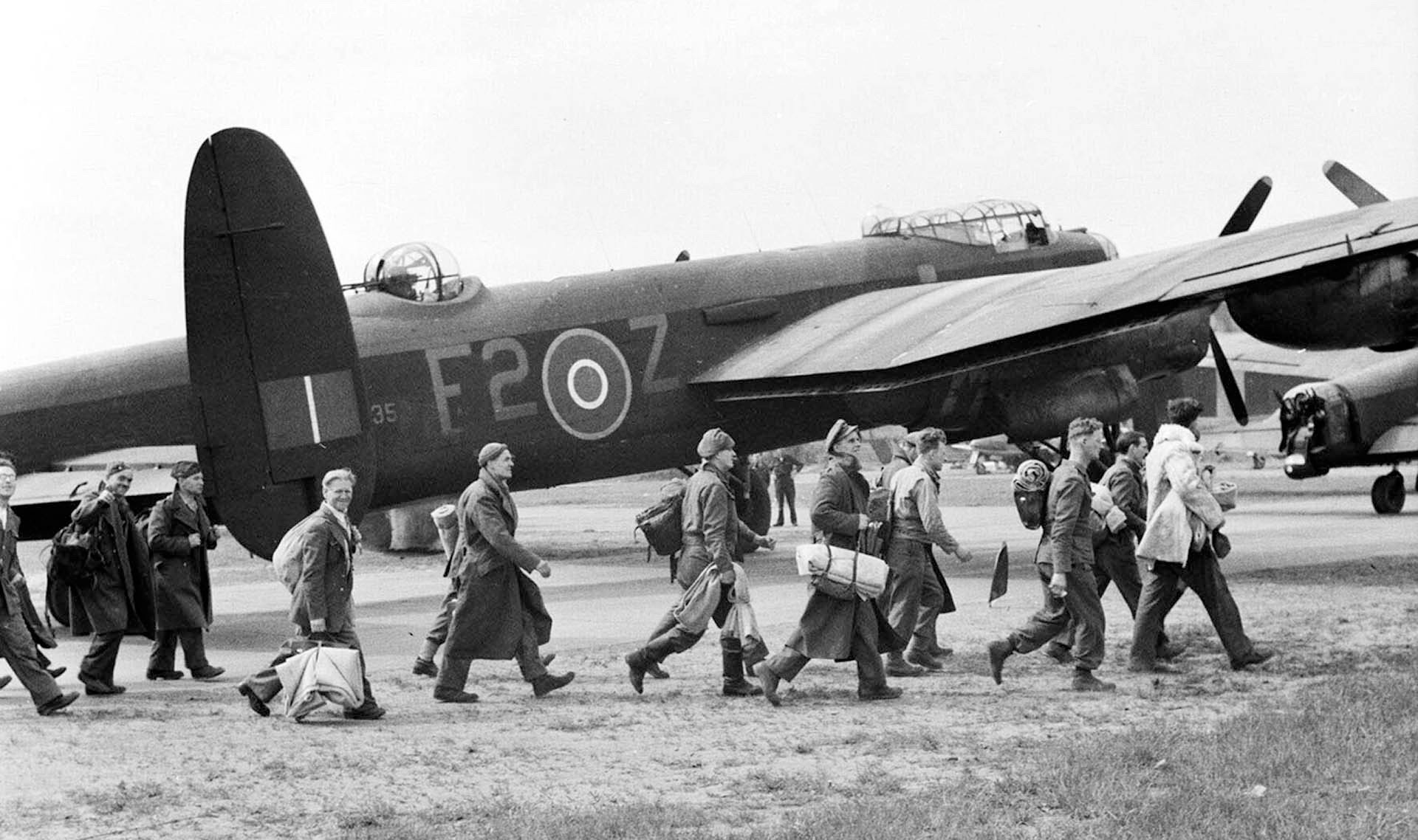
Duncan understands that in the early part of the war Norman was in the Middle East, possibly seeing service in Bristol Blenheims. He ended it flying in Lancaster heavy bombers, which didn’t enter service until 1942 and by war’s end had largely supplanted the Halifaxes in which Angus flew.
Norman was killed along with the rest of his crew when their Lancaster was shot down during what must have been a massive raid on a synthetic oil plant in Poland in February 1945. They were killed just a month after joining 630 Squadron at East Kirkby, in Lincolnshire, on their third operation with the squadron. Norman was the oldest crew member on their aircraft ND554, which had moved back and forth between 617 and 630 Squadrons, and was at one time known as Conquering Cleo.
Their plane, Lancaster ND554 LE-A, took off at 1649 hours on the afternoon of 8 February 1945 to join a force of 475 Lancasters and seven Mosquitos heading for the refinery at Pölitz, near Stettin in Poland. 630 Squadron’s Lancasters were in the first wave, the LE-A signifying that ND554 was the lead aircraft. It’s believed their Lancaster was intercepted by a night-fighter flown by Oblt. Rudolf Mangelsdorf. It was shot down at 2203 hours, one of 12 Lancasters lost in a highly successful raid that halted fuel production at Pölitz for the remainder of the war.2
The men’s bodies were not recovered after the war. All are remembered on the Runnymede Memorial, where Norman’s name can be found on panel 096.
Unfortunately the Sharpes seem to have lost contact with Olive and her daughter. The Goodall and Brew families both appear on ancestry.com, and I can see that Olive died in 1958, only 40 years old. But I don’t know when Olive and Norman’s daughter Jennifer was born, although the fact that Olive was still living in the nurses’ quarters in October 1939 suggests that it was some time during the war itself. Alternatively she may have been the unidentified minor living with the Sharpes at Purley Road back then.
§
Margaret (Maggie)
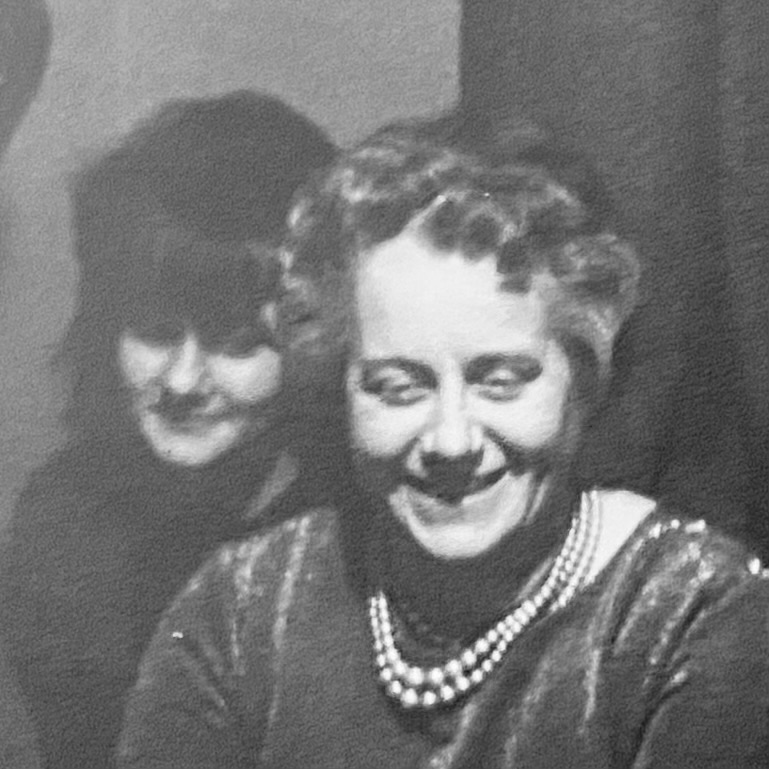
Douglas reckoned that Maggie, the oldest of his three sisters, had an amazing capacity for knowledge, and enjoyed acquiring it. She was competent and tenacious, and maybe a little intolerant towards those not so well equipped. But she had a great sense of fun, was a born raconteur, and — “like many a good storyteller” — was known to embellish a narrative at times. (I agree — you should never let the facts get in the way of a good story!)
Douglas and Angus, eight and nine years younger than Maggie, loved the stories she told them. One of their favourites was an ongoing saga about three schoolgirls, Belle, Avice and Claire, who got up to all sorts of improbable pranks at boarding school and during the holidays.
§
Maggie went to St Martin’s High School on Charing Cross Road, not far by tram from her father’s studio on Carey Street, at 7 New Court, Lincolns Inn. She was a frequent visitor after school and would prepare canvases for him. One of her major tasks was preparing canvases for the Selfridge window displays that her father was commissioned to produce for the coronation of George the Sixth. Duncan says images of the Sharpe children made up the numbers in quite a few of the scenes, and that Selfridges took years to pay.3 Life was very tough for most people in the thirties, and Maggie, the oldest of the girls, quit her place at art college to help support her family. In the 1939 England and Wales Register her occupation was recorded as “shorthand typist”.
Margaret married William Archibald McGill (Willard) in April 1939, and as Angus says they had a few months together before the war. Willard was in Military Intelligence, and his service mirrored my father’s, through North Africa and Italy. Unlike Dad, he rarely spoke about the horrors he’d seen. Maggie, meanwhile, helped manage a troop canteen at St Martin-in-the-Fields Church on Charing Cross Road. Their oldest daughter, also named Margaret, was born in 1942 and their second, Kathleen, soon after it ended. Their third and last child, Duncan, was born in 1952.
Of the three girls only Dorothy went on to a career in art, but Willard was sure that his wife was the best of them. She was deeply engaged in music too — a singer and piano player, and involved in the Norwood Operatic Society, as was her son Duncan. “We used to have two week long shows every year. The society’s productions were Gilbert and Sullivan in the “original unadulterated versions”.
The three sisters were good friends. Willard told Bert and Mike, Kath and Dorothy’s husbands, that when they got together in the kitchen they reminded him of MacBeth. Of the brothers it was Douglas that young Duncan remembered best — no wonder, since Norman was dead and Sonny and Angus soon gone to Canada. “I loved his visits, and my Mum and Dad used to be awake until the early hours talking, laughing and drinking finest single malt!”
We visited Maggie and Willard in 1980. They were still living at 1 Ardlui Road, but young Heather remembers Maggie back in the early ‘50s too, when she was attending Oakfield Preparatory School along with Maggie’s two girls.
After Heather’s family moved to Canada, Maggie would send them Christmas presents, and Heather loved everything about them — “her writing, the brown paper, the string and sealing wax, and then, inside, always, the most welcome books. The Water Babies, the Girls’ and Boys’ Annuals, and my absolute favourites, the What Katy Did series.” Duncan thinks his parents did more than that, supporting both Douglas and Joyce when their families were in need.
§
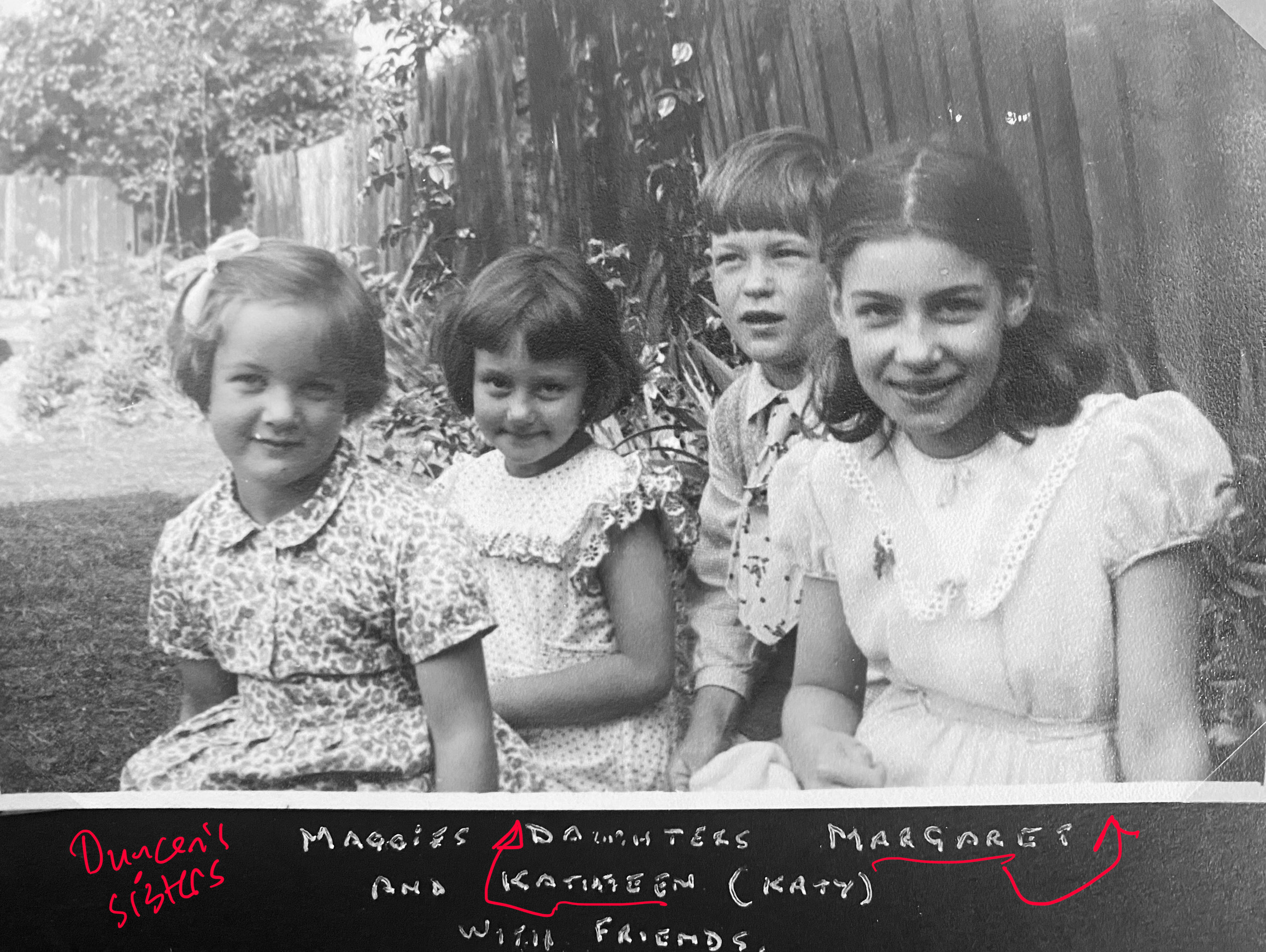
Meanwhile Duncan’s “somewhat idyllic childhood” ended abruptly on 29th October 1958, when his sister Margaret’s body was found on the embankment of a South London Railway track after a day at Streatham and Clapham High School. The loss of their daughter almost destroyed her parents. The police concluded that she’d been alone in a compartment, standing to collect her bag and get off at the next station, when a sudden lurch of the train threw her against the door and out on to the tracks. She died of a spinal haemorrhage.
In one of life’s sad ironies, Duncan’s second sister Kathleen (Katie) married the son of Norman’s pre-war business partner in Purley. The son turned out to be a “right bastard” in the words of her father Willard. Angus was a bit harder on him, saying Katie suffered injuries from the “brute of the man” she’d had the misfortune to wed. Unsurprisingly the relationship ended in separation and divorce, and Katie living back at Ardlui Road. She died after a heart attack in May 2021.
Duncan married and had two boys. His wife Pauline left the marriage, but Duncan keeps in close contact with his sons, their partners and his grandchildren, all of whom mean a great deal to him. He’s kept up contact with both sides of his family, the McGills and the Sharpes, including with Heather since 2011, and he’s been very generous with this project.
§
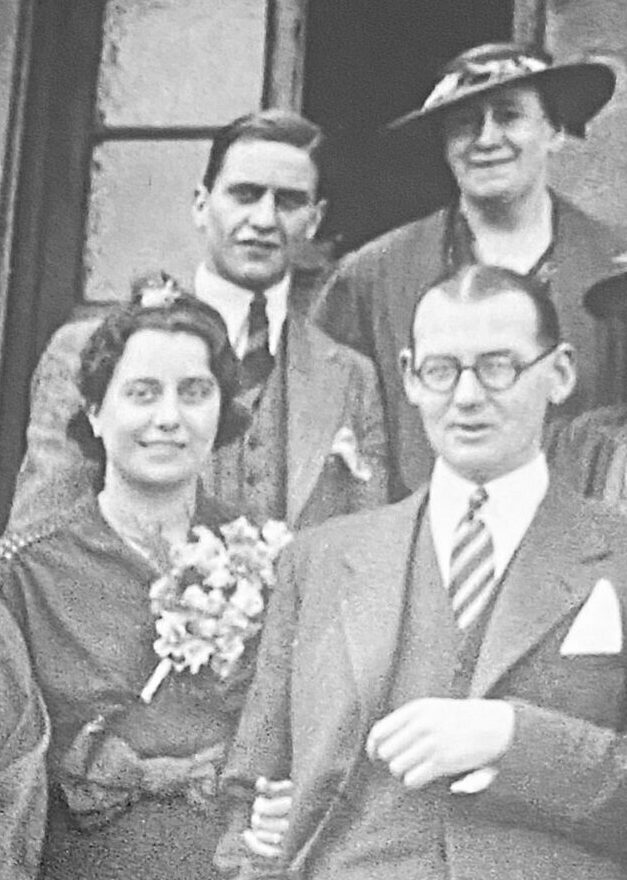
Duncan describes his father Willard as a very quiet person, the result of a very strict upbringing, what he’d seen during six years of war and the loss of his daughter Margaret. He was highly intelligent with a dry sense of humour, and very patient with his children and the wife he loved. He worked in insurance after the war, and got Angus a job at one stage, presumably after Angus had stopped working with Sonny. As for Maggie, she worked until after the war according to Angus, and had a couple of lodgers after that. From 1956 to the mid ’70s they also had French exchange students live in during July and August.
`Maggie’s sisters envied her for her gardening abilities, and maybe for the husband who followed her round picking up the prunings. The week before she died in July 1993 they moved an apple tree from one side of the garden to the other, with Willard doing the digging. Willard was devastated by her death. He died in December 1996.
After their death a number of photographs and newspaper articles were discovered, which Douglas entered into albums. Angus says his wife Adrienne retained them in good order for the benefit of the family.
§
Mary (Dorothy)
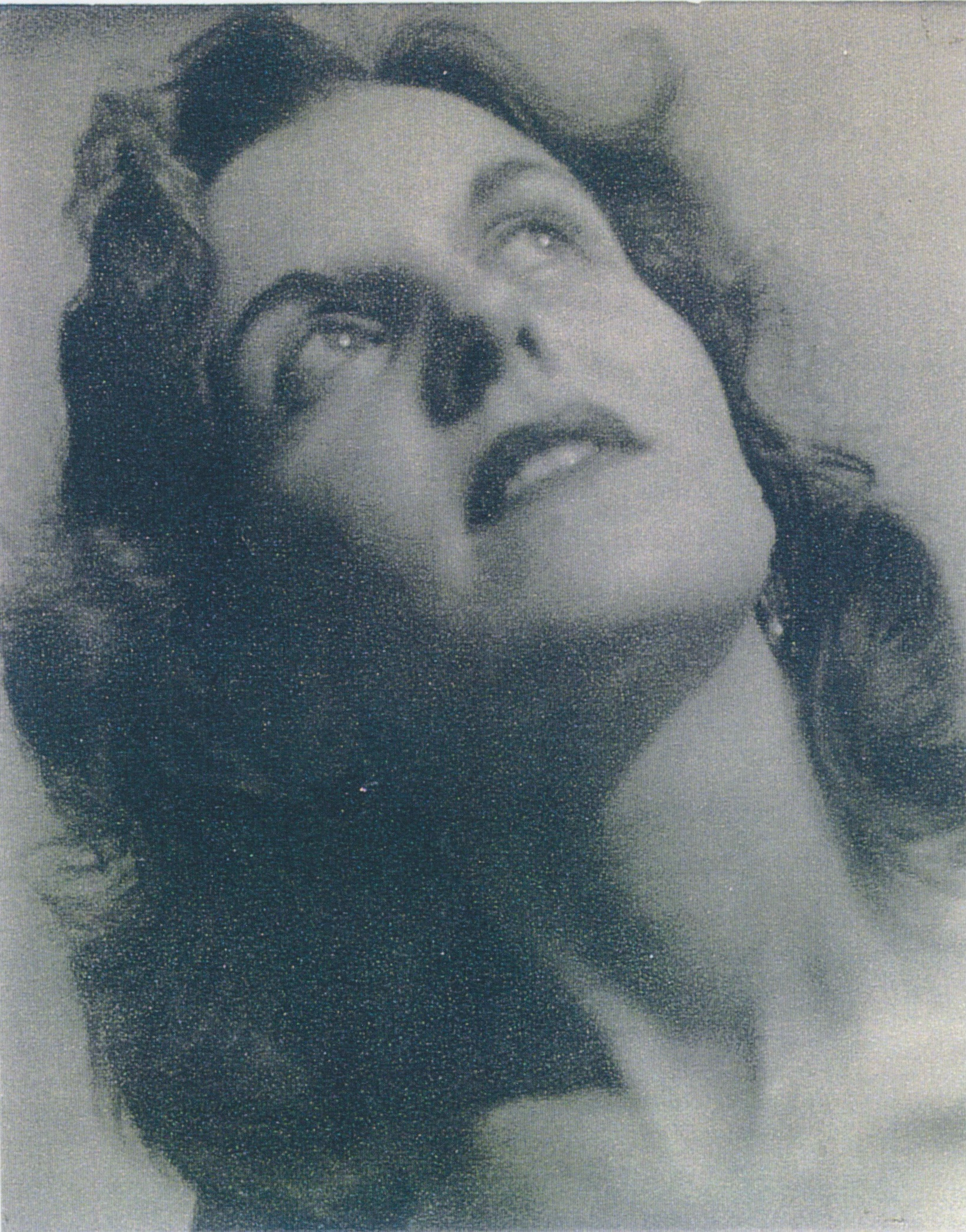
Douglas says that Mary (always known as Dorothy) was born in Wigtown, Scotland. That’s where her Aunt Polly and Uncle George lived, and where her parents took the family for holidays, so the story may be true, but still I’d like to see the paperwork. Whatever the truth of it, she had a tremendous affection for South West Scotland.
Dorothy, too, told stories to her wee brothers, but hers were more fantastic than Maggie’s — about ghosts, witches or just plain old terror — anything to keep them spellbound. Again, the boys loved them.
Douglas says she had a unique imagination and a rare depth of artistic talent, but not much sense of business. “She tended to dream her way through commissions which could have provided her with a handsome return.” Not that she was lazy, but her time was to be thought about and not just prostituted in haste. If she’d been a little more worldly and little less compassionate, Douglas thought, she wouldn’t have been Dorothy.
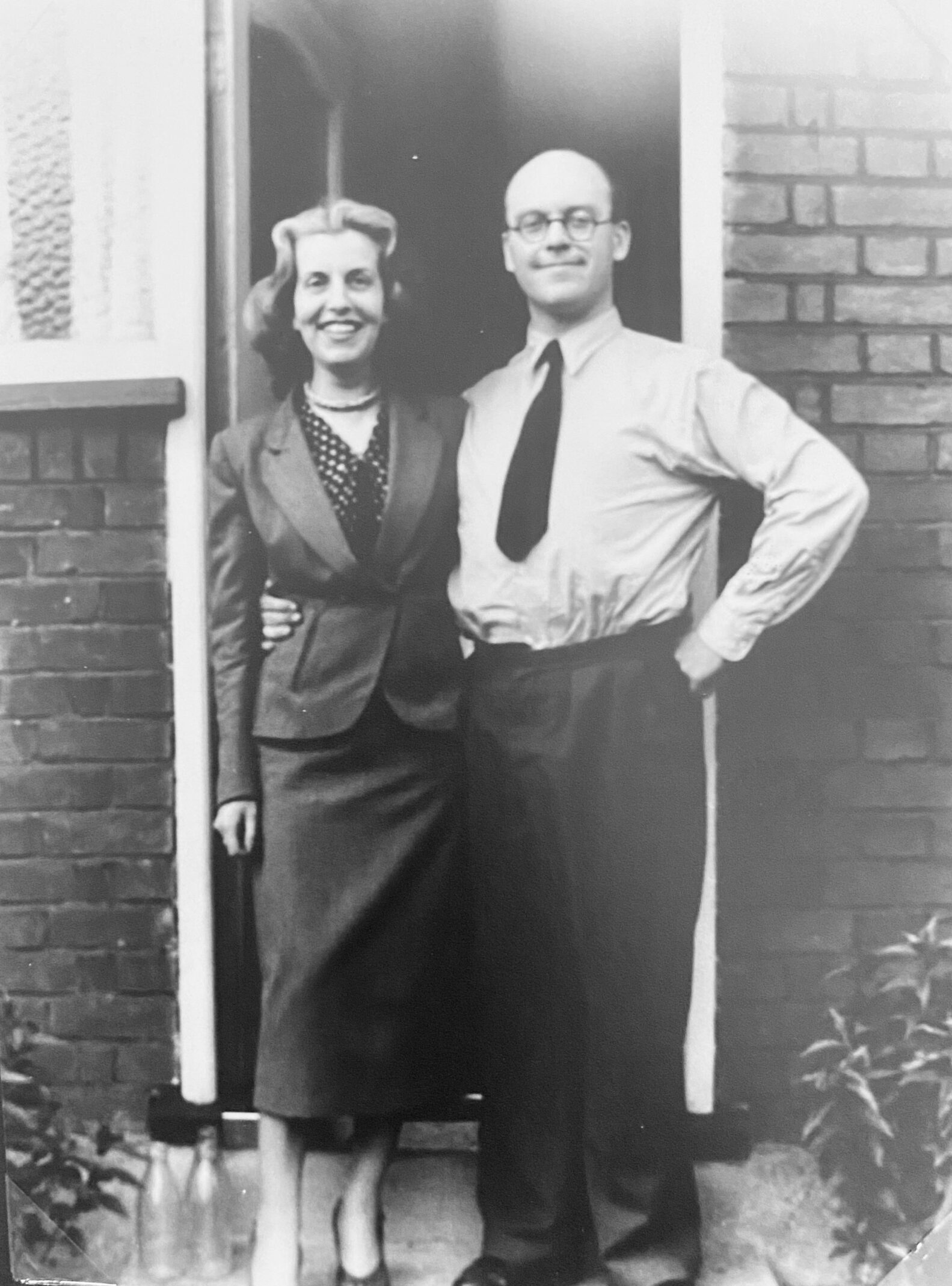
She trained at Camberwell School of Art, and practiced after that as a commercial artist. She married Eugene Michael Vesey, Mike, after the war. He too had been an art student, but whether he practiced as an artist I don’t know.
It was heartbreak for her when after only nine or so years of happily married life, Mike suffered a brain tumour, and couldn’t be saved from virtually immediate death in 1955.
Over the years Dorothy appears to have lived in a few places across Southern England — alone for much of the time, but for several years with her Aunt Topsy, until Topsy went into care at the end of her life. Dorothy got some solace teaching art and writing poetry, but according to Angus she never got over the loss of her husband and all those who’d died during the war years. He mentions a poem called Summer 1944 that appears to be lost.
She had a terrible time in later years with stomach cancer. Kathleen related how she and Maggie stayed with Dorothy in a lovely thatched cottage in Brighton to help her through them. When she died in 1988, aged 70, the probate recorded her last address as an attractive looking two-storey semi-detached on Caburn Road, Brighton and Hove. She left legacies to her living brothers and sisters, and also to her sister-in-law Joyce.
§
Kathleen
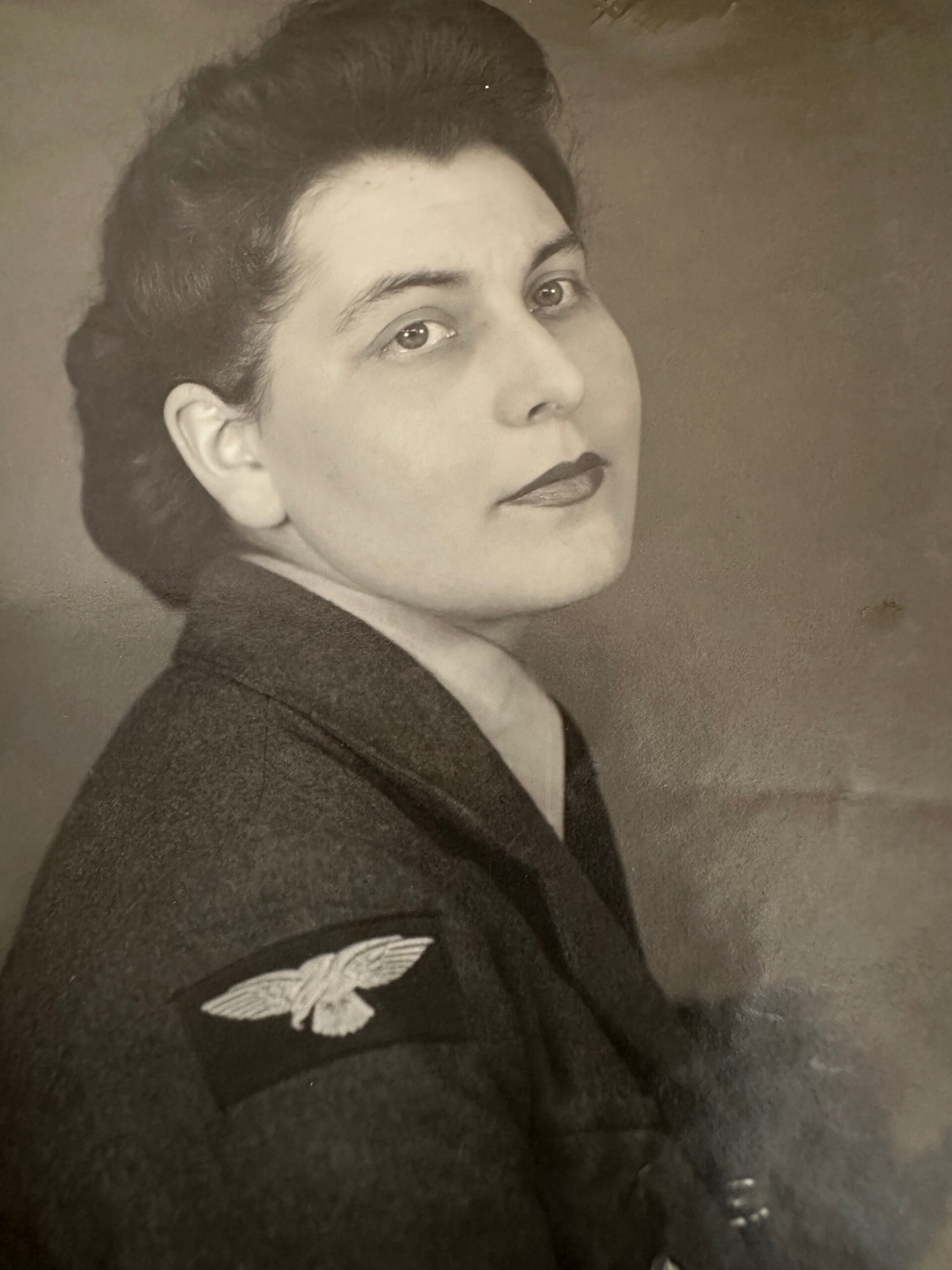
Kathleen was Douglas’s “special person” — only two years older than him, and “very pretty and universally liked”. Douglas admired Kath’s self-confidence and her ability to cope with school, homework and friends. She also coped well with her younger brothers, joining in their games but never seeming to get into the scrapes that the boys did. Kath often read to Douglas, too — novels like The Scarlet Pimpernel and Beau Brocade.
Angus, meanwhile, looked back in wonder at how he and Douglas had tormented Kath and her sisters — nettles and snowballs in their beds, water glass on bathroom door handles and so on.
Kath was 18 and still studying at Camberwell Art School when the war began, while Dorothy, just three years older, could already call herself a commercial artist. Both girls signed up for the Women’s Land Army, Kath in 1941, when she turned 20. She resigned almost a year later to join the Women’s Auxiliary Air Force.
Oh, the happy happenstances that shape our lives — Kath married a pilot, Albert Markland, after she came out of WAAF and Bert was able to get de-mobbed from the RAF. It was a charmed marriage that gave them two daughters, Vivienne in 1951 and Adrienne in 1954.
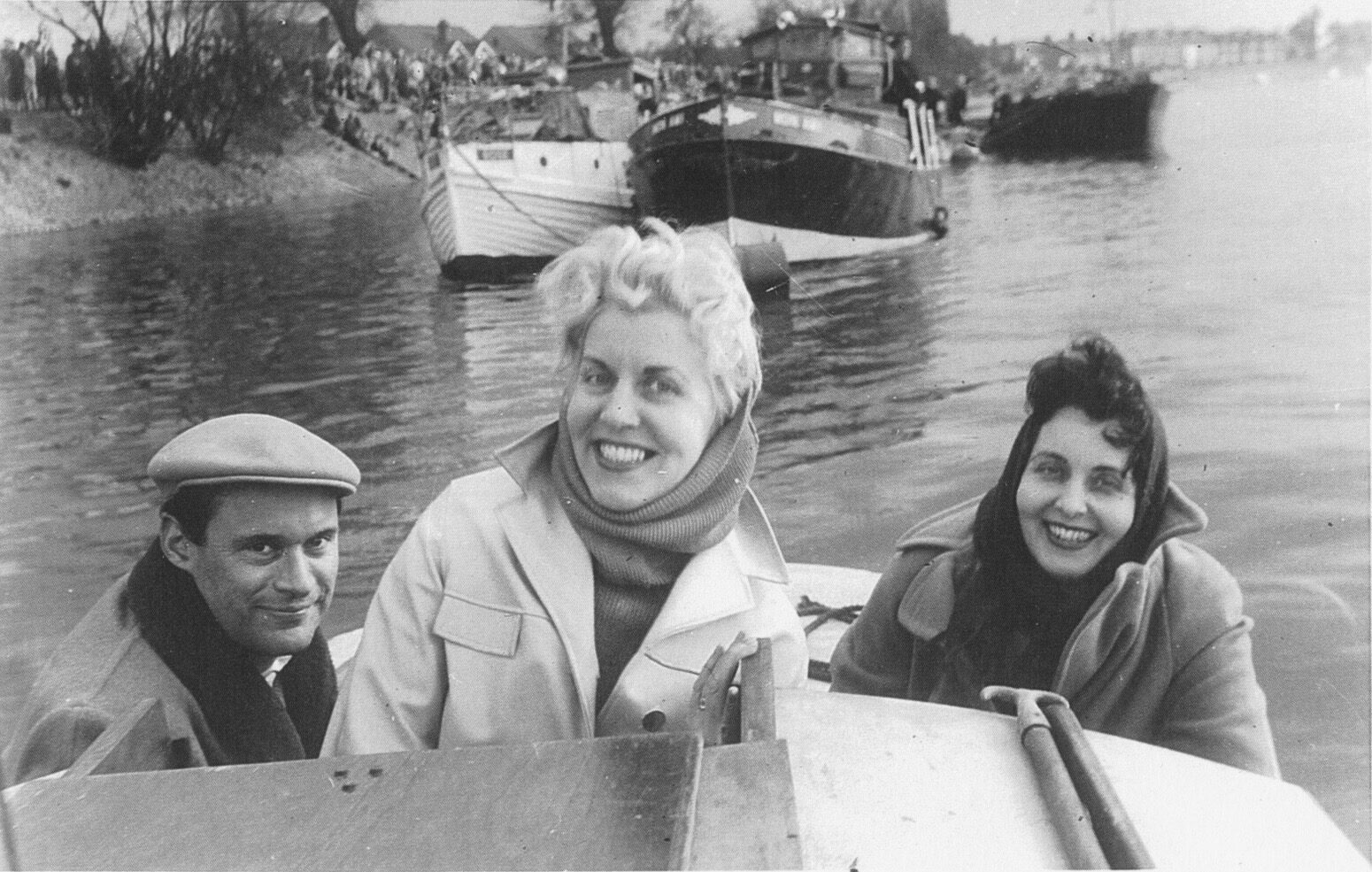
Bert had flown Mosquito fighter-bombers during the war and won the DFM (Distinguished Flying Medal) — a decoration rarely given, and only to non-commissioned aircrew. He served his post-war career working for BOAC (British Airways), first as Navigator and later as Pilot, and found all the flying in civil aviation quite stressful.
In retirement he and Kath moved to a quiet suburban bungalow with a lovely garden at Ashley Heath in Hampshire. Heather and I stayed overnight with them twice, in 1980 and 2001, and both times ate lunch at a very English restaurant in an ancient thatched building, where I had to duck to avoid the overhead beams, and ascend what was almost a ladder to visit the loo. They were gracious hosts, Kath almost stately, Bert an engaging conversationalist. We’d met Bert once before, when he visited Heather’s mother Joyce in Auckland while still a pilot. Bert, his conversation and the whisky he brought almost left me under the table.
Sadly, Kath and Bert both died in 2016.
§
Douglas
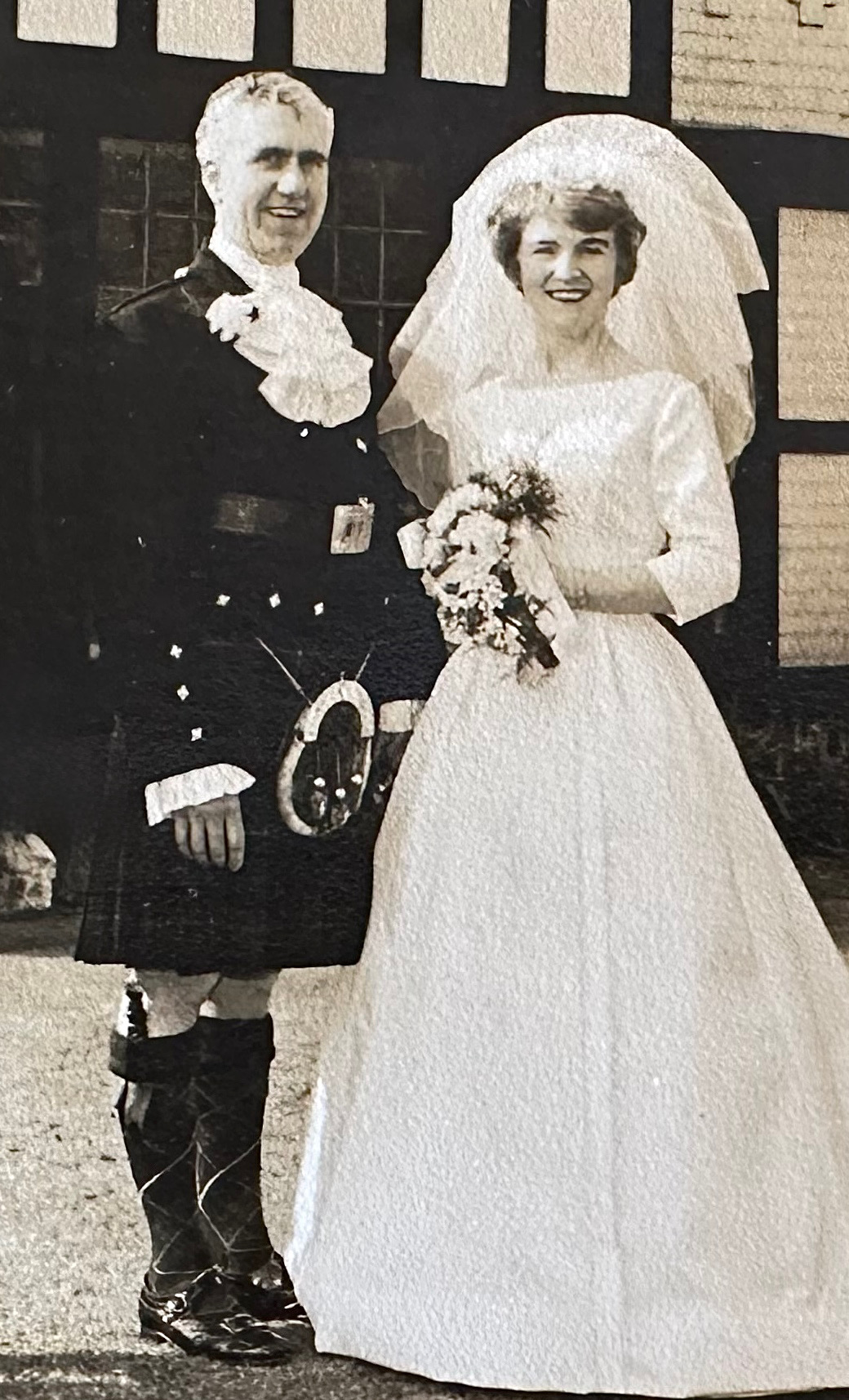
Angus described Douglas as a “clever, trained electrical engineer, devoted to family life and love of all things Scottish.” You can catch the full flavour of all three in Wind of Dreams.
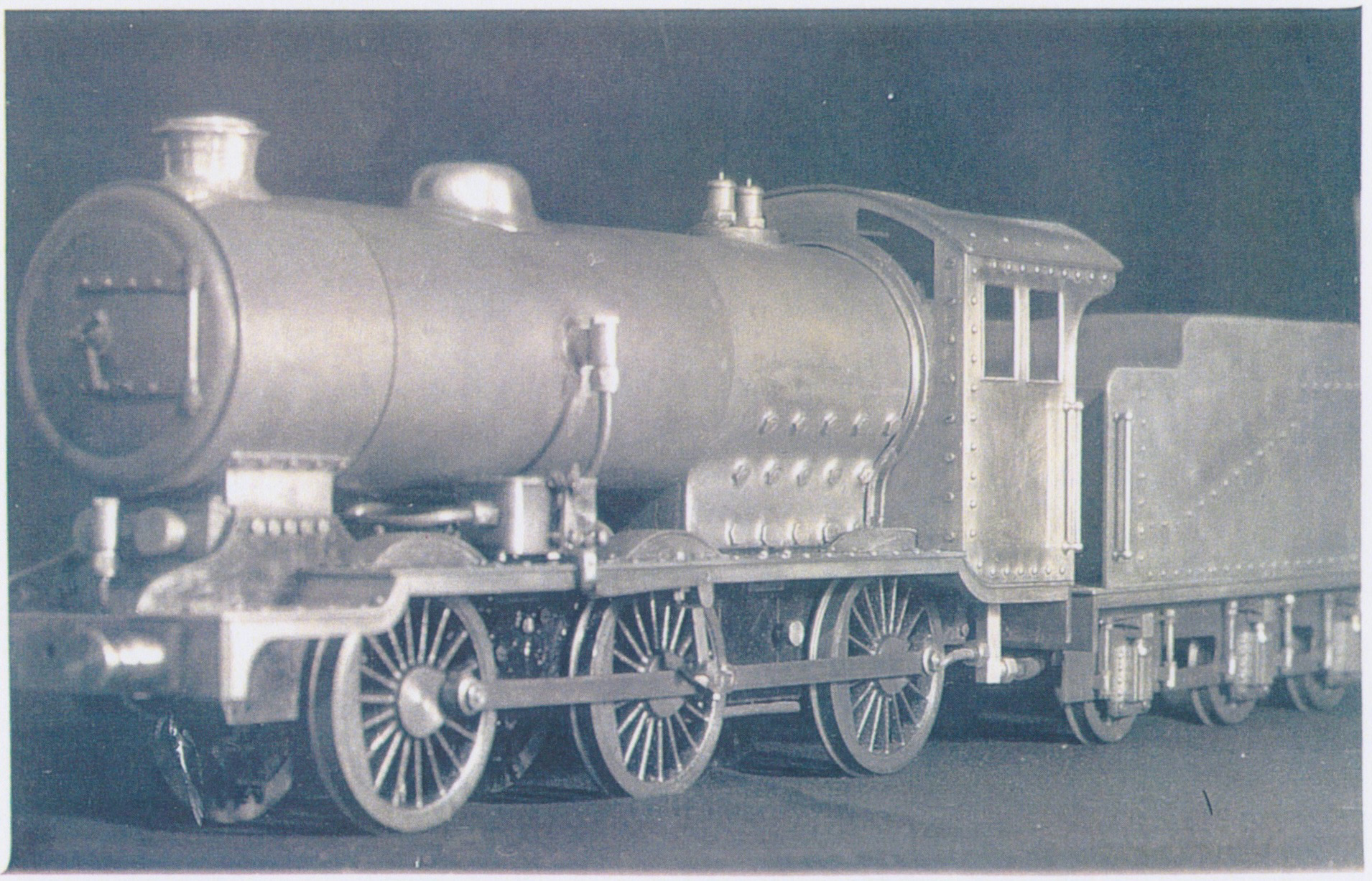
Their father’s passion for engineering, and the workshop he provided them — the working model engines and traction engines and trains that he built under James’s tutelage — all played a hand in shaping Douglas’s working life. And Jim and Heather both remember that train in the back garden of 51 Chestnut Road.
After the war Douglas moved to Cheshire, south of Liverpool and Manchester. He married Adrienne Ireland in Manchester, in 1963, and between 1965 and ‘69 they had three children, Graeme, Murray and Kirsty. Writing this I was struck that Douglas, more than 20 years older than us, was raising a family that grew up in the ‘60s and ‘70s, like ours.
§
Heather and I visited Douglas and Adrienne once, in 2001. It was on our first trip to the UK and Ireland to do studio visits and seminars, and it had been quite a learning experience. “By the time we had a few seminars under our belts,” I wrote, ” Heather and I were sleeping better. The scars on my head from the low overhead beams in the B&Bs were healing, we could look prices in the eye without visibly flinching and life was picking up.”
So it was a pleasant relief to meet them both — and, for me, to sit, relax, drink tea and listen while the Sharpes talked family — Heather remembers finding out that Adrienne played the accordion. It was also a shock to learn that “Heather’s Aunt was earning about £4.50 an hour as a long-standing admin person at a private school. She would have had to work for almost three hours to buy Heather and me a sandwich-type lunch on the Motorway.”
§
An interesting little side bar is that at some time in the late ’80s Douglas and Angus toyed with the idea of making and selling miniatures of the Elgin Marbles. In the 1810s the Scottish sculptor John Henning had been granted access to the Parthenon friezes by Lord Elgin, and had created 1/20th scale models of them. This took Henning twelve years, and he was understandably distressed when others proceeded to copy the idea, often poorly — he was an early advocate of copyright, and died a pauper. It’s no consolation to him that many of his slate originals are now in the British Museum, some copies in the Royal Scottish Academy and a few others in private collections.
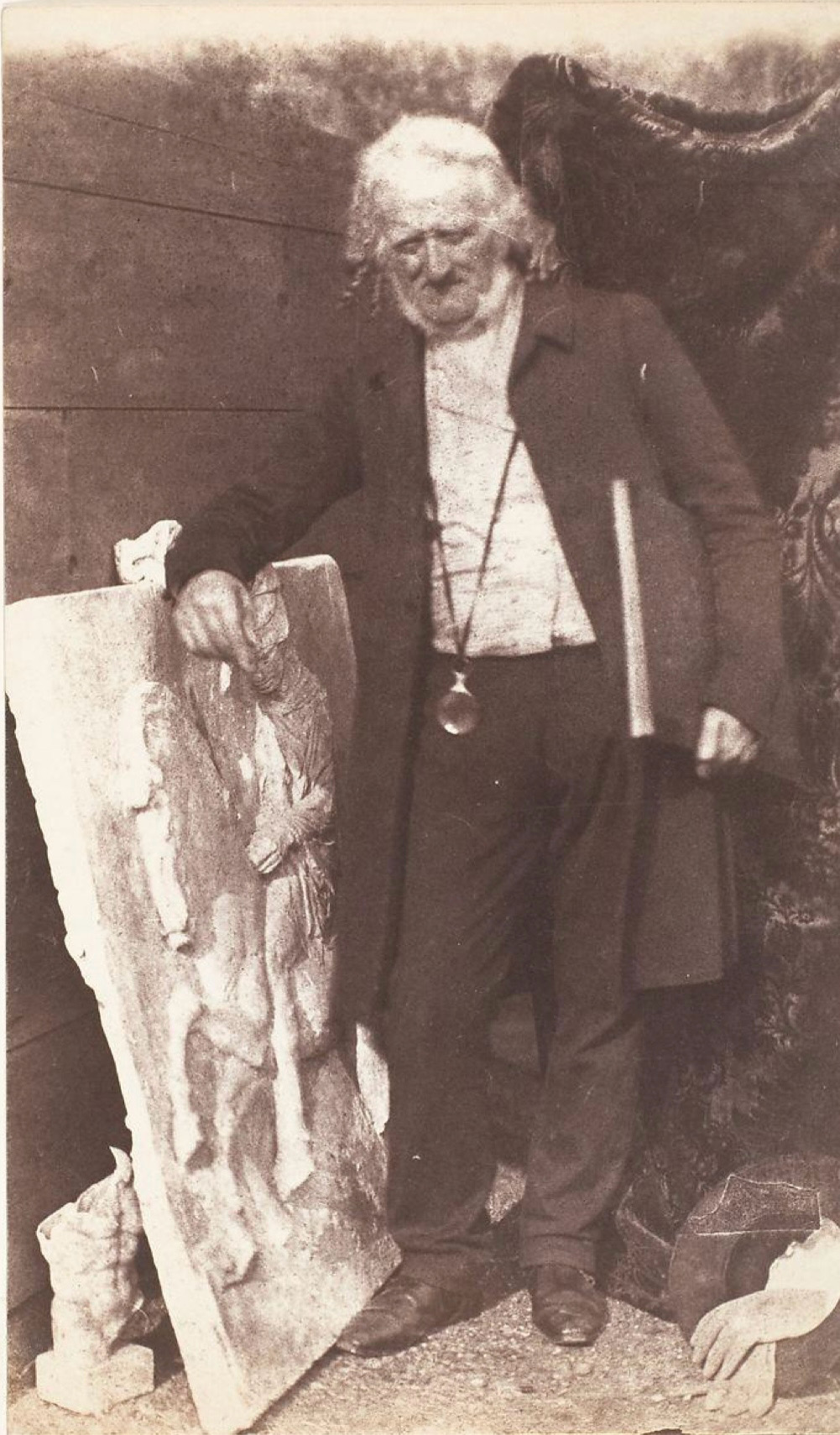
Somehow a set had come into Sharpe family hands, through either James Thomas or his father, and Angus now had them. He got as far as printing brochures, but the enterprise came to nought, although not before he’d made sets for his entire family.
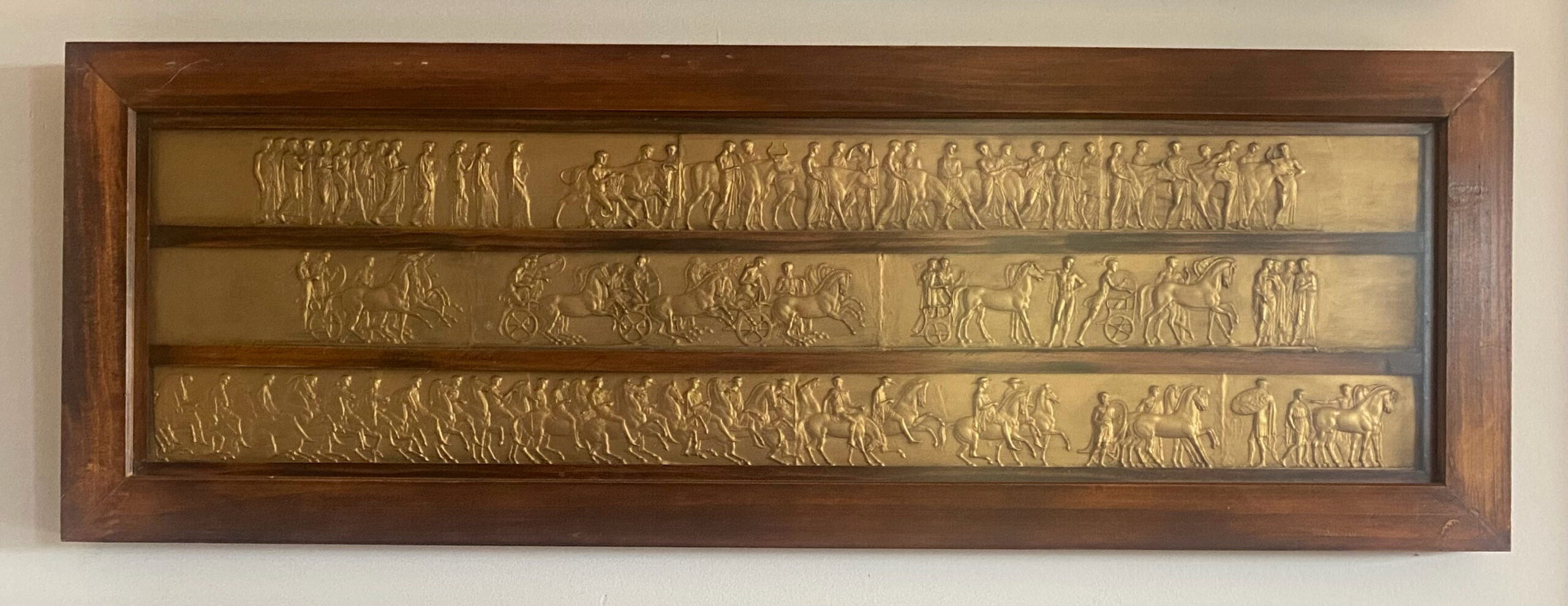
A quick Wikipedia search says that one version of the miniatures was just 2 inches high but over 24′ long. If that’s the case, we appear to have a complete set, cast in plaster with a bronze finish, in four wooden frames on our wall. Typical Sharpe enterprise, although John Henning mightn’t have approved.
§
A generation passes
Angus writes:
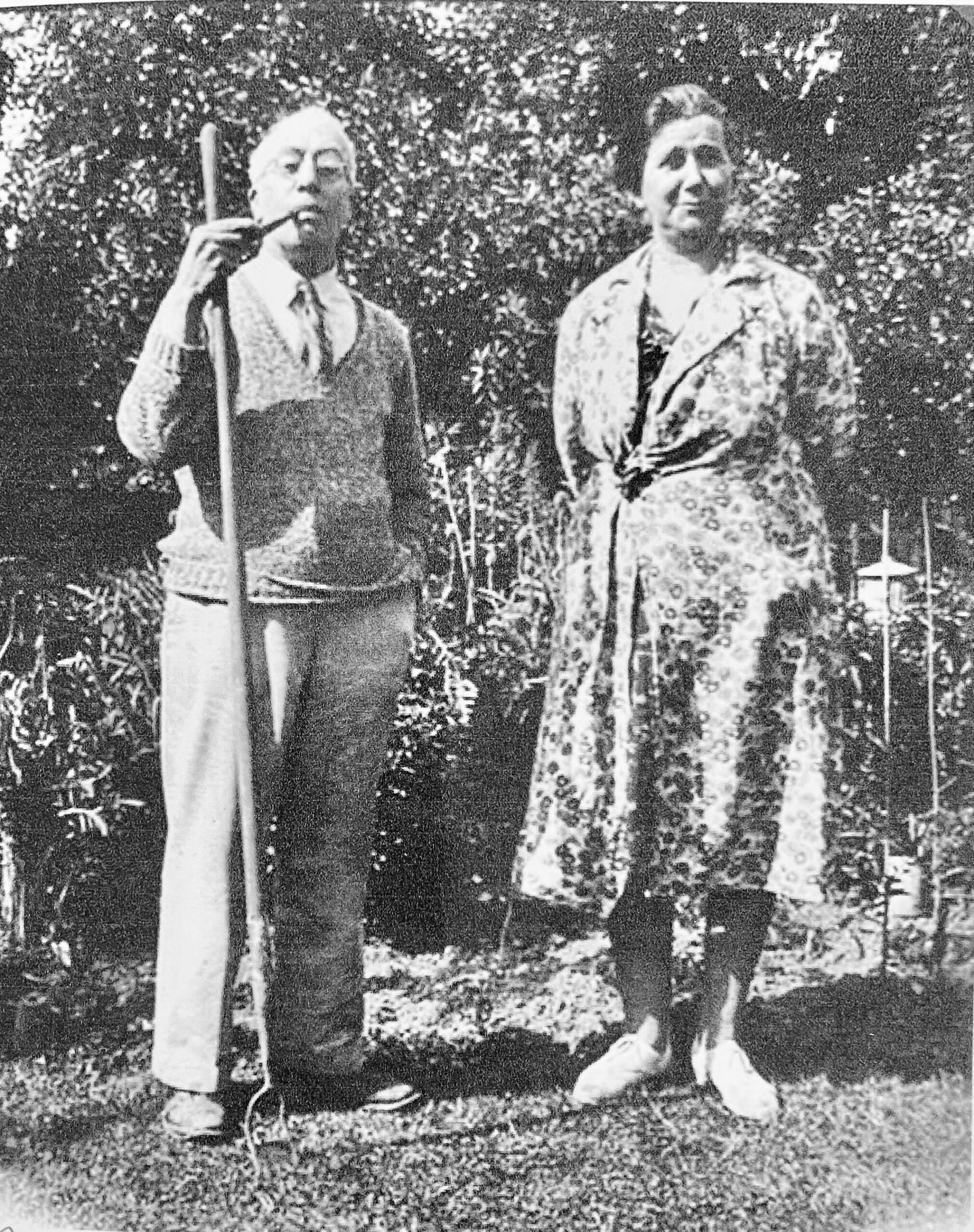
…Dad’s health deteriorated from stomach problems, which the foolish Doctor did not understand, and virtually starved the patient for several years, causing a massive loss of weight — until eventually Dad was taken to hospital but could not survive the treatment provided and he died…
Mamma’s health was always good but suddenly at 7.00am one morning I heard a bump in her bedroom and on inspection found Mamma on the floor, the result of a brain haemorrhage. I hope she hadn’t suffered any pain beforehand. The girls arranged the funeral…
Footnotes
- “He was a superb sculptor and modeller, with a marvellous artistic bent and a truly outstanding ability in crafting with wood. I have remarked elsewhere how very accomplished he was at woodcarving, but he could also perform the more mundane tasks quite effortlessly. I once watched him make a cabinet in which the top and sides were jointed by hidden, mitred dovetails and although he seemingly made no special effort (and by gosh he was quick), every joint was absolutely perfect.” — This and the other quotes from Douglas are from Wind of Dreams.
↩︎ - International Bomber Command Losses Database. The others who died were the pilot F/O Robert Knight RNZAF, flight engineer Sgt. Arthur Newby, navigator Flt. Sgt. James Montague, wireless operator Flt. Sgt. John Lamont RNZAF, mid-upper gunner Sgt. Leon Young and rear gunner Sgt. Stanley Cameron.
↩︎ - By the mid-1930s the Depression had impacted the store. Gordon Selfridge’s grandiose plans hadn’t always helped, and Selfridge himself was deep in debt. The Board forced him out in 1941, and the company was taken over ten years later.
↩︎