| Contents |
After too many tedious hours in ancestry.com…
There are two types of family tree. The first draws a circle around me (us) and asks where I (we) came from. That’s what I’ve been doing. So, kids, the first graphic shows where you came from. You grandkids, it’s half of your family tree!
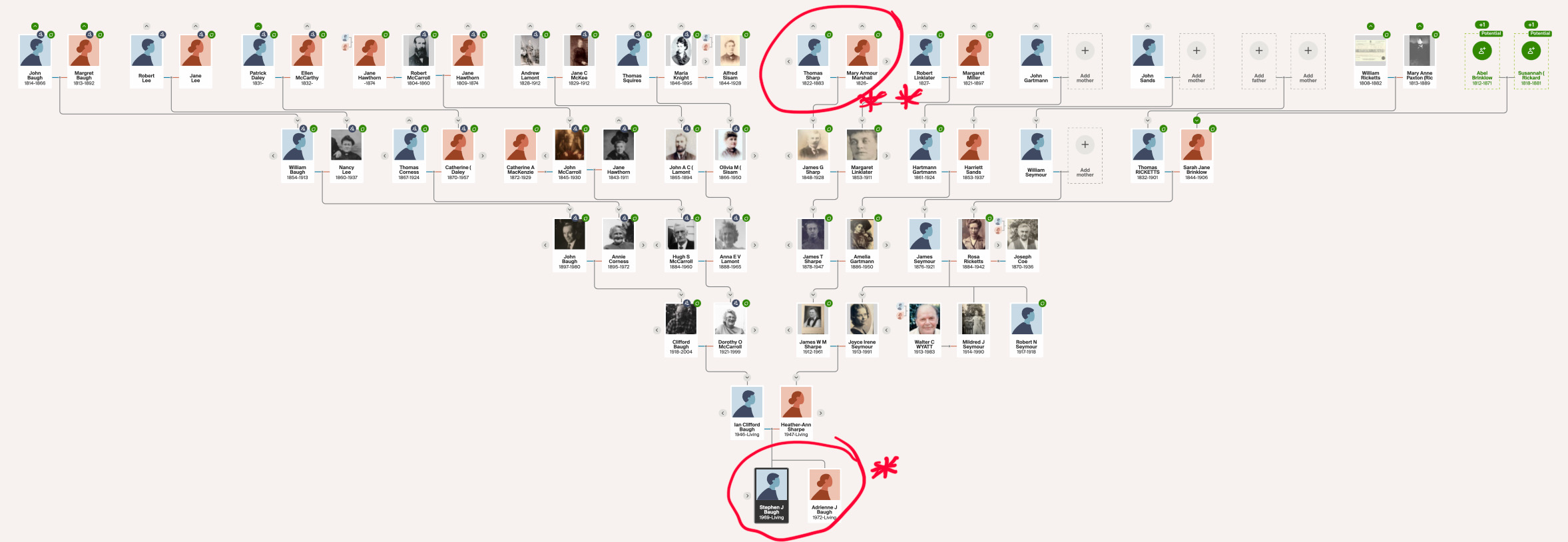
** = Their Sharp great-great-great grandparents.
Click on the image to view it full size.
The second is the Ghengis Khan model — or more accurately, the Mr and Mrs Khan, or Big Bang model. You draw a circle around the progenitors and admire how far they spread their genes.
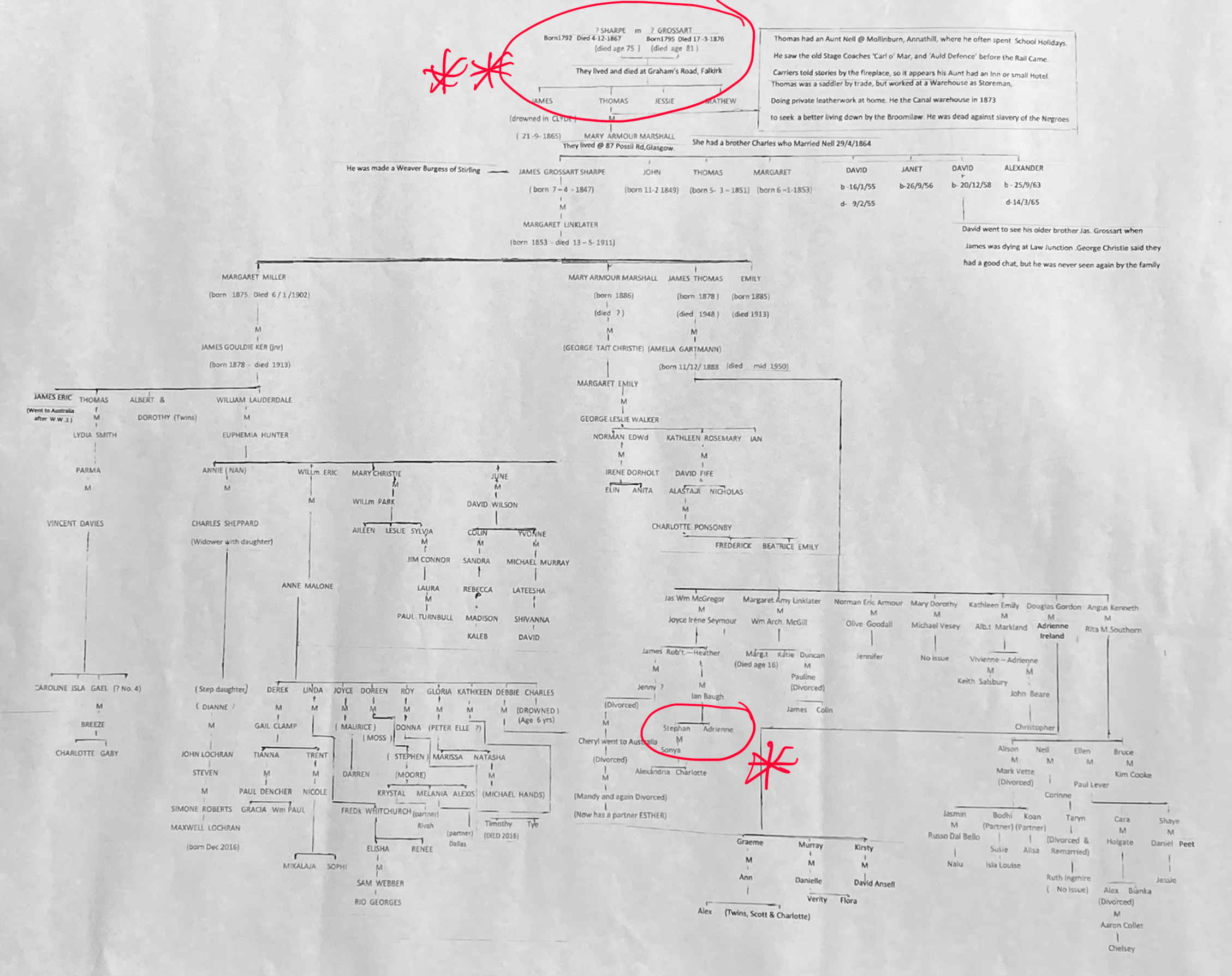
** = Their Sharp great-great-great grandparents.
This is someone’s work of love and diligence pre-internet.
In a sense both models are rather silly. The Big Bang option emphasises your personal insignificance — reminding you that you’re just one of their multitudinous progeny.
The other shows how insignificant the founders are. My mother Dorothy was rightly proud of her McCarroll forebears. I have photos of her great-grandparents, Robert McCarroll and his wife Jane Hawthorn, on which she’s written “Who started all this”. But together they were only a quarter of her genetic inheritance. I’m proud too, but they’re only an eighth of mine.

If we focus on the McCarroll line alone we ignore the families that married into them, and especially the women who bore the babies! We really need to look wider, and take in the Lamonts as well. The Sisams and the Hawthorns. The McKees and the Squires and the Knights. Which is what I’ve tried to do, still in a once-over-lightly way, making grateful use of all the photos and papers in our cupboards that Mum and Dad left behind.
The value of discovering your family tree isn’t to fill in the names and dates and relationships. As I’ve said too frequently, it’s to put flesh on those dry bones — or try to. To tell their stories. Tell stories about them. Turn the names into human beings — as far as possible. Not like us, but knowable.
I think they’d do the same for us. In the unlikely event there’s an afterlife, maybe they’re trying to work us out now. An unsettling thought.
More than that, it’s to try and understand the family, the clan, the community, the trade, the town, the country they were part of. The beliefs and customs and conventions they lived by. As far as possible. Not like ours, but knowable, and what we sprang from.
And not just to understand it all, but value it, take pride in it. Because we won’t get very far in a changing world by not valuing who we are.