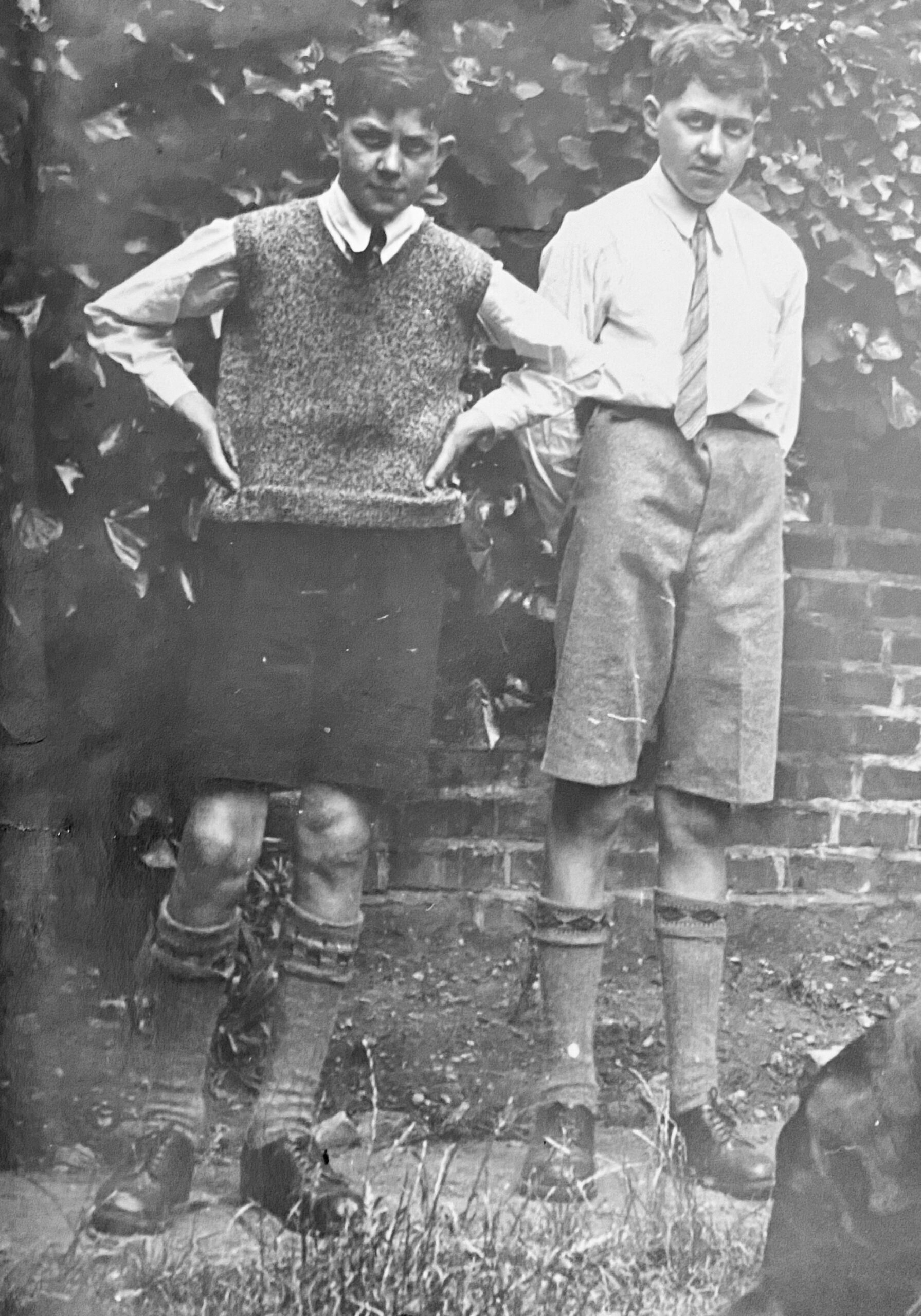
Treat this as a prologue by Angus to Douglas’s Wind of Dreams.
Douglas’s effort is a book in itself, so this will give you a taste from the boys’ point of view of life in James and Amelia’s family home.
By the way, I love the photo. My mother would have said that “butter wouldn’t melt in their mouths.” ~ Ian
After that peculiar yet vivid memory of meeting his grandfather in the “wee Turkish hat” as a three year old, Angus’s next memory was when he was six — “making scooters and riding the South London roads with brother Douglas and friends”.
His brother James (“Sonny” from now on) gave him a pair of street skates for his seventh birthday, and his favourite hobby became roller skating. From then on until war broke out in 1939, he skated to school and everywhere around South London, including to Mrs Coe’s sweet shop, hoping for treats. Sonny was thirteen years older than Angus, and Mrs Coe was his sweetheart Joyce’s Mum.
§
Angus aptly described himself and Douglas as “terrors”.
“Once we got a shiny key from the lock on our rear door, tied a thin copper wire to it, hid in the front garden, and, having heated the key really hot, when someone was nearing the front gate we’d kicked the key onto the sidewalk. The unfortunate finder would bend to pick it up, burn their fingers and drop it rapidly — and we’d pull sharply on the wire to make the key disappear completely. To the astonishment of the poor soul who first found it.
“A second attempt at the same ruse was dampened when the person who saw the key put a foot on it, the copper wire snapped and we lost the key, resulting in having to replace the lock in our door, at the expense of some pocket money for a while.
§
“Then we used one of the smaller steam engine boilers to make a pressure cylinder for cold water, which we pumped up to 40 lb pressure with a motor cycle pump. After turning a fine holed nozzle on the workshop lathe, we could use the boiler valve to release a little bullet of water from Norman’s bedroom window, high up on the top floor, and fire at passing pedestrians, who would be confused as to where such wetness came from. We little monsters thought this a great lark, but it’s a good job our parents never knew about that one until we were many years older and related the detail to them. I bet the neighbours were glad when the Sharpes moved.
§
“One way and another — what wonderful years as children, and then adults, we all had, with such remarkable parents and siblings and relatives generally. Who could possibly have better memories of fantastic Christmases with huge turkeys and hams, and all the home made puddings and cakes, and happy Hallowe’ens with apple dunking, roasting chestnuts, and our older sisters toasting bread and cheese around the open fire in their bedroom — where Maggie cleverly gave us wee boys toasted Sunlight soap in place of cheddar cheese. Still, we got our own back with our other games.
“Sonny came in for one event. He would often get home late when courting Joyce, and we decided that a water bucket and books on the partly open bedroom door would give him a treat. Knowing that, when he got the dunking, he would come to our double bed to smack us, we got a large sheet of cardboard, stuffed it full of thumb tacks, nails and drawing pins, and held it over our heads. Sure as fate, it worked perfectly, and we were laughing so much that the bed collapsed — I went down and Douglas went up — I scooted round the bed, out the open door, and jumped downstairs a flight at a time, Bang, Bang, Bang. Dad heard all the noise and growled “What the ??? is going on out there?”
§
“We never did get smacked, and were very, very fortunate more than once. We did deserve it when we unfortunately set fire to the wardrobe and wall in our bedroom, where we’d been toasting cheese over a candle. When Mamma called us for lunch we stored the orange box and the lit candle behind the wardrobe. Some time later we heard a knock on the front door, and a neighbour told Mamma that smoke was showing over the roofline. The fire brigade were called and a rapid extinguishment left a lot of water dribbling through the wall and into the girls’ bedroom below, so a fair bit of redecorating was needed.
“We were lucky that Dad and Mamma decided that we had both been scared enough to prevent such things from being repeated, and they never were. I think that was the end of those childhood pranks, as we were involved in the dreadful war years shortly after that affair.”
§
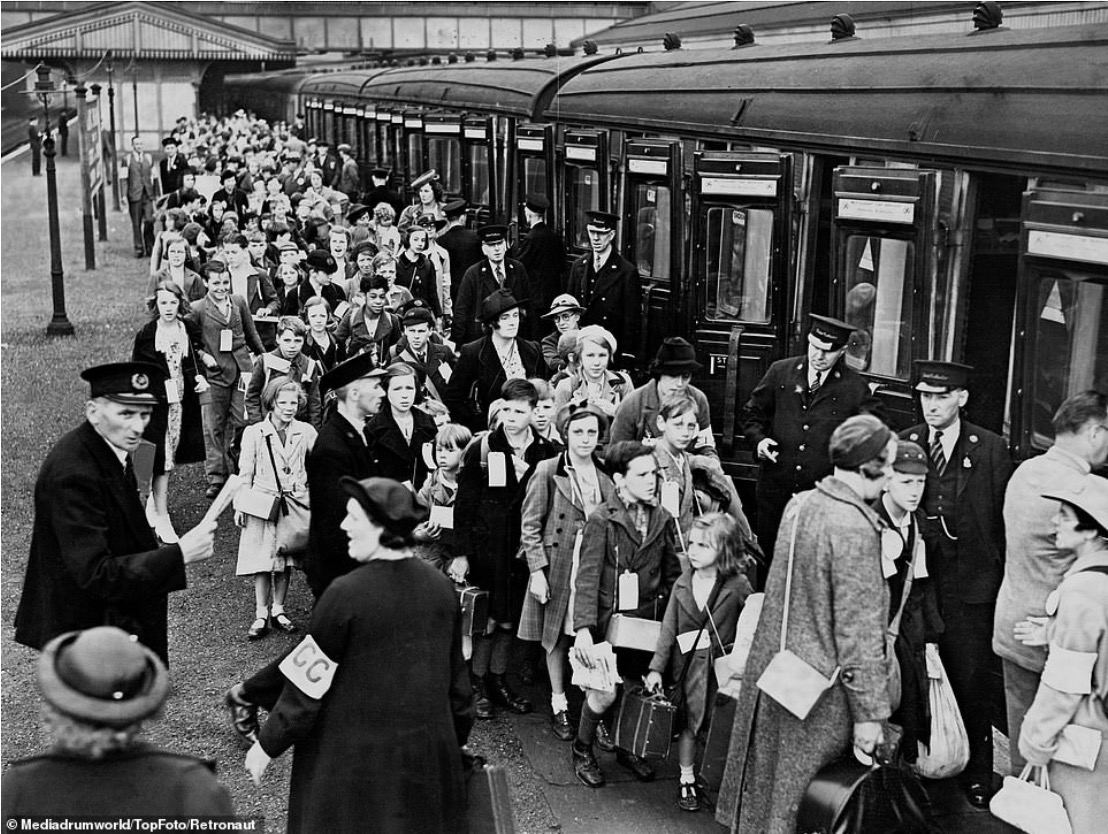
Douglas and Angus were enjoying a short holiday on the Gartmanns’ Rickards farm when war was declared on September 3rd 1939. Starting just before war was declared, the UK government had begun to evacuate children and other vulnerable people from cities to the countryside for fear of German bombing, and the two boys were sent for a time to Exeter in the South East of England, although it’s unclear for how long.
At that point Douglas had one year’s school to complete, Angus two. The experience certainly disrupted his schooling, which he described as “part commercial, part engineering”.
Meanwhile, according to Angus, the boys’ parents had themselves decided to move further out from the central city, to 51 Chestnut Street in West Norwood, South London. Actually I think there was another stop before they got there, but this does seem as good a time as any to return to my slightly weird obsession with where the Sharpes lived over the years…
§
Residences
I’ve written about where both the Sharp and Gartmann parents lived, but what about James and Amelia themselves? Like their parents, they rented, and they seem to have been rather nomadic.
(Heather’s parents, too, by the way. She swears they’d moved sixteen times by the time we married — across London, Quebec, Toronto and Auckland — and I’d joke about how often we helped Joyce move after that. Anyway…)
James and Amelia married in 1911, but the first clue as to where they lived comes ten years later, in the 1921 census, by which time they had four kids, with a fifth on the way.1 The census records them at 8 Burton Road in Brixton, which is where Amelia’s parents and sister lived.
The way the census works is that you record the people actually in the property on a particular night regardless of why they’re there. But on that day, 31 March 1921, there were no kids in the Burton Road house — just James and Amelia and the Gartmanns. Goodness knows who was looking after them, or why James and Amelia were even there that night, but I assume they were just visiting. In other words, as of 1921 we still don’t know where they were living.
However, when Amelia’s father died three years later, her sister Emmeline and her mother Harriett, who was already in her mid-70s, were left alone and unsupported. Back when I was writing about the Gartmanns I thought that Topsy and Granny Sands must have moved in with the Sharpes about then. Understandably. Now I’m pretty sure it was the Sharpes who moved in with them!
8 Burton Road features in the record for several years, and fits in well with Angus and Duncan’s stories about their childhood. Angus describes
a large Victorian house built on four levels. The ground floor had kitchen, scullery, large storage cupboards, dining room and coal store. Stairs led to the second floor with toilet, front entry, main lounge and parents’ bedroom. The next floor had the girls’ bedrooms, bathroom and storage cupboards, and the fourth floor the boys’ bedrooms and storage together with an amazing workshop housing seven steam engines and boilers, a huge work bench with a wood vice and large engineer’s vice, numerous cabinets full of tools of every description — and the fireplace and mantel where on Sunday evenings in the winter months Dad would have a blazing fire and sit with his pipe aglow reading to Douglas and me all the great classics, Scott, Dickens, etc.
Often, after coming home late from his studio at New Court, Lincolns Inn, Dad would sit by the fire with a pencil and pad and sketch some fantastic quick Idea for what he had coming up for work.
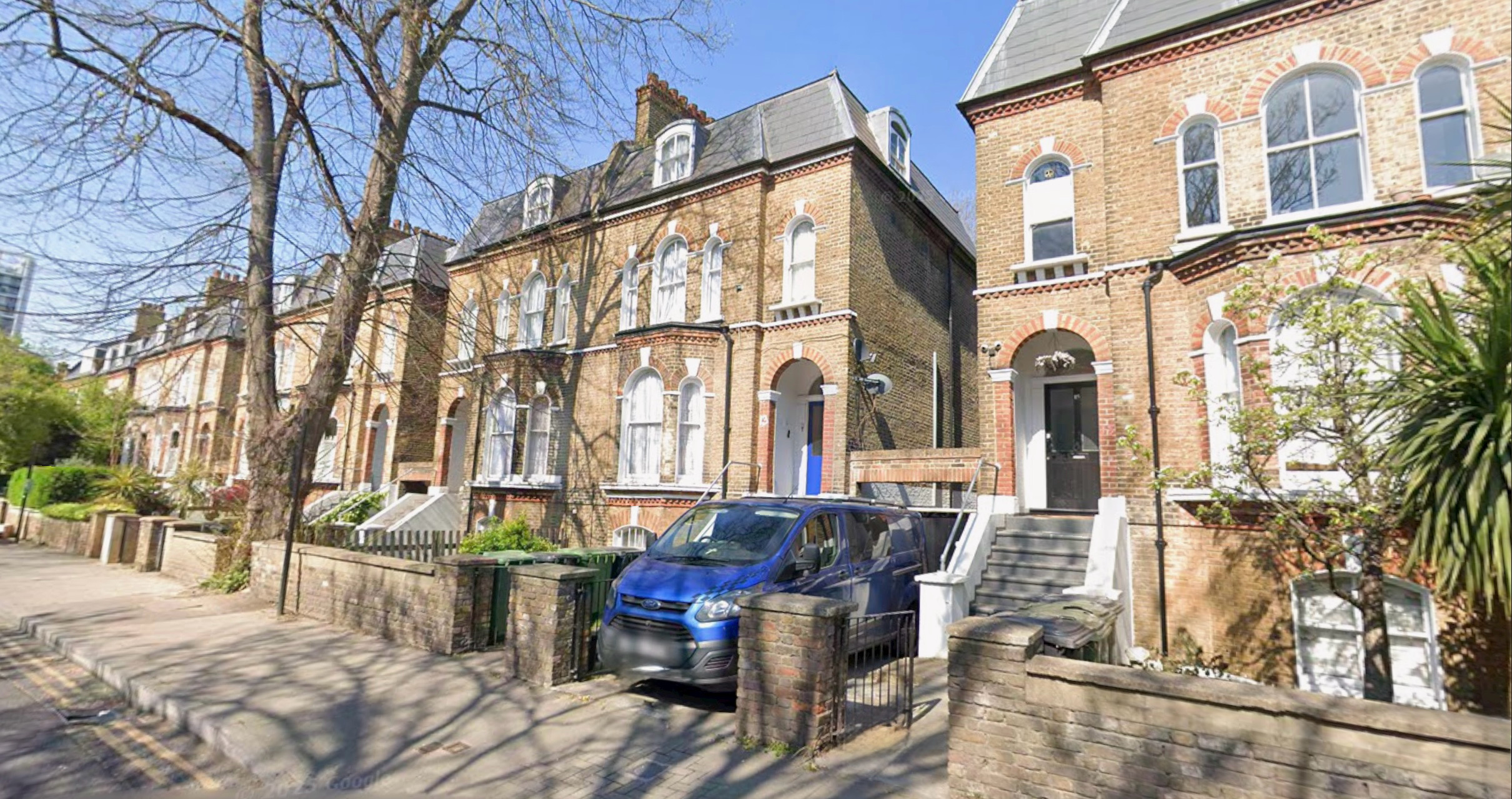
That part off Burton Road has since been demolished to make way for an industrial area, but if you move one street across to Loughborough Road you find a row of brick and tile houses that, with minor differences, are pretty much what both Angus and Douglas describe.
So yes, on the weight of the evidence I’ve concluded that 8 Burton Road most likely was the Sharpe family home for 15 years or so pre-war, and the setting for Douglas and Angus’s childhood stories. But then along came a Mrs Coe and her two daughters to queer the pitch somewhat. Mrs Coe had a sweet shop on Blackfriars Road, and her daughter Joyce was stepping out with James and Amelia’s first born, Sonny. And Sonny’s little brother Angus was pretty fond — not just of his brother’s girlfriend — but also Mrs Coe’s sweets and her black Labrador.
I used to take their black Labrador dog home on Friday and [roller] skate back to Blackfriars on Saturday, often staying the night, no doubt in the hope of an extensive savouring of the candy, but rarely getting much of those goodies. I don’t think Mrs Coe was used to having a “hungry for candy” child around.
But the sweet shop must have been at least two miles away from Burton Road, and even if you can imagine Amelia letting her 12-year old roller skate between them, it’s a long way to walk a dog. I suppose they barely had helicopters back then, let alone helicopter parents.
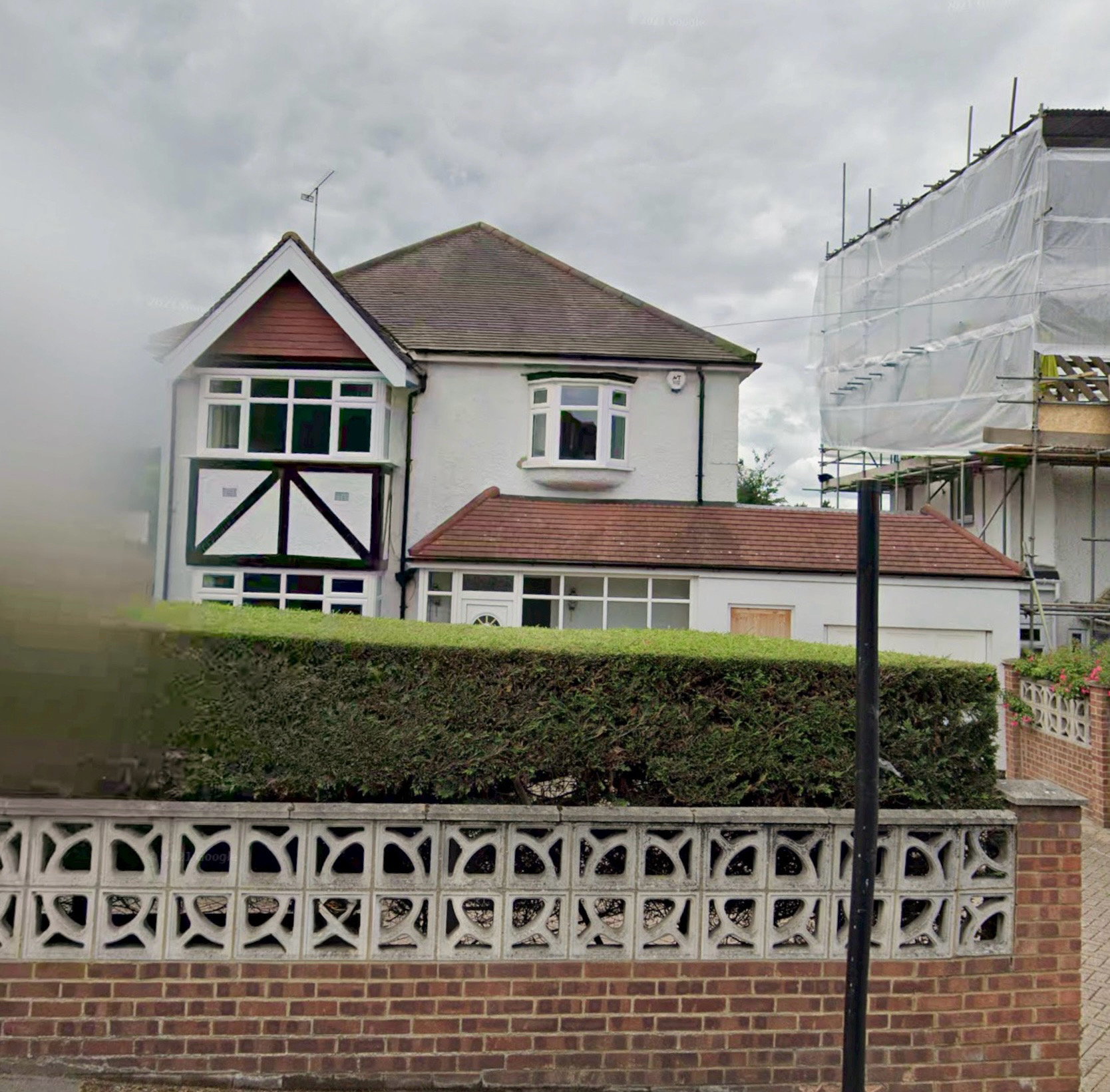
The declaration of war in 1939 definitely saw some changes. Sonny, Norman and Maggie were all married and living away, and, by the time the register of civilians was taken after war broke out, the family had moved further south to the house in Purley where Norman had been living with his in-laws before be joined the RAF.
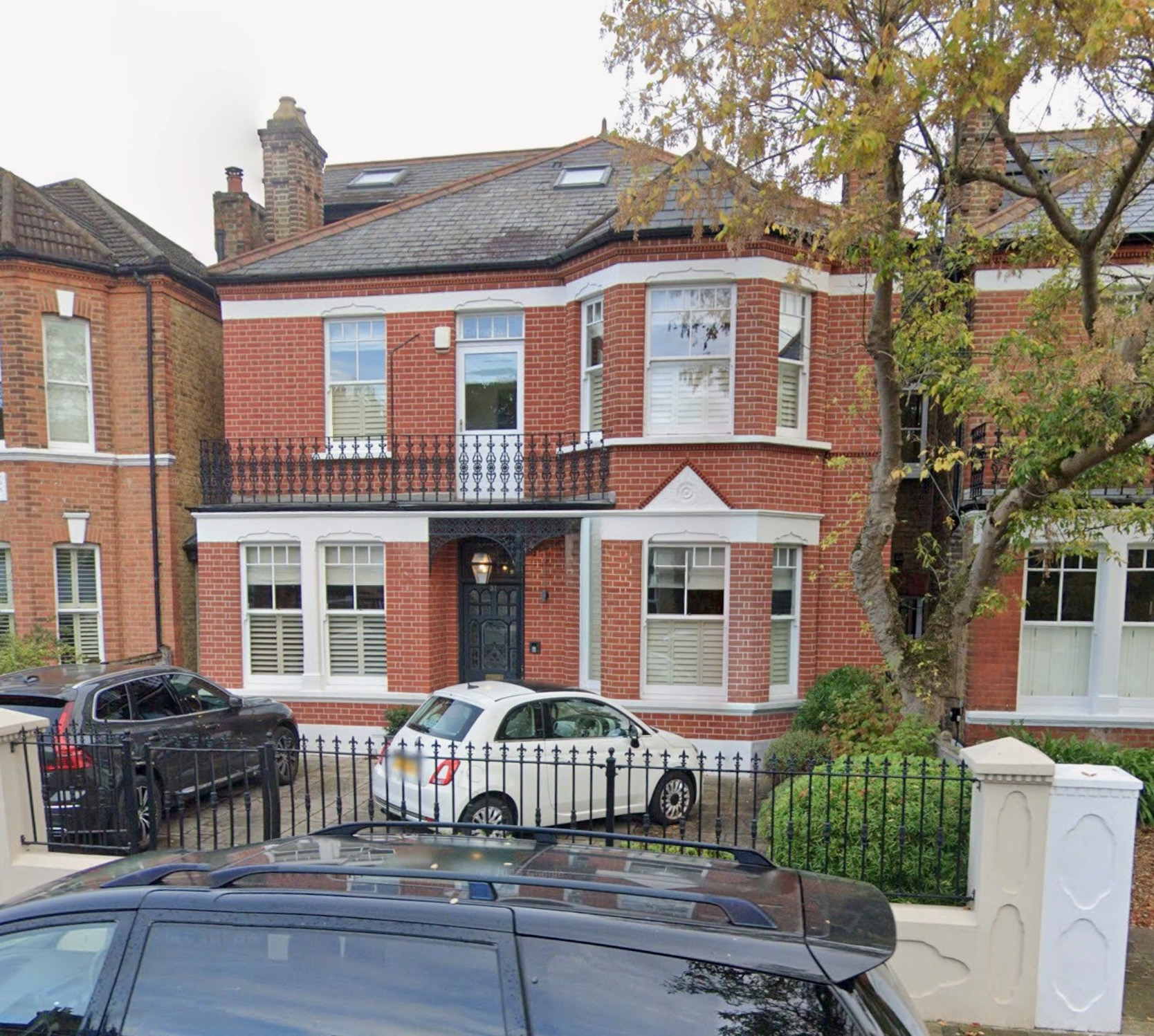
That move may have been to get further away from central London and the danger of German bombing. But within a year or two they’d moved to 1 Chestnut Road in West Norwood, which both Dorothy and Kath stated as their home address when they joined the Women’s Land Army in 1941.
51 Chestnut Road wasn’t quite as expansive a house as Burton Road, but it had a big back garden, which is where Douglas set up the train that Heather and Jim remember riding in the late ’40s. James and Amelia also had a close neighbour, their oldest daughter Maggie. Maggie had married Willard McGill in March 1939, and at some stage they’d bought a property just around the corner at 1 Ardlui Road. I don’t know which came first, Ardlui or Chestnut, but surely the fact that the properties were adjoining, right down to the gate between them, must have been a consideration, just as it was when my own Aunt and Uncle, Evelyn and Bob, bought a property next door to my grandparents.
§
Chestnut Road must have started to feel a bit empty and echoey during the war, with the kids all gone, except possibly Douglas and Angus at times. Granny Sands had died in 1937, so the permanent residents would have been just James, Amelia and Topsy. And then James died in 1947, the year Heather was born, leaving just Amelia, her sister Topsy, and probably Angus again post-war. Norman was dead, and Sonny, Maggie, Dorothy and Kath all married. After Amelia’s death in 1950, Topsy lived with Maggie until she died in 1962.
Footnotes
- I can’t find a record of any Sharpes, anywhere, in the 1911 census.
↩︎