In retrospect I have often thought it somewhat surprising that, at any rate on some occasions, the Fire Brigade was never alerted by some zealous passer-by on Sunday afternoons to the old Victorian semi-detached in south London which served as our family home when I was a wee boy.
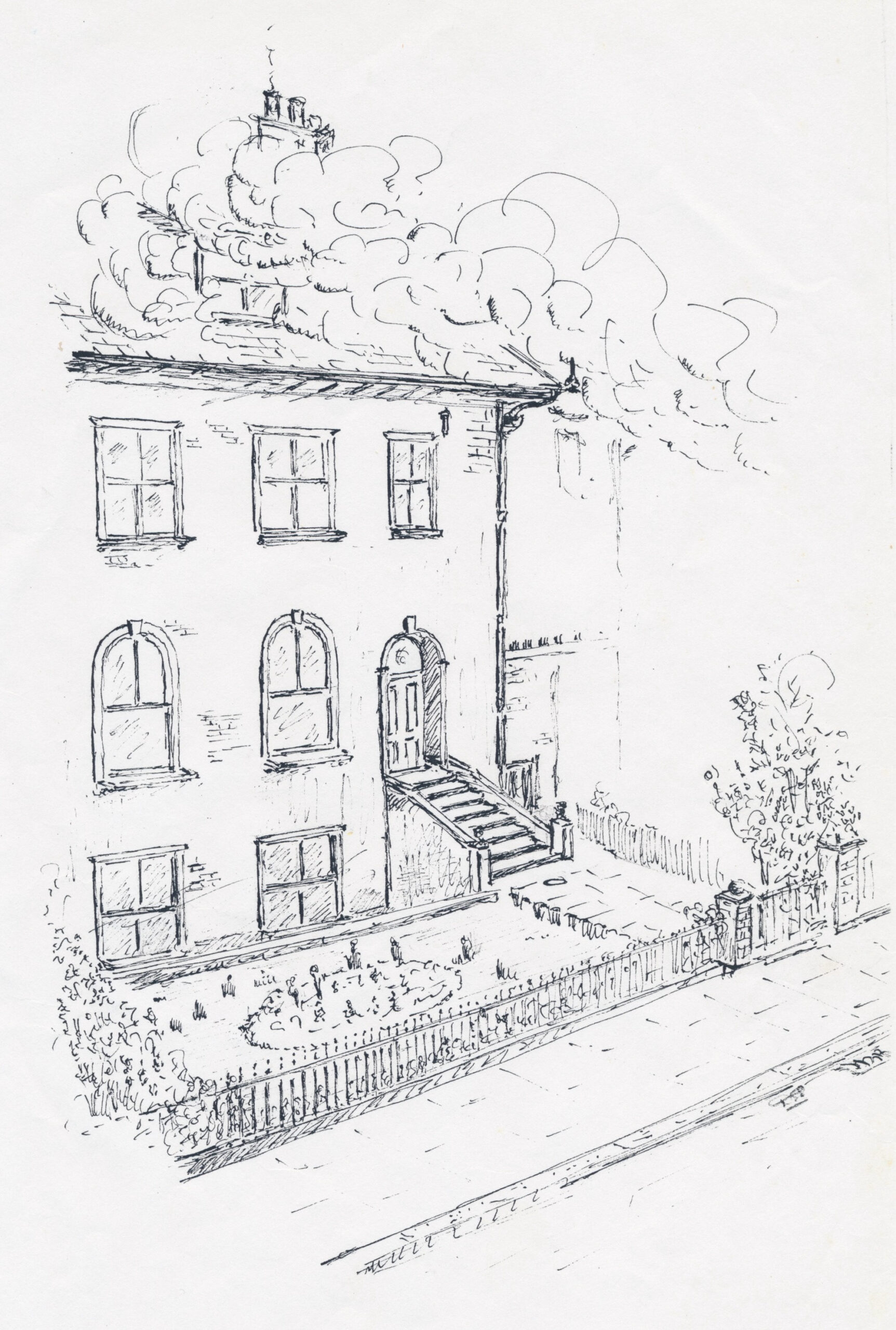
Very often, on such afternoons, the top storey of the house would be enveloped in great clouds of smoke and steam which eddied and curled from the dormer windows of the attic floor, to go billowing and hurrying down the street as if anxious to escape from the vibrations which appeared to invade the whole house, in varying intensity, from the basement level to the attics three floors up.
If one imagines a casual visitor arriving at basement level, (kitchen, scullery, dining-room, toilet, coal-cellar, side-door and garden ) then the house vibrations would appear as a sort of general pulsating, vaguely coupled with a low-pitched humming, a kind of harbinger announcing some odd events emanating from the upper part of the house as yet unvisited. All a trifle Perplexing maybe, but then one waited for, rather than demanded, an explanation from one’s hostess in those somewhat politer times many years ago.
Progressing from the basement up the lower two flights of stairs to the first floor (front-door, hall, parent’s bedroom, conservatory, toilet, drawing-room ) the humming now more intense and definitely laced with a regular rumbling frequency, confirming the expectation of some unusual goings-on nearer to the roof.
The visitor’s slightly apprehensive, quizzical look prompts a matter-of-fact, “Just Jimmie and the wee boys in the workshop – perhaps you’d like to see?” from the hostess.
So, reassured by this acceptance of the situation the guest follows up two more flights of stairs to the second floor ( bathroom, girl’s room, Grandma’s room, landing and gas-meters), to be greeted by the now very surprising throbbing, rumbling and vibration, imparting to the house a sort of palsy which spills to the ornaments and vases, involuntarily performing rhumbas and tangos along the window sills. The climbers from below tackle the last two series of stairs and eventually arrive at the attic floor, more than a little bit breathless, having staggered up forty-seven stairs since they started from the basement. (Why the Devil didn’t they live in a bungalow! thinks the visitor between gasps).
Anyhow, here we are, at the attics ( boy’s room, Norman’s room, workshop and landing). The landing has a huge cupboard on one side, extremely dark but crammed full of all sorts of “treasures” for the young “Alladdin” brave enough to ignore the enormous house spiders which appeared to infest every corner – the darker the corner, the bigger they seemed to be! ( What do they live on ? I wonder).
The noise and motion are now complemented by the acrid smell of hot oil and the sulphurous taint of burning coal and coke. They open the workshop door and view a kind of miniature “Dante’s Inferno”, and as far as the visitor is concerned, – all Hell let loose!
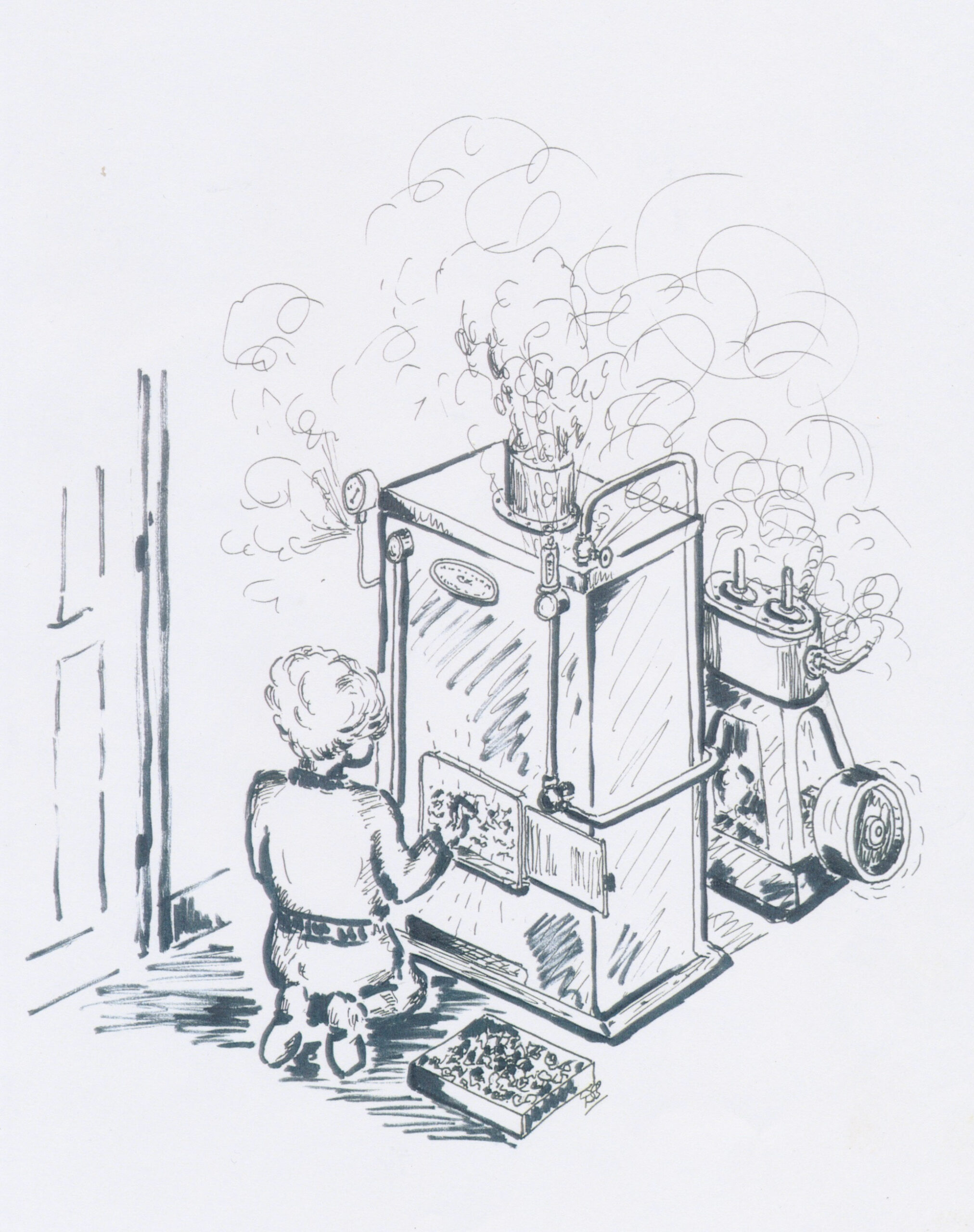
Dimly, through the smoke and steam, can just be discerned a small Imp (sometimes two, all too enthusiastically poking pieces of fuel through the fire-hole door of the Bolsover Express Steam Generator, and so engrossed in the process that the lower portion of the boiler casing is almost glowing and the steam pressure gauge stands at 150p.s.i., sufficiently high for the safety-valve to be blowing-off and noisily contributing vast quantities of steam to unite with the exhaust from the wonderful high-speed, vertical steam engine which had, in the dim distant past, performed an auxiliary function such as driving a dynamo exciter or something similar, aboard a long since defunct destroyer and was now buzzing merrily around to the obvious enjoyment of the workshop inmates.
Fortunately, this engine utilises a lot of the boiler’s excess steam produced by the Imp’s over-enthusiastic application of boiler firing principles, although in the event, it is also the major source of the vibration and noise. Minor boosts to the inferno are provided by a smaller vertical engine (Stuart No. 5a) and a lovely, short-stroke, horizontal engine (Stuart No.9) which drew its steam from a Cornish type, single-flue, gas-fired boiler.
Certainly the landlord would have been more than justified in complaining, for I cannot imagine that all the shaking and vibrating was really very good for the fabric of the old house, although I can say that throughout all the years that we lived there I don’t recall my folks ever saying that any such complaints were made. I have no doubt that my Grandmother, eighty odd and all bombazine and lace, whose room was directly beneath the workshop, must have wondered occasionally if conceivably this was a foretaste of the final penance she would have to endure if she dared to complain. She was very deaf so maybe she just attributed the rumblings to a weekly attack of severe indigestion! The ladies of the house may have looked upon the event as all a bit pointless — after all the engines never appeared to actually drive very much, and the garden would appreciate a trifle of male attention — but we were left to it and there was certainly no overt criticism.
As far as my own feelings are concerned, the running of the engines, and the smell of smoke and hot oil in the steamy atmosphere on some Sunday afternoons in the old attic workshop many, many years ago, is one of the fondest and most enduring memories I have of a wonderful childhood. My dear old Dad, who was an artist by profession but with the soul of an engineer, was never happier than when the engines were working and I’m sure he enjoyed implanting some of his enthusiasm in his offspring, especially in me. He certainly sparked off an appreciation of things mechanical that has lasted throughout my life and gave me a love of steam engines which I still have and, even now, experience a wee quickening of the pulse at the sight and sound of a steam locomotive or traction engine. Another little plus for me in the old days, was the knowledge that not one of my friends had anything like the steaming event, and though I suppose I was wrong, it secretly gave me a tad of satisfaction!
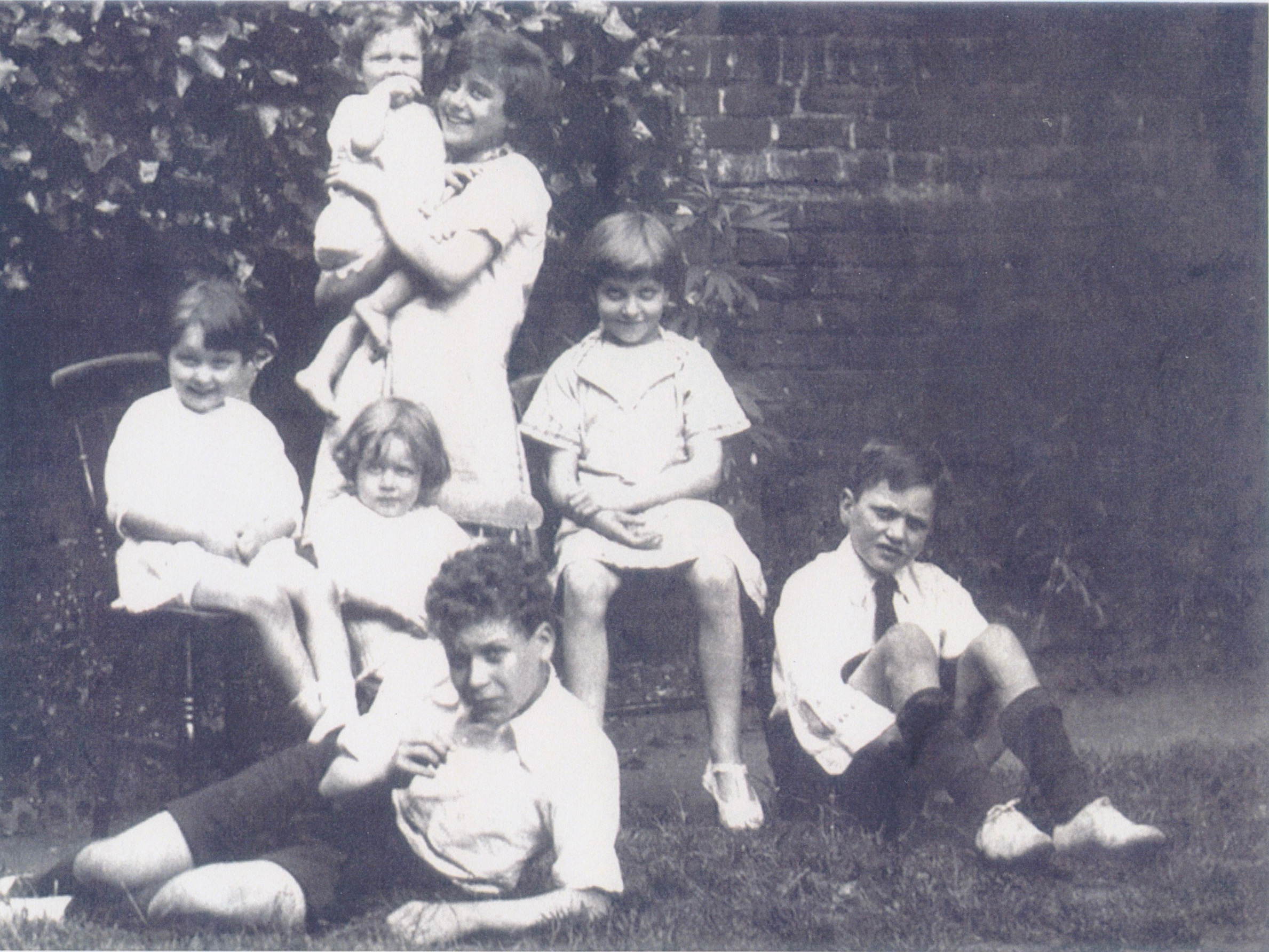
The Imp in the scene depicted was myself, Douglas, second youngest of the seven children of James and Amelia Sharpe and the “Inferno” simulation was quite typical of occurrences on some Sundays up until the time I was about eleven or twelve years old.
Just exactly when they began I can’t recall, but I was certainly attracted to any jollifications in the workshop as a very small child. I can definitely remember having to be lifted on to a chair at the side of the workbench in order to watch my eldest brother doing a spot of woodcarving on a tray (and cutting his thumb in the process), so I must have been pretty young.
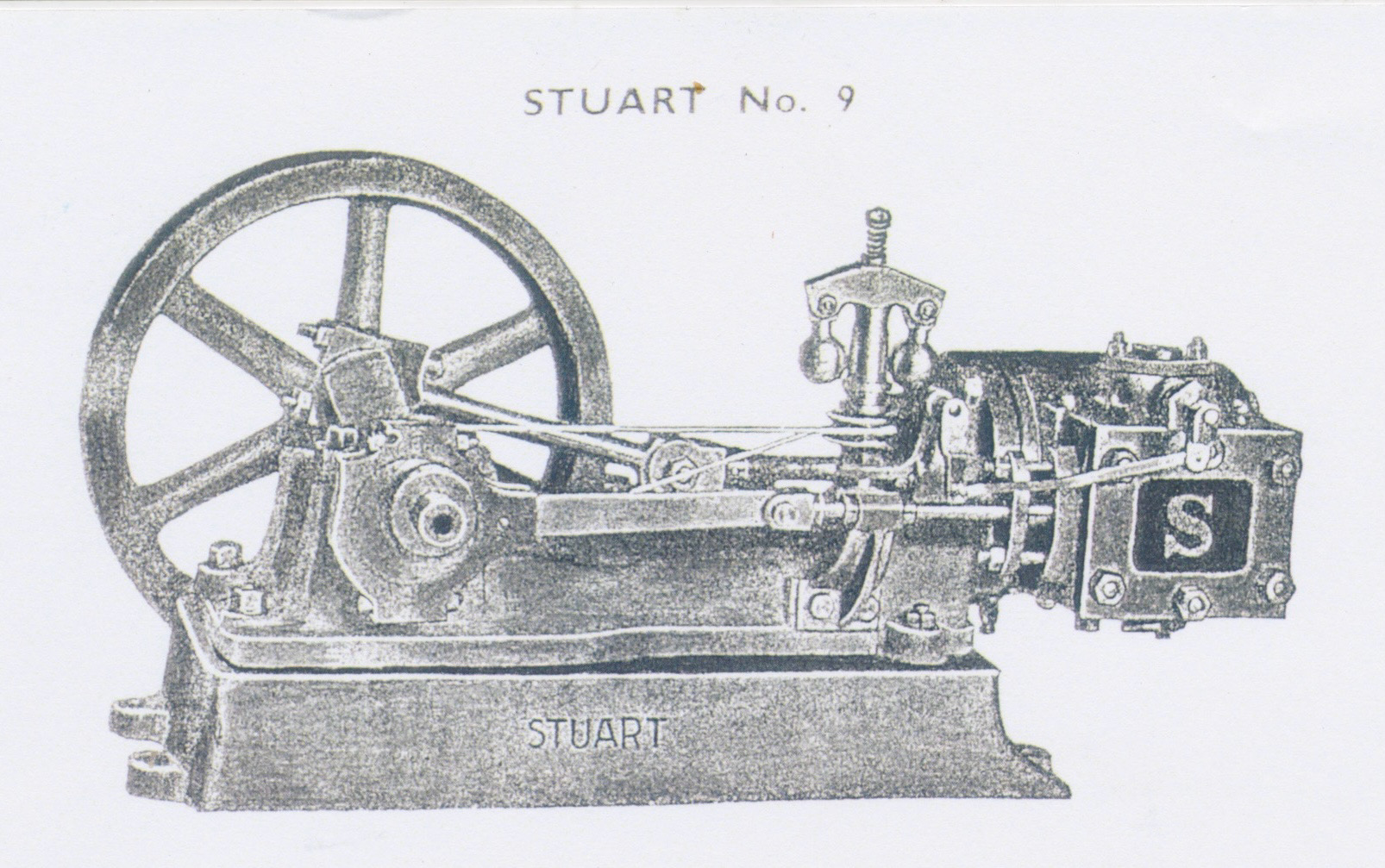
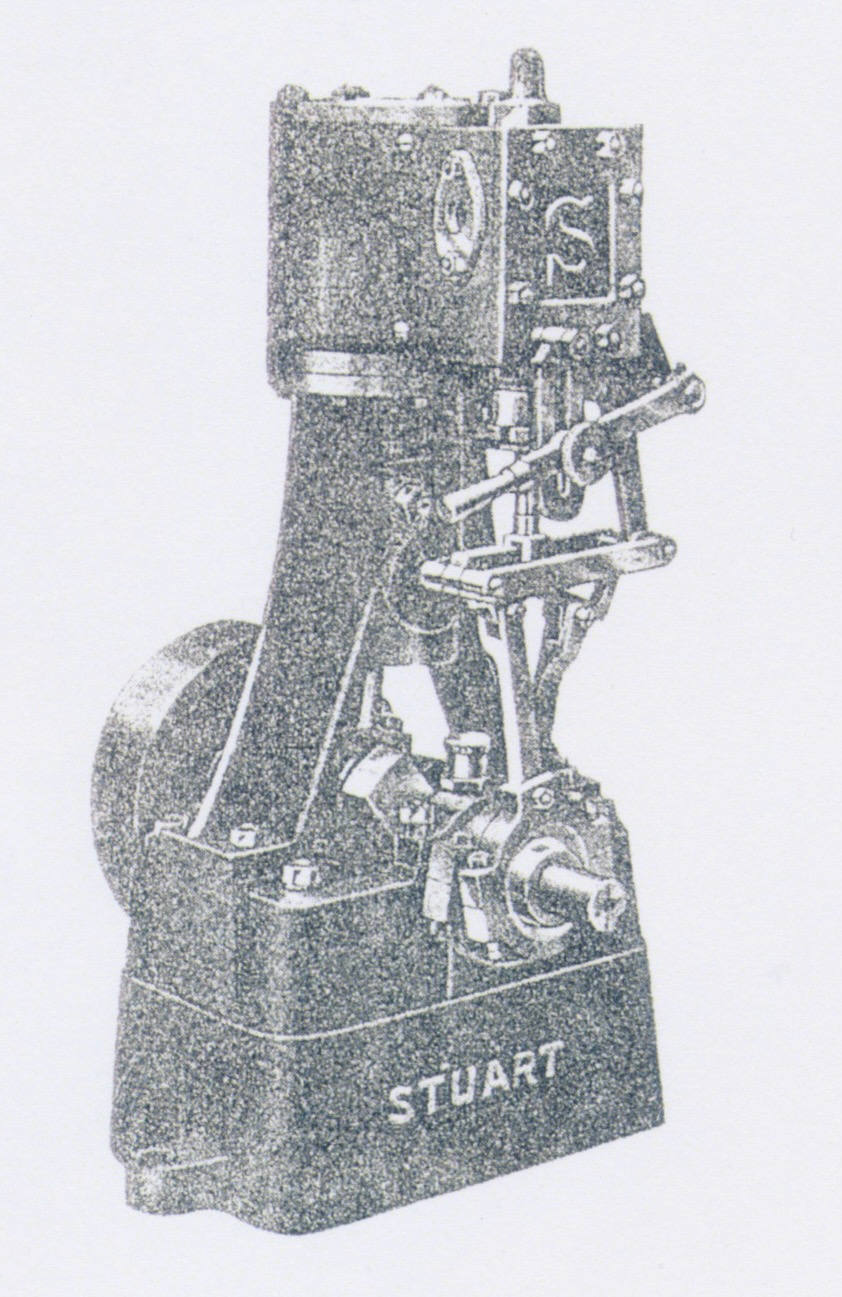
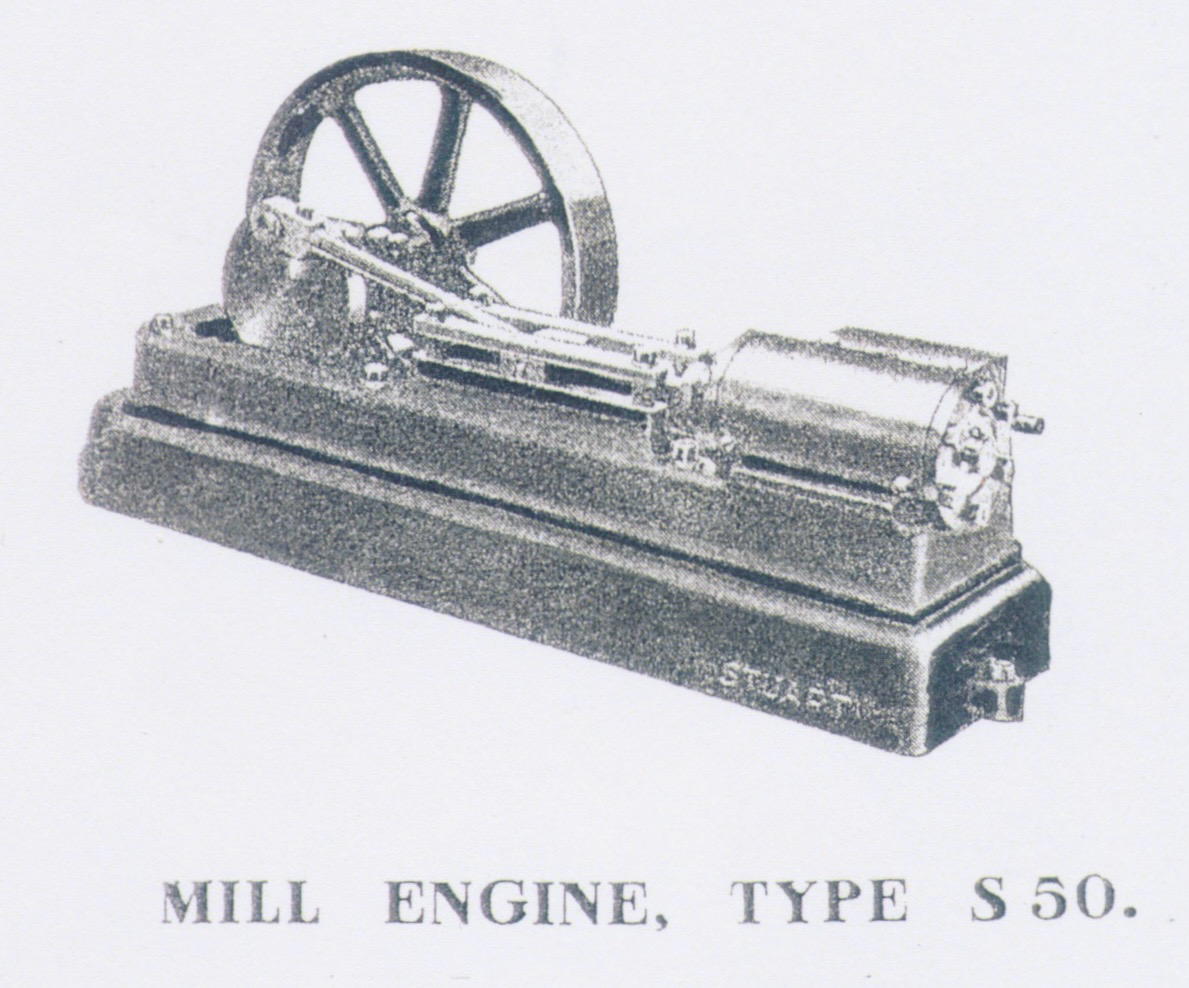
The No. 5a and the No. 9 engines were both built from castings and materials supplied by Messrs. Stuart Turner Ltd. Henley-on-Thames and machined by my father, the No. 9 being a particularly fine job with working feed-pump and governor and was an endless source of fascination to me.
My eldest brother had mounted this engine on a handsome sheet-zinc covered base and fitted it with a water reservoir, thus enabling it to feed the boiler via a check-valve while running, and so allowing the little steam plant to operate continuously if so desired.
Another model from the Stuart range, also made by my father, and most enjoyable to watch running, was a little horizontal engine modelled after the style of the old cotton-mill engines. It was served with steam from its’ own water-tube boiler and could be set to run very slowly, allowing the convolutions of the crank, eccentric and valve gear to be followed easily.
Stuart Turner’s factory at Henley-on-Thames produced some very handsome engine designs throughout the years and the quality of their castings was legendary. I made my first model locomotive using Stuart castings for the driving wheels and was absolutely delighted with the ease with which the cast-iron could be machined. I believe that the firm, albeit in maybe a different form, still market sets of castings for model engines.
But back to “Dante’s Inferno”.
One adult figure could vaguely be observed leaping about, oil-can poised, in the steamy, smokey fog, yelling instructions, opening valves, operating boiler hand-feed pumps, controlling gas-burners, lubricating cross-head slideways, adjusting stuffing-boxes, keeping an eye on pressure-gauges, etc. and generally confirming the horrified guest’s opinion that this is indeed, the home of idiot parents and unbalanced offspring!
But how wrong such a cursory belief would have been!